

A practical guide / Fonix.AI
Caller verification: a practical implementation guide
A worked scenario, illustrated decision review and a practical pilot worksheet.
Caller verification is an access boundary
Voice bot customer verification determines which information and actions a caller may access. Recognising a telephone number is useful routing context, but it does not prove the caller owns every account associated with that number. Shared devices, forwarded calls and changed numbers make that distinction important.
This is a workflow and security review for Fonix.AI deployments. It does not claim voice-biometric authentication or certify a particular identity method. Your organisation must choose and validate its verification process for each action.
Map actions to verification states
Separate public information, low-risk intake, protected record reads and sensitive account changes. Give each action an explicit required state and enforce it in the business-tool layer. A model instruction saying “ask for verification” is insufficient if the underlying endpoint accepts an unrestricted account identifier.
Avoid exposing which private accounts match an unverified number. The agent can offer a general route without reading names, balances or private appointment details. Verification success should be scoped to the account, session, method and permitted actions, with an expiry defined by your policy.
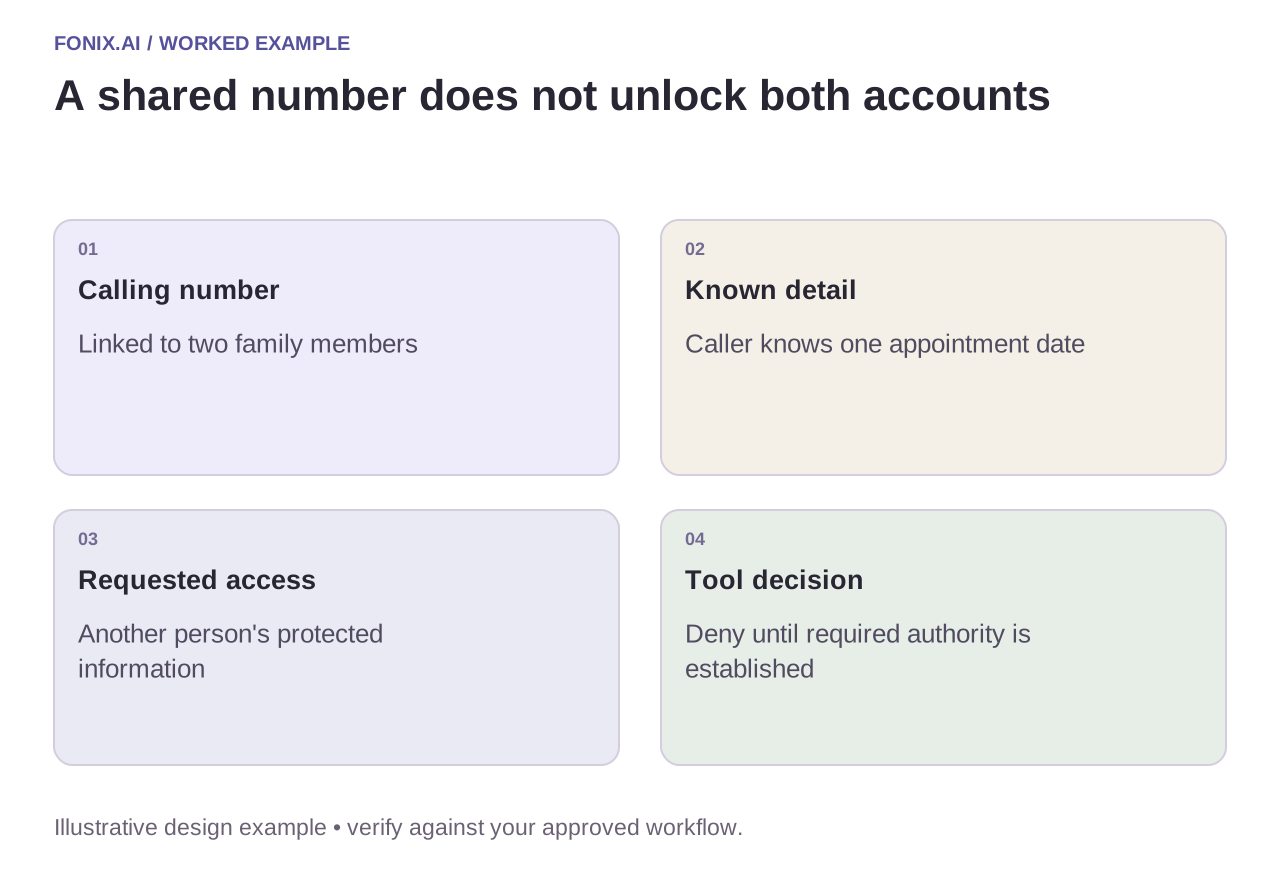
Worked example: a shared family telephone
A fictional caller uses a number associated with two family members. They know one appointment date but request the other person's result information. The date is context, not proof of authority. The tool must reject protected access until the required verification and relationship checks succeed.
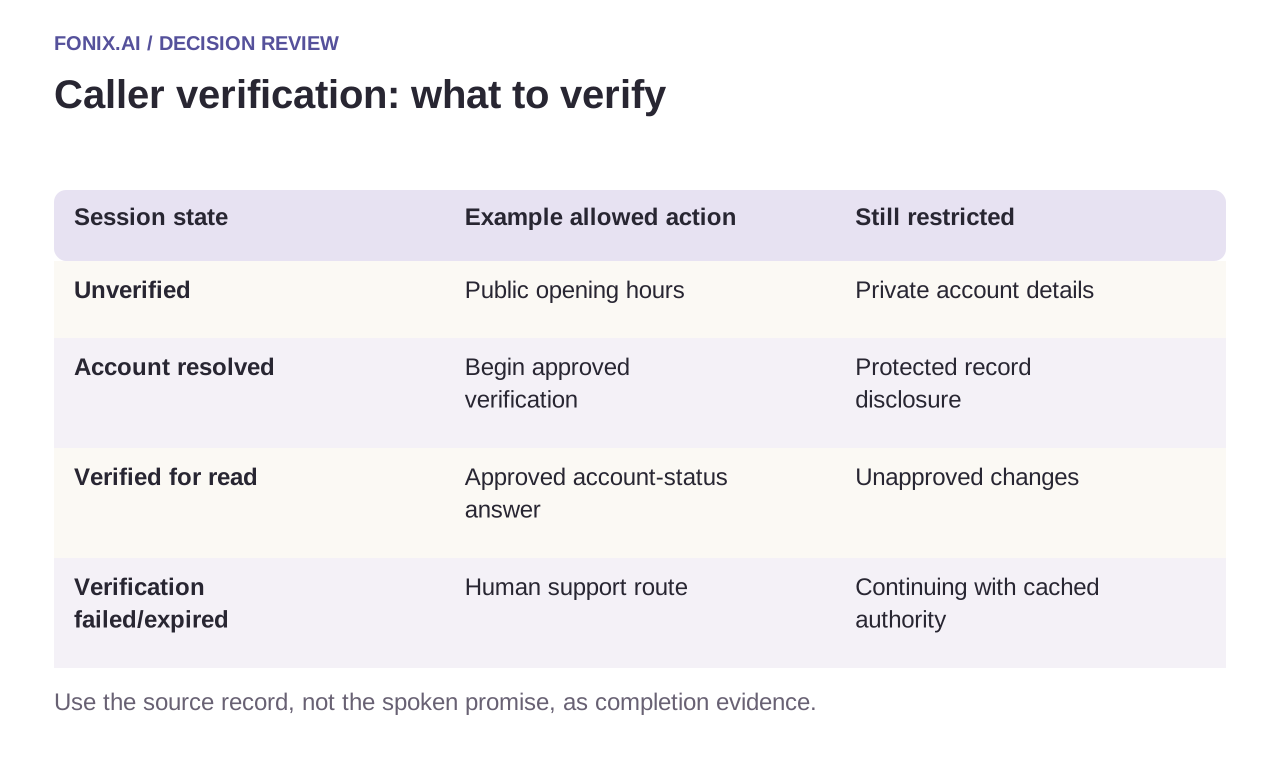
| Session state | Example allowed action | Still restricted |
|---|---|---|
| Unverified | Public opening hours | Private account details |
| Account resolved | Begin approved verification | Protected record disclosure |
| Verified for read | Approved account-status answer | Unapproved changes |
| Verification failed/expired | Human support route | Continuing with cached authority |
Handle failures without teaching an attacker
Use bounded attempts and approved generic failure wording. Do not reveal which secret answer was wrong or enumerate matching accounts. Keep authentication secrets out of transcripts and general support notes; use a purpose-built secure flow where the method requires one.
On transfer, pass verification state only through a trusted mechanism the receiving team accepts. A free-text summary saying “verified” should not become a reusable credential. Recheck authority when the account or requested action changes, and invalidate the session when the defined security boundary requires it.
An action-by-action identity boundary test
List public information, protected reads and sensitive changes separately. Use synthetic accounts sharing a number and a test verification flow chosen by the business. Document session scope, expiry and the approved failure route.
| Pilot case | Required behaviour |
|---|---|
| A shared number matches several people | Avoid enumerating private accounts and apply the approved resolution process. |
| The caller switches account after verification | Recheck the required authority rather than reusing unrelated session access. |
| A model requests a protected tool without verification | Reject it in the business-tool layer and retain minimal decision evidence. |
Review unauthorised disclosures and actions directly, alongside legitimate completion and unnecessary denial. Count by action and account scope. A high verification completion percentage can hide a control that accepts the wrong people.
Can the transcript itself prove that verification passed?
A free-text statement is insufficient as a reusable credential. The receiving service should validate trusted state containing the permitted account, session and actions. Keep verification secrets out of general transcripts and support notes.
Test denied actions as carefully as successful ones
Run wrong-account, expired-session, shared-number and mid-call account-switch cases. Inspect both spoken output and server-side access decisions. Measure unauthorised disclosures and actions directly; a high verification completion rate can hide permissive controls.
Bring your action inventory and approved identity flow to review caller verification boundaries. See access-control audit logs for evidence and prompt-injection testing for attempts to bypass the tool policy.
The banking action-authority example shows why verification for a protected read must not silently authorise a sensitive account change. The institution's approved process remains the decision boundary.
Reference and scope
OWASP authorization guidance. Action permissions should be checked at the trusted application boundary. This supports the access-control design; it does not validate a particular identity method. Reference reviewed 17 October 2026.