

A practical guide / Fonix.AI
Access control and audit: a practical implementation guide
A worked scenario, illustrated decision review and a practical pilot worksheet.
Voice-agent access control needs both actor and action
Voice agent access control audit logs should explain who requested an action, which account and policy authorised it, and what actually happened. A transcript alone cannot establish permission. An administrator's dashboard access should not automatically grant an AI agent the same business-tool authority.
This guide is a Fonix.AI deployment review framework. Actual role enforcement and audit-event coverage must be inspected in the target system; a checklist is not evidence that every control has already been implemented.
Separate operator, administrator and agent permissions
Map actions such as listening to recordings, editing prompts, changing routes, publishing agent versions and executing business tools. Assign each action to explicit roles and tenant scope. Keep content editing separate from permission to release a production configuration where the operating process requires review.
Business tools should derive account scope from trusted server context. The model must not select an arbitrary tenant or escalate its own role by changing a request field. Recheck authorisation when the requested resource or operation changes.
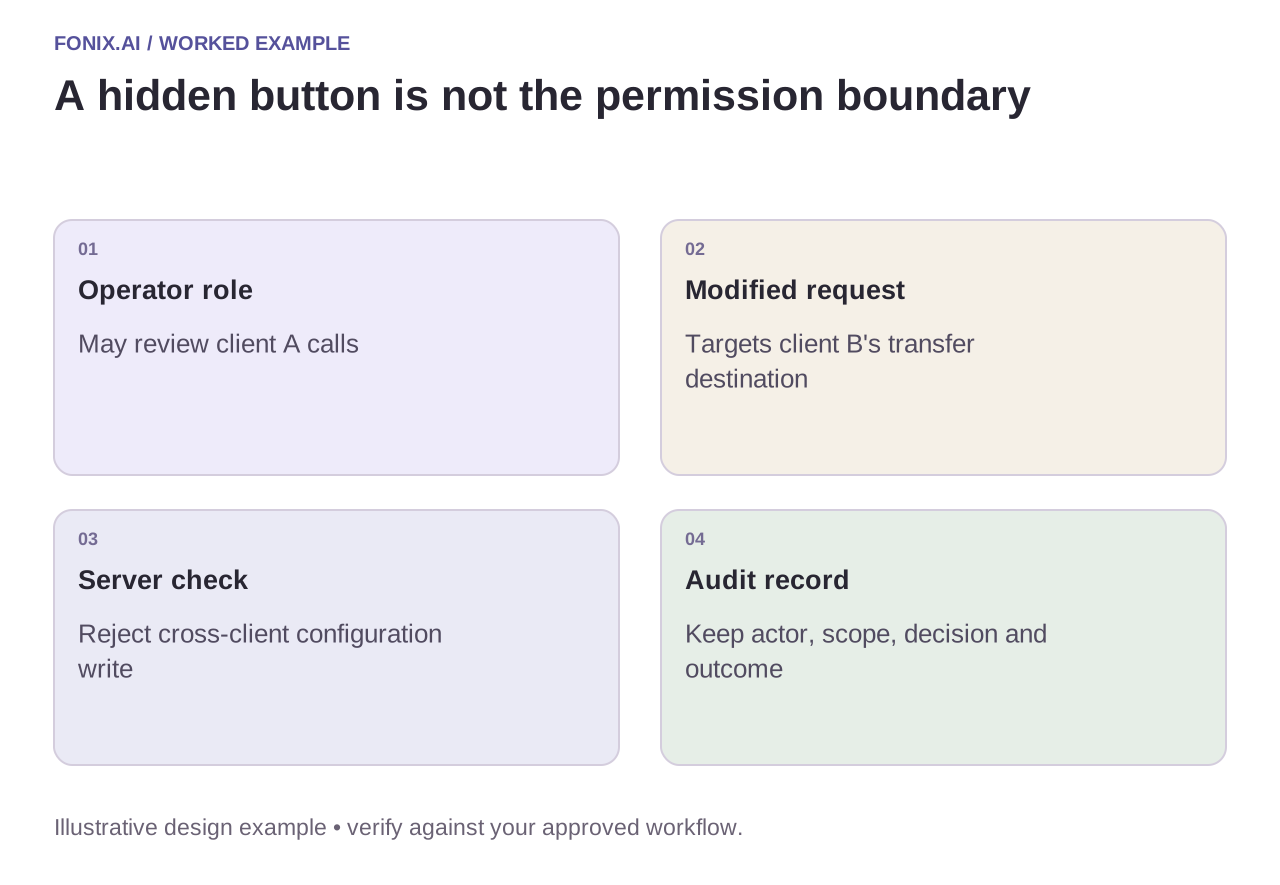
Worked example: an operator edits a destination
A fictional operator can review calls for client A but should not change client B's transfer number. Test both the visible dashboard control and the underlying request. Hiding the button is insufficient if the endpoint accepts a modified client identifier.
| Audit field | What it explains | Minimise |
|---|---|---|
| Actor and role | Who initiated the action | Unnecessary personal details |
| Tenant/resource | Which boundary applied | Full private record content |
| Policy decision | Why allowed or denied | Secrets/authentication values |
| Outcome/reference | What changed or failed | Raw transcript duplication |
Log configuration and tool decisions separately
A prompt release, route change and booking write have different review needs. Record configuration version and authorised change references. For tool actions, retain the requested operation, permission decision and authoritative result or unknown state.
Protect logs against unauthorised reading and alteration. Define retention and incident access. Logging a token, full identity response or entire recording can create a second sensitive data store while adding little investigative value.
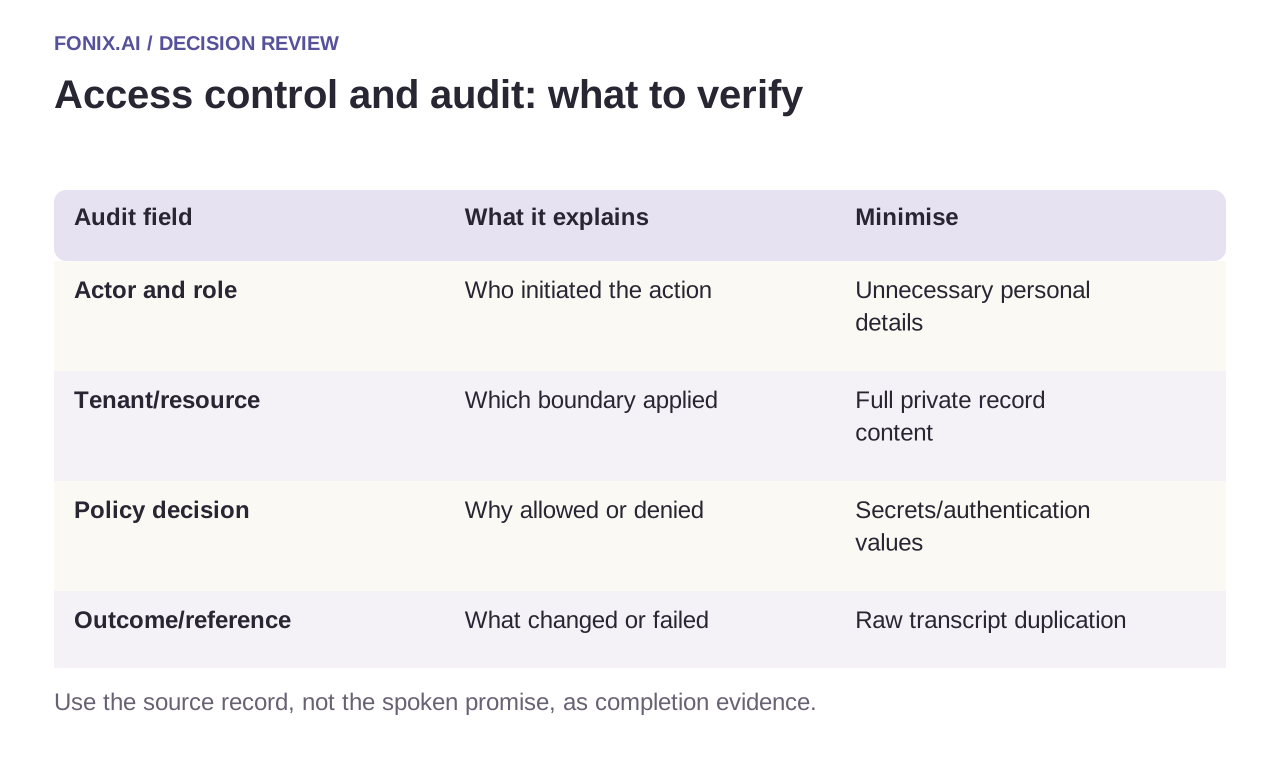
A restricted-identity audit and denial worksheet
Prepare restricted operator, administrator and agent-tool identities in a test environment. Map allowed actions to client resources. Define minimal audit fields and an owner for reviewing denied access and configuration changes.
| Pilot case | Required behaviour |
|---|---|
| An operator substitutes another tenant identifier | Reject the underlying request even if the dashboard normally hides that option. |
| A caller asks the model to grant itself a new permission | Keep authority outside conversation content and deny the unapproved action. |
| A destination changes through an authorised workflow | Record actor, target, policy decision and actual result without unnecessary private payloads. |
Review allowed and denied decisions against the role/resource matrix, plus missing audit events. Include legitimate work incorrectly blocked. A long log is not useful evidence if it cannot show who changed which authorised resource.
Should audit logs contain complete transcripts and credentials?
No. Keep the evidence needed to explain the decision and outcome while minimising private content. Secrets should not become log fields. Apply restricted access and an approved lifecycle to audit records themselves.
Run negative tests under restricted identities
Try cross-tenant reads, forbidden writes, expired sessions and revoked roles in an authorised environment. Verify server rejection and useful audit evidence. Include denied attempts in review; an absence of successful incidents does not establish correct enforcement.
Review voice-agent permissions and audit events with your role/action matrix. Caller verification covers customer authority; prompt-injection testing covers attempts to manipulate action requests; retention covers log lifecycle.
Reference and scope
OWASP authorization guidance. Use deny-by-default permission checks on requests. The worksheet applies this principle to voice-agent roles and resources; enforcement must be tested in the deployment. Reference reviewed 17 October 2026.