

A practical guide / Fonix.AI
Recording retention: a practical implementation guide
A worked scenario, illustrated decision review and a practical pilot worksheet.
Recording retention is a data-class decision
Voice AI recording retention should specify what happens to audio, transcripts, summaries, tool logs, analytics and backups separately. Deleting an audio object does not establish that the corresponding transcript or exported summary has disappeared.
Use this Fonix.AI guide to design and verify a deployment's retention lifecycle. It is not a legal retention schedule or a claim that a particular storage policy satisfies every jurisdiction. The responsible organisation defines approved periods and exceptions for its actual purpose and obligations.
Inventory every copy and derived record
Map the call's artefacts from creation through storage, indexing, export and backup. Include temporary buffers, application logs and third-party observability. Record purpose, owner, location, access roles and deletion mechanism for each data class.
Do not choose one default duration simply because the dashboard has one setting. Audio used for a permitted review, a minimal operational outcome and a financial transaction record may have different purposes. Keep any approved hold or exception explicit and controlled.
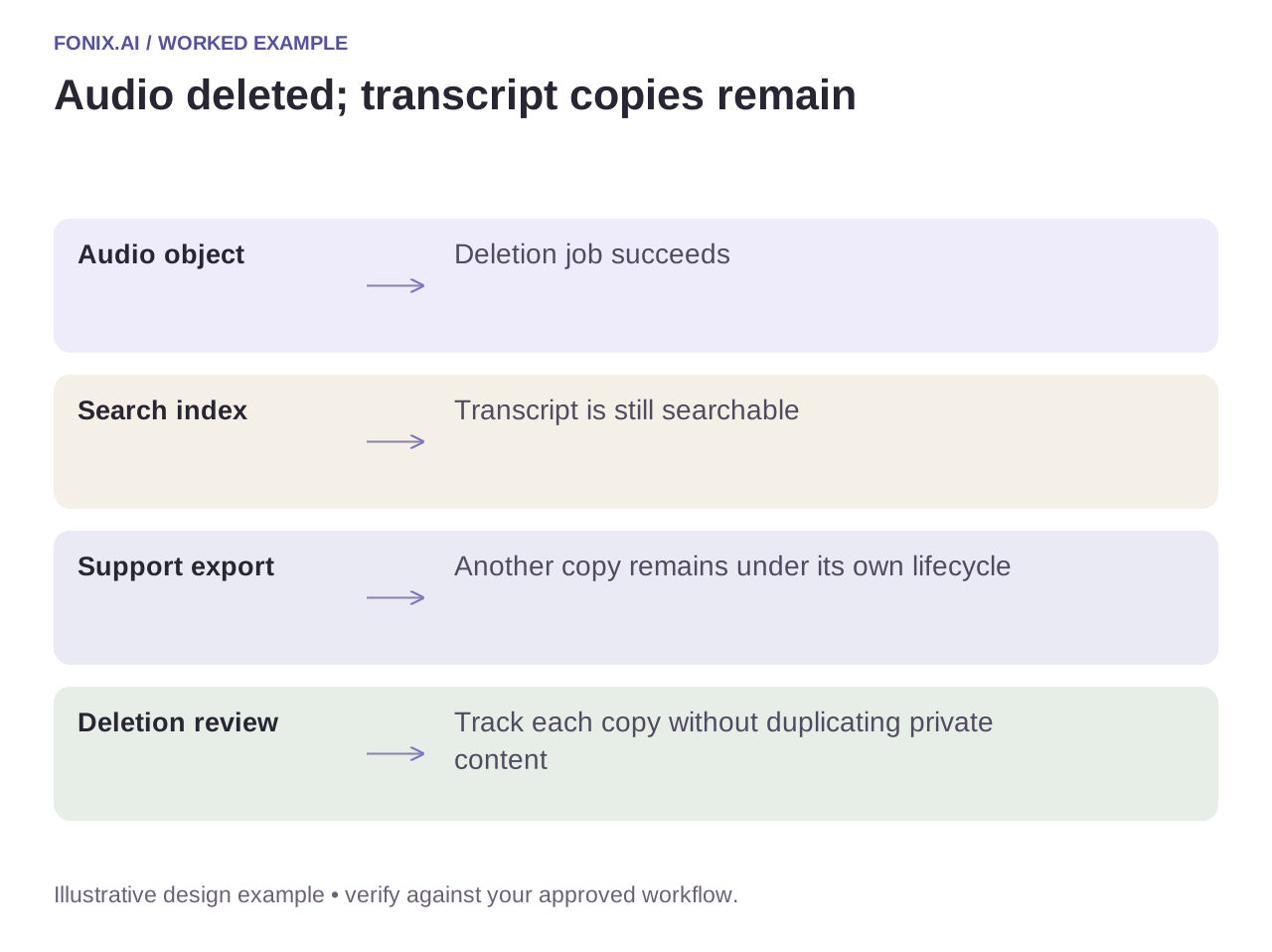
Worked example: the recording is gone but search still finds it
A fictional deletion job removes an audio file. The transcript remains in a search index and a support export. A complete process needs to identify those copies, apply the appropriate policy and retain minimal deletion evidence without copying the deleted conversation into an audit log.
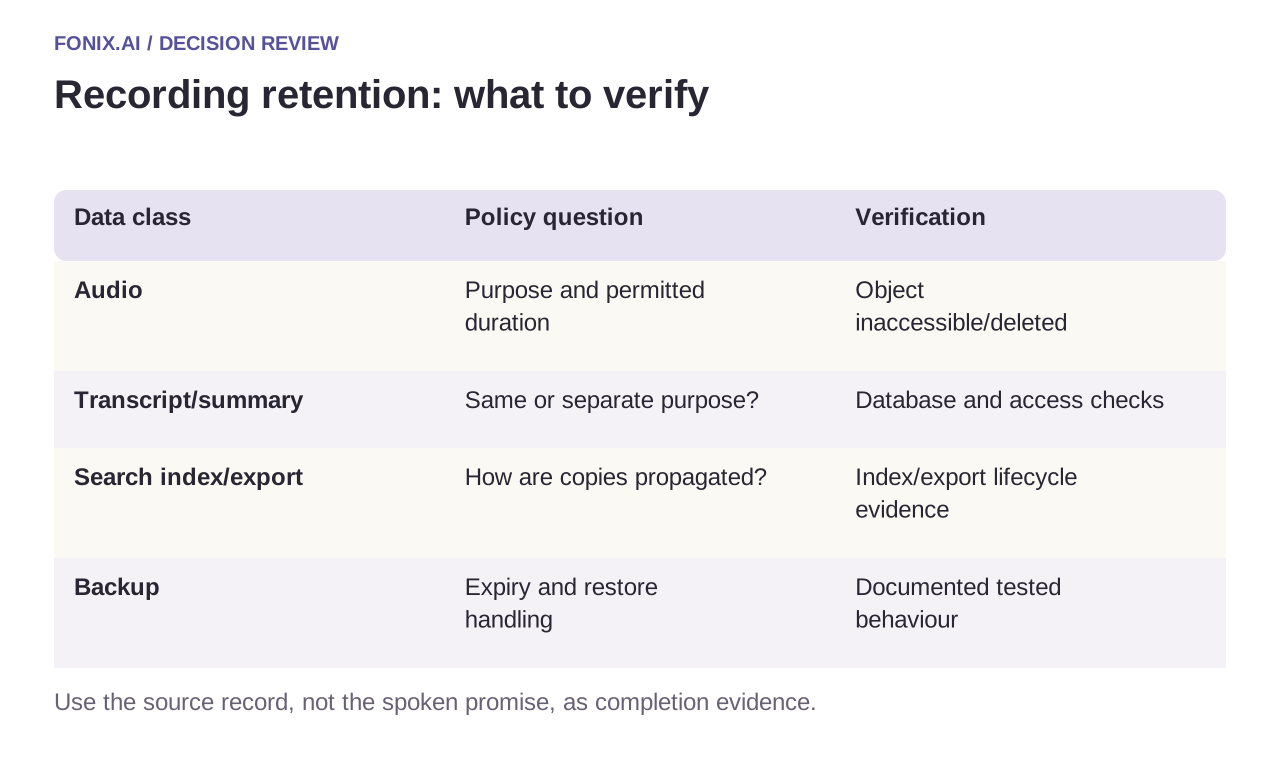
| Data class | Policy question | Verification |
|---|---|---|
| Audio | Purpose and permitted duration | Object inaccessible/deleted |
| Transcript/summary | Same or separate purpose? | Database and access checks |
| Search index/export | How are copies propagated? | Index/export lifecycle evidence |
| Backup | Expiry and restore handling | Documented tested behaviour |
Restrict access throughout the lifecycle
Retention and access are independent controls. A record kept for an approved period should still be visible only to authorised roles. Review signed links, downloads, support access and diagnostic copies. Revoking a dashboard permission does not necessarily revoke an already exported file.
Design deletion as a traceable job with per-system results and retry ownership. If one destination fails, preserve the incomplete state rather than reporting global success. On restore, ensure expired or deleted records are handled according to the approved recovery policy.
A copy-by-copy retention verification exercise
Create synthetic conversation records with known copies across the selected storage, search and export paths. Have the responsible organisation approve purposes, periods, exceptions and backup behaviour. Assign deletion and verification owners.
| Pilot case | Required behaviour |
|---|---|
| Audio is deleted but the transcript remains searchable | Identify the remaining copy and apply its approved lifecycle rather than declaring blanket deletion. |
| A hold conflicts with an ordinary expiry job | Apply the approved exception and keep access restricted with minimal evidence. |
| A backup is restored after a deletion request | Test the documented restore-handling process for previously expired or removed records. |
Verify each expected copy against the approved policy and record unresolved locations. Retain minimal lifecycle evidence instead of copying deleted text into the audit. A successful storage-job result alone does not prove all derived data is gone.
What universal recording-retention period should we use?
This guide does not prescribe one. The responsible organisation must define retention for its purpose, obligations, data classes and exceptions. Implement and test that approved schedule across all copies rather than applying an arbitrary duration to everything.
Verify using synthetic records
Create a controlled call, locate its artefacts, apply the test policy and check each destination. Test a failed deletion step and a backup restore procedure. Report the scope actually checked; do not promise absolute removal from systems outside the deployment's control.
Review a recording lifecycle with your data-class map. Access-control audit logs cover evidence, and private-cloud deployment covers storage and support boundaries.