

A practical guide / Fonix.AI
Private-cloud deployment: a practical implementation guide
A worked scenario, illustrated decision review and a practical pilot worksheet.
Private-cloud voice AI needs an ownership boundary
Private cloud voice AI deployment in India should answer a concrete question: which components, data and operating responsibilities are inside the customer's environment, and which still depend on external services? A VPC label alone does not establish where speech inference, recordings, telemetry or support access reside.
Use this guide to scope a Fonix.AI private-cloud review. It is an architecture worksheet, not a certification or a promise that every deployment uses the same controls. Hardware hosted at your own site is covered separately in the on-premise guide.
Inventory the entire call path
List carrier/PBX connectivity, media ingress, speech services, language-model inference, business tools, storage, observability and administration. Mark location, account owner, network route and data exchanged for each. A CRM or external speech endpoint remains an external dependency even if the application workers run in your VPC.
The Amazon VPC overview explains a logically isolated networking environment. Use provider documentation to configure the selected cloud, while reviewing application-level access and data flows separately.
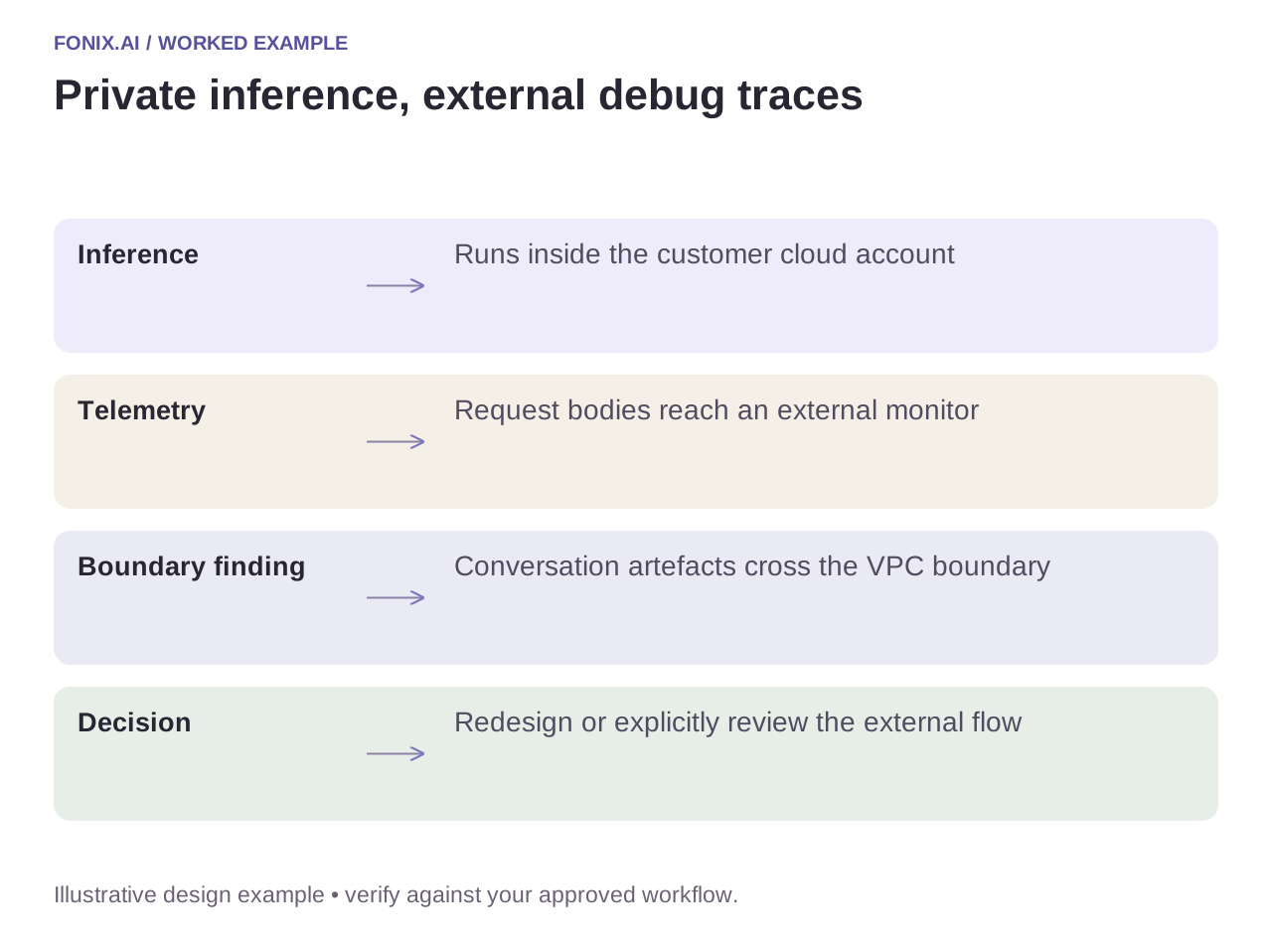
Worked example: inference is private but telemetry is not
In a fictional architecture, speech and language inference run in the customer's cloud account, but debug traces send request bodies to an external monitoring system. The deployment cannot accurately be described as keeping every conversation artefact inside the VPC. Either redesign telemetry or document and approve that boundary.
| Component | Decision to record | Verification |
|---|---|---|
| Inference | Endpoint and model location | Observed network route |
| Storage | Account, region and access | Object/database policy |
| Business tools | Permitted egress | Destination/action allowlist |
| Support | Time-bounded access owner | Access and audit evidence |
Separate deployment authority from support access
Define who can release code, change models, read recordings and approve network changes. Use the actual cloud identity system and application permissions. Remote support should follow an agreed process with revocation and an audit trail; a private subnet does not prevent overbroad administrator access.
Document backup location, key ownership and incident responsibilities. Test restore as well as backup creation. Avoid promising a residency or compliance outcome from architecture alone; assess the complete operating environment with the responsible teams.
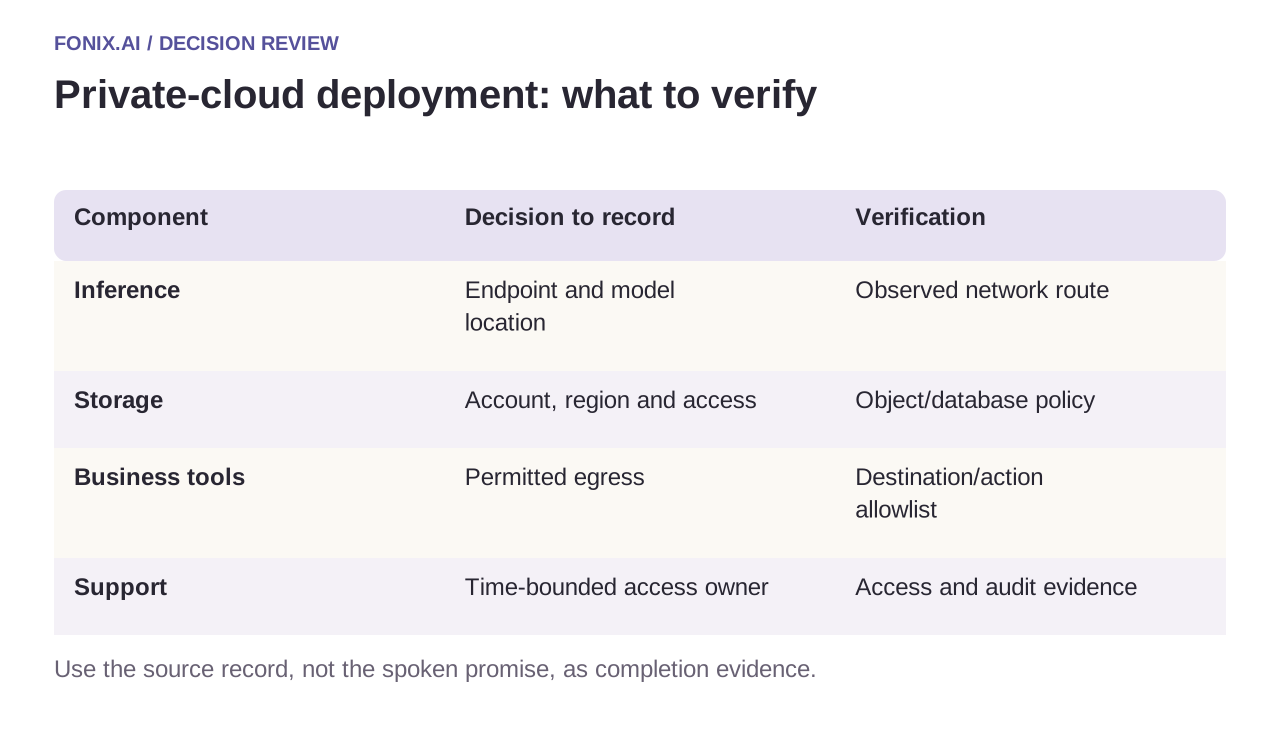
An account, region and egress evidence worksheet
Create a component inventory covering telephony, speech, model inference, retrieval, storage and monitoring. Assign account, region and operator ownership to each. Include credential rotation, egress policy and a controlled restore exercise in scoping.
| Pilot case | Required behaviour |
|---|---|
| Inference is private but debug payloads leave the account | Identify the external destination and redesign or explicitly approve that data boundary. |
| A support user retains access after a service window | Verify time-bounded revocation and the resulting audit event. |
| A restore uses backups from another region or account | Check actual recovery location and access against the approved architecture. |
Record observed allowed and unexpected data flows, restore results and unresolved component ownership. Treat these as deployment evidence, not a compliance certificate. A network label alone does not establish where every conversation artefact is processed.
Is a private cloud the same as an air-gapped site?
No. A cloud network may still have authorised internet, provider or business-system connections. An air-gapped requirement needs its own architecture and operational proof. Confirm the exact data and connectivity boundaries rather than using the terms interchangeably.
Verify with observed traffic and a restore drill
Run representative calls and inspect permitted connections, artefact locations and restricted-role access. Simulate an external dependency failure. Record which functions remain available and which require an owned fallback.
Review a private-cloud Fonix deployment with your topology and data-class inventory. Recording retention covers lifecycle controls; high availability covers recovery ownership. Provider reference checked 15 October 2026.