

A practical guide / Fonix.AI
High-availability deployment: a practical implementation guide
A worked scenario, illustrated decision review and a practical pilot worksheet.
High availability must preserve the owner of each action
A high availability voice AI deployment should keep serving within its agreed failure boundaries and recover unfinished work without duplicating business actions. Restarting a voice worker is only one part of that design. Sessions, tool transactions, storage and telephony each have different recovery properties.
Use this Fonix.AI worksheet to agree the architecture and test objectives. It does not claim a measured uptime, recovery-point objective or recovery-time objective for a deployment that has not been tested.
Classify state before adding replicas
Separate replaceable computation from durable conversation/task state and authoritative business records. A second worker can accept a new call, but it may not recover an existing media session. A database replica does not automatically prevent two workers from committing the same booking.
Define ownership leases or an equivalent coordination mechanism for active tasks. Retain stable action references and reconcile unknown external writes. Document which component can take over, which evidence it needs and when manual intervention is required.
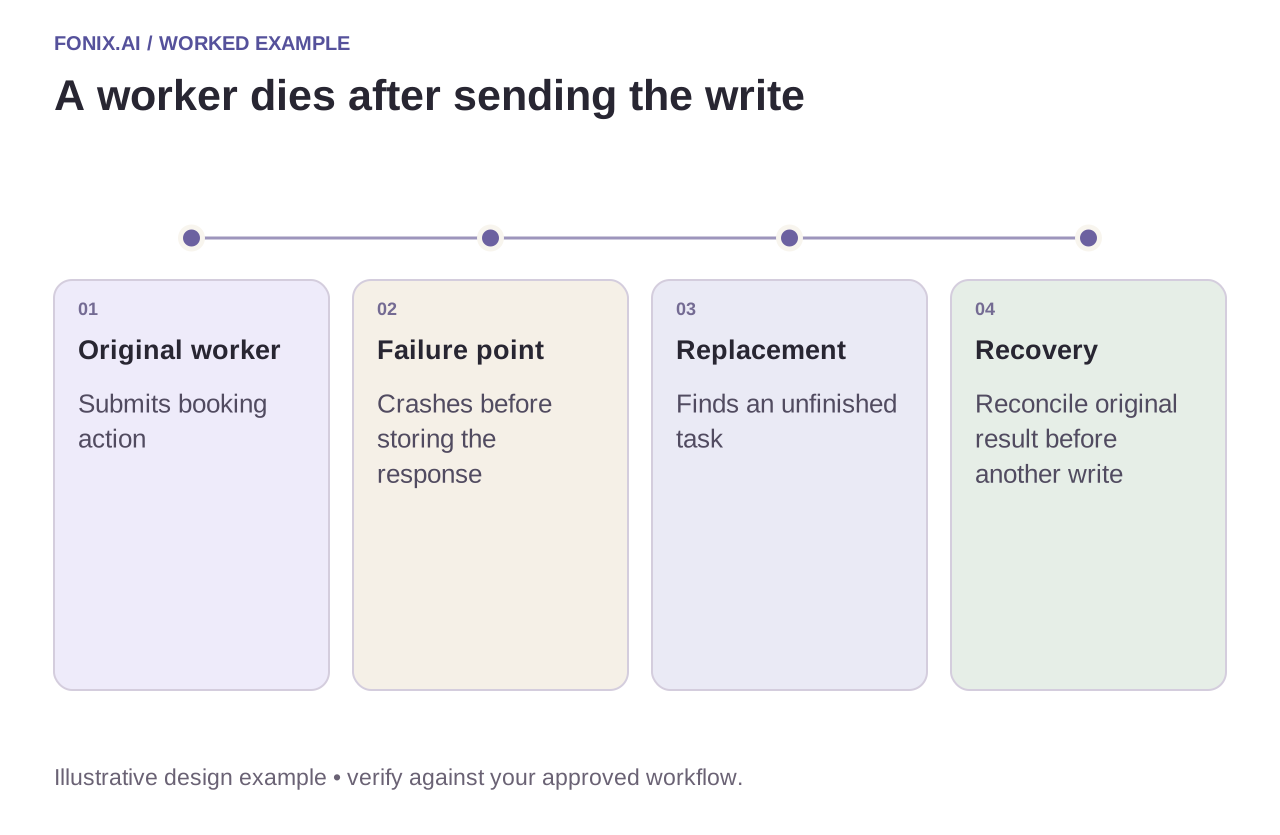
Worked example: a worker dies after requesting a booking
A fictional worker sends a booking request and crashes before saving the response. Its replacement sees an unfinished task. It should query the original action's result using the supported reconciliation path before submitting again. Otherwise improved worker availability can produce worse booking correctness.
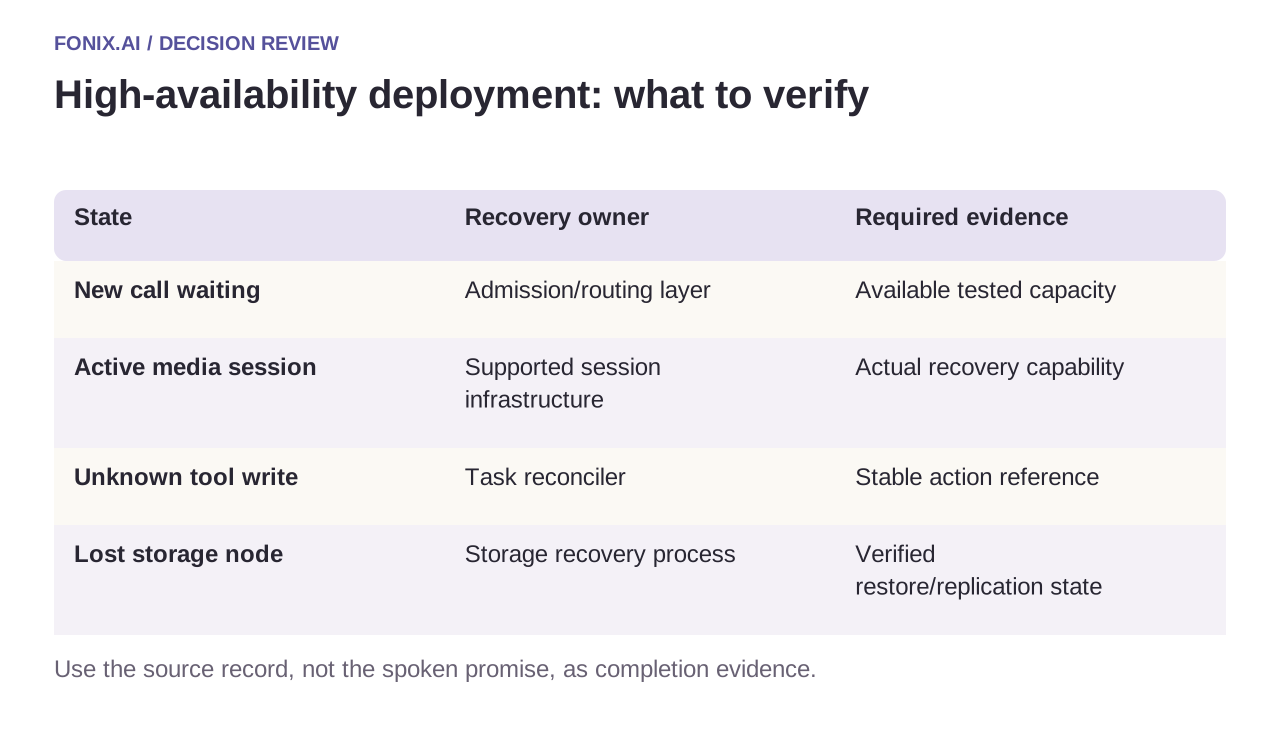
| State | Recovery owner | Required evidence |
|---|---|---|
| New call waiting | Admission/routing layer | Available tested capacity |
| Active media session | Supported session infrastructure | Actual recovery capability |
| Unknown tool write | Task reconciler | Stable action reference |
| Lost storage node | Storage recovery process | Verified restore/replication state |
Make recovery objectives specific
Set objectives for new-call admission, unfinished task recovery and data loss separately. State which faults are included: process, node, network zone or regional outage. A successful process restart is not evidence for a regional-disaster claim.
Assign alert, incident and restore responsibilities. Backups need a tested restore path and restricted access. After recovery, inspect orphaned calls, stale leases and queued callbacks so the system does not appear healthy while customer work remains unowned.
A fault drill that scores correctness as well as uptime
Classify ephemeral audio, durable task state and external business records. Assign recovery owners and define the objectives for each failure domain. Prepare synthetic actions and a restricted environment for worker and storage fault drills.
| Pilot case | Required behaviour |
|---|---|
| A worker crashes after sending a booking request | Reconcile the original action before a replacement submits another. |
| A storage component is restored | Verify the recovered task state and its relationship to external accepted actions. |
| A standby worker takes new calls | Check resource readiness and usable media, not only process health. |
Record service availability and business correctness for each injected fault. Report duplicate actions, lost tasks and observed restore/recovery intervals separately. Architecture diagrams and replica counts do not establish a measured recovery objective.
Does redundancy guarantee seamless active-call recovery?
No. New-call routing, media-session continuity, durable task ownership and storage restore are distinct. Test the supported path for each and document what drops, resumes or requires reconciliation rather than promising uninterrupted conversations from replica count alone.
Run fault drills against correctness and availability
Interrupt one component at a time in an authorised environment. Observe new calls, active sessions, pending writes and the recovery queue. Record actual detection and recovery times with the test setup. Treat duplicate business actions and lost requests as failures even if the service endpoint remains available.
Review a Fonix availability design with topology and recovery priorities. SIP failover covers carrier routing; function reliability covers ambiguous transactions; private cloud covers infrastructure ownership.