

A practical guide / Fonix.AI
SIP failover: a practical implementation guide
A worked scenario, illustrated decision review and a practical pilot worksheet.
SIP failover protects new-call routing first
Voice AI SIP failover should define what happens when a carrier, PBX or voice endpoint becomes unavailable. Rerouting a new call is different from preserving an active call's signalling and media state. A secondary trunk does not automatically rescue conversations already in progress.
Use this Fonix.AI guide to design a failure-and-restore drill around the actual supported topology. It does not claim a measured recovery time or seamless active-call migration for an untested deployment.
Identify the failure domain and the deciding system
List carrier routes, session border controllers, PBX nodes, voice workers and business-tool dependencies. For each, identify the health signal, decision owner, alternate destination and capacity limit. A process responding to a health endpoint may still fail to pass intelligible audio.
Distinguish carrier failure from an application or tool outage. Moving to another carrier will not repair a failing calendar API. The SIP topology guide separates signalling from media so the backup can address the right fault.
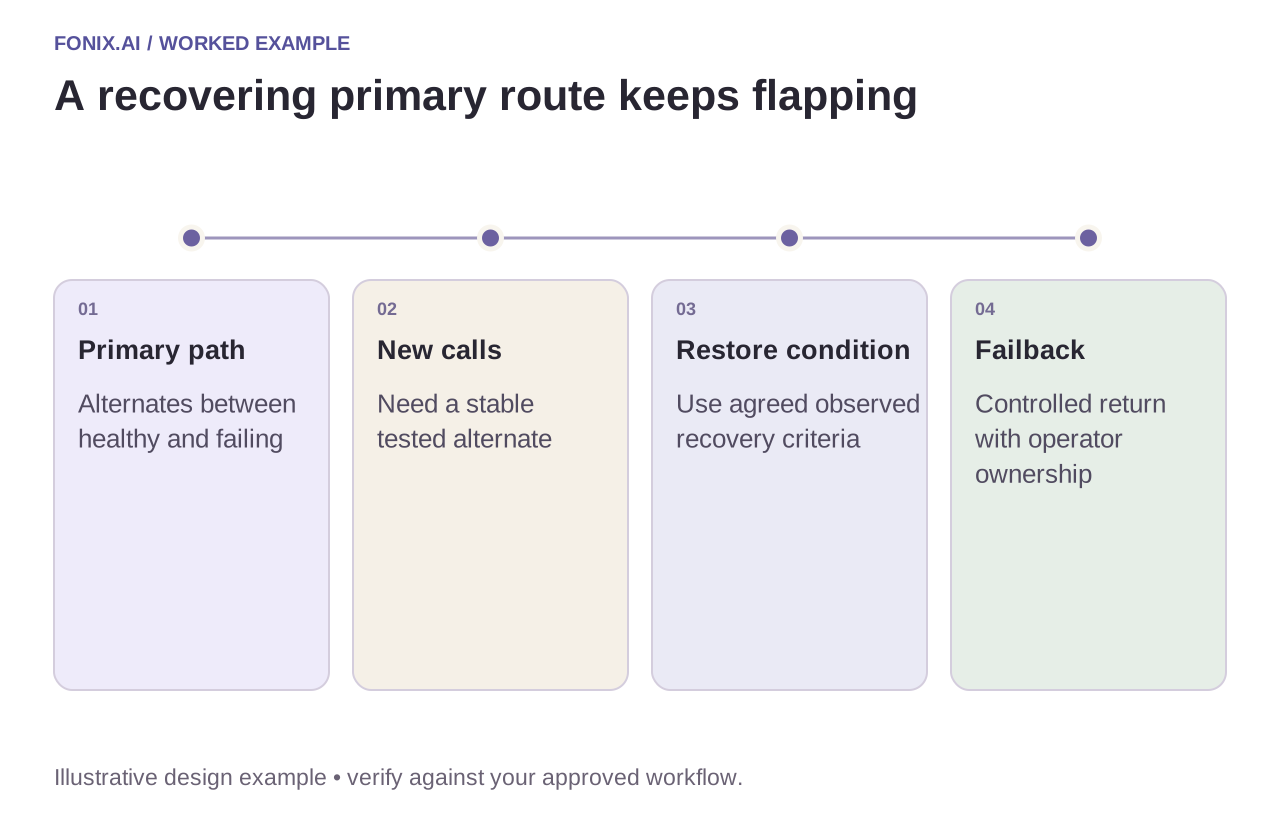
Worked example: the primary path recovers intermittently
A fictional primary route alternates between healthy and failing. Immediately switching every call back can produce route flapping and another outage burst. Define the observed recovery condition, stabilisation period and operator override before testing, rather than inventing a universal timing value.
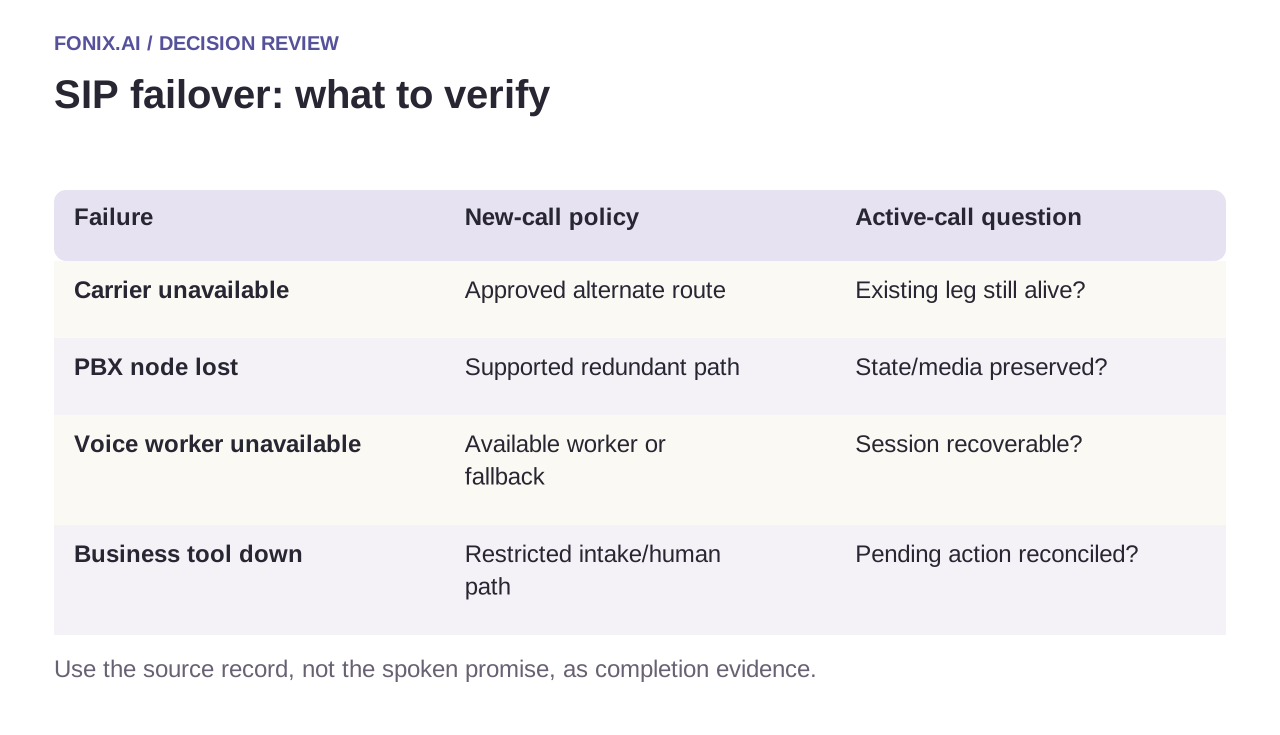
| Failure | New-call policy | Active-call question |
|---|---|---|
| Carrier unavailable | Approved alternate route | Existing leg still alive? |
| PBX node lost | Supported redundant path | State/media preserved? |
| Voice worker unavailable | Available worker or fallback | Session recoverable? |
| Business tool down | Restricted intake/human path | Pending action reconciled? |
Reserve capacity on the alternate path
The backup needs tested call admission, number routing and human fallback capacity. A route that accepts a single test call may fail under the full redirected load. Check caller identity presentation, codec compatibility and transfer destinations on the backup too.
Keep incident and route-decision records linked to call identifiers. For interrupted actions, retain business ownership even if audio cannot be restored. A caller should not be charged with resolving duplicate bookings caused by a failover retry.
A failure-and-failback drill with explicit scope
Draw primary and alternate carrier, PBX and worker paths. Agree who decides health, the recovery condition and the operator override. Use a controlled failure window and synthetic calls with no real customer work.
| Pilot case | Required behaviour |
|---|---|
| The primary route flaps between healthy and failed | Apply the documented stabilisation and return policy instead of switching every call immediately. |
| The alternate route carries new calls under load | Verify media, tool capacity and receiving-team fallback as well as signalling. |
| An active call loses its original dependency | Observe the actual continuity or drop behaviour; do not infer seamless migration. |
Measure new-call admission and usable audio during each defined failure, plus observed recovery time for that drill. Report active-session loss and failed business actions separately. Do not present a single successful test as an uptime guarantee.
Should failback happen as soon as a health check passes?
Not automatically. Define recovery evidence, stabilisation and operator control for the actual topology. An intermittently recovering path can create more disruption if all calls return immediately. The timing should be tested, not copied from a universal recommendation.
Drill failure and return to service
Disable one component at a time in an authorised test environment. Measure detection, new-call recovery, affected active calls and action reconciliation separately. Restore the component and verify controlled failback. Publish only observed results with workload and topology, not a broad uptime guarantee.
Review a SIP failover drill with your primary/backup diagram. High-availability deployment covers application state; load testing covers redirected traffic capacity.