

A practical guide / Fonix.AI
Concurrent-call testing: a practical implementation guide
A worked scenario, illustrated decision review and a practical pilot worksheet.
Concurrent-call capacity needs a reproducible workload
Voice agent concurrent call load testing should establish how a defined deployment behaves under arrivals, sustained conversations and downstream work. A headline maximum is incomplete without call duration, language mix, speech overlap, tool use, telephony path and resource configuration.
This is a test design for Fonix.AI evaluation, not a published benchmark result. Select the environment and acceptance thresholds with the operating team before running a controlled test.
Model arrivals as well as active conversations
Concurrency emerges from arrivals and call durations. A test holding many silent sockets does not resemble customers speaking, interrupting and making tool requests. Define a mix of short enquiries, longer conversations, transfers and failed contacts using synthetic or properly authorised material.
Start with a baseline, increase load in deliberate steps and include a burst profile. Record offered, admitted, active and completed calls. Keep rejected arrivals in the report instead of excluding them to improve the success rate.
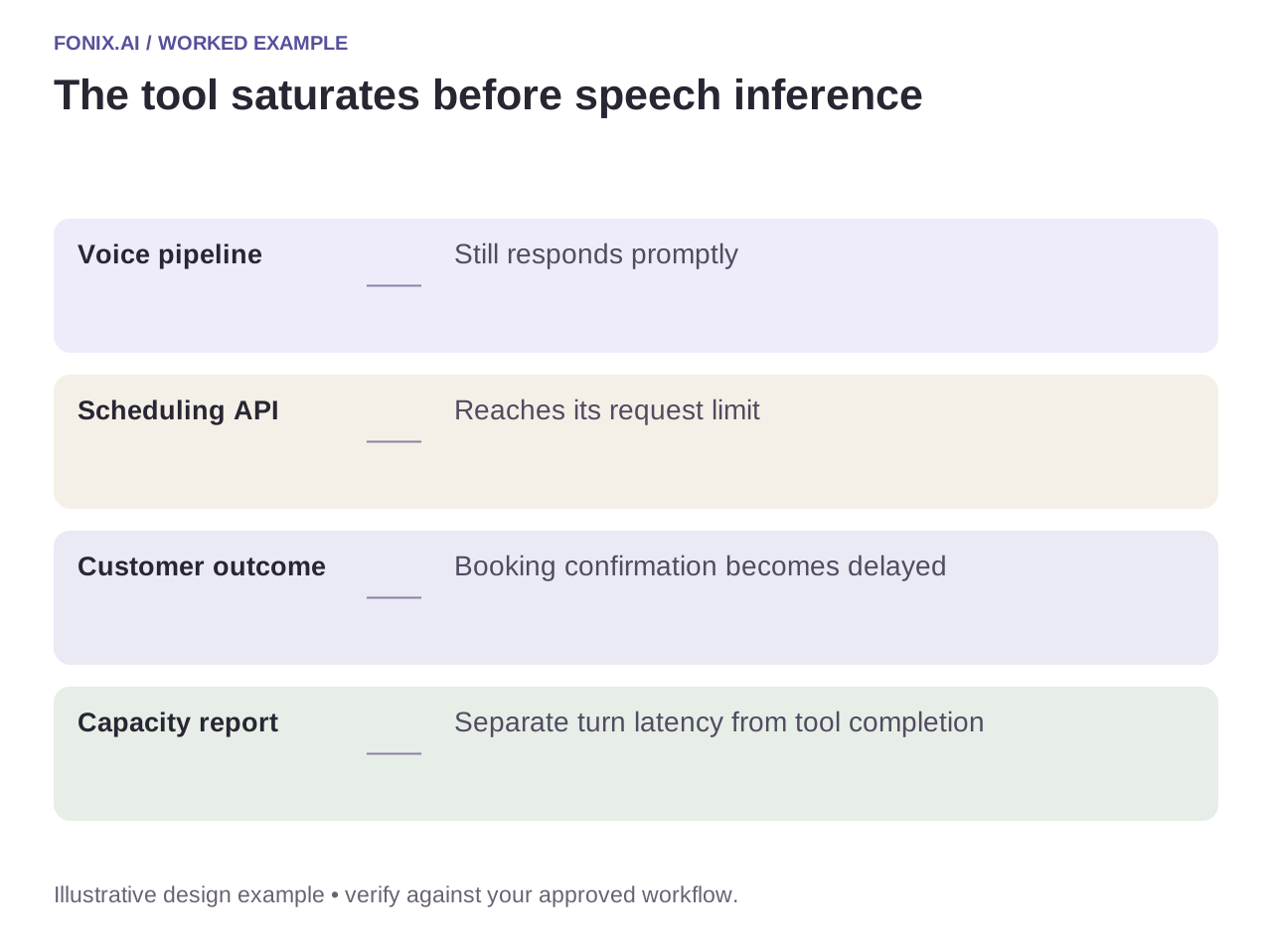
Worked example: speech stays fast but bookings queue
In a fictional experiment, voice inference remains responsive while a scheduling API reaches its request limit. Spoken acknowledgements still sound quick, but confirmed bookings arrive late. The bottleneck is the action path, and the user outcome is degraded despite a healthy model latency chart.
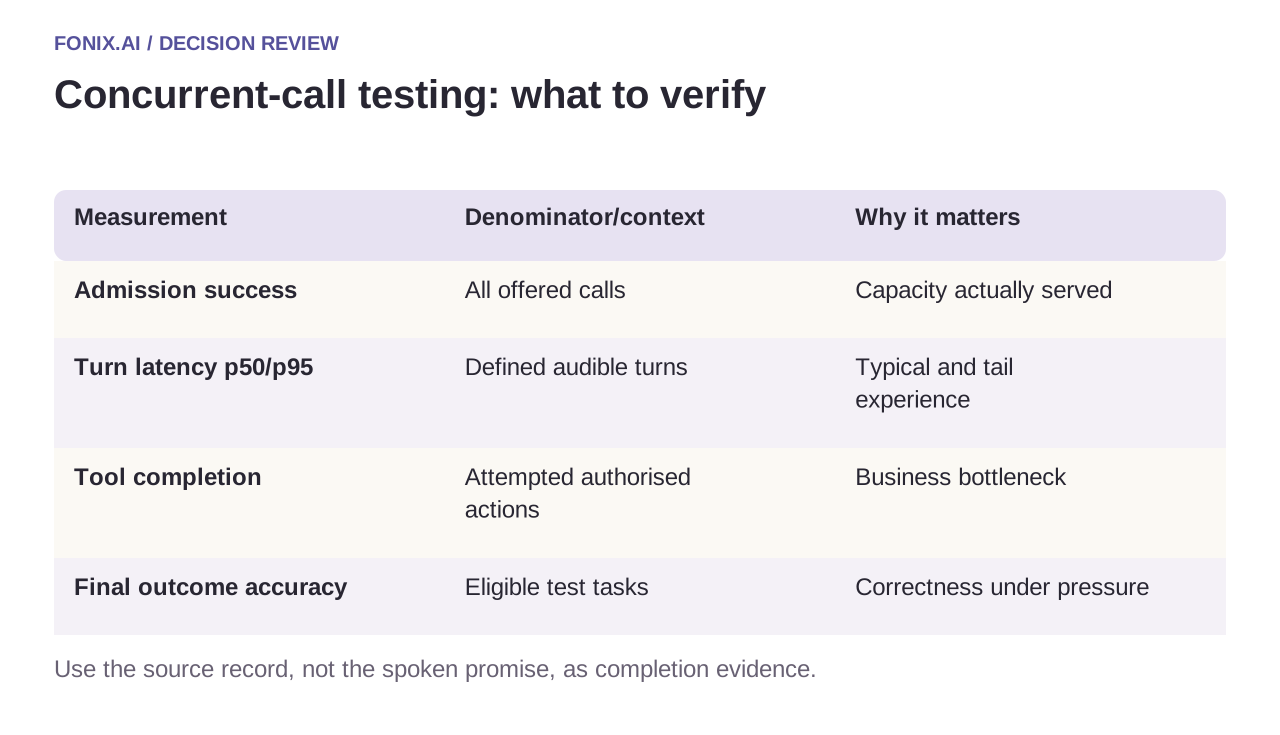
| Measurement | Denominator/context | Why it matters |
|---|---|---|
| Admission success | All offered calls | Capacity actually served |
| Turn latency p50/p95 | Defined audible turns | Typical and tail experience |
| Tool completion | Attempted authorised actions | Business bottleneck |
| Final outcome accuracy | Eligible test tasks | Correctness under pressure |
Record enough to repeat the experiment
Save deployment version, model/configuration identifiers, resource shape, test duration, arrival profile and dependency limits. Synchronise clocks and keep warm-up separate. Use a consistent failure taxonomy for telephony, media, inference, tool and application errors.
Avoid a test that overloads shared external services or real customer numbers. Use an authorised environment and controlled endpoints. Abort conditions should protect existing sessions and preserve the evidence needed to understand saturation.
A reproducible workload card for capacity testing
Document the test environment, language mix, call durations, arrival pattern and tool workload. Agree safety limits and acceptance thresholds with the operating team. Generate synthetic tasks so load does not reserve real inventory or contact customers.
| Pilot case | Required behaviour |
|---|---|
| Speech remains quick while the booking API saturates | Count delayed or failed confirmed outcomes and identify the action bottleneck. |
| A burst arrives above the tested admission limit | Record offered and rejected calls rather than excluding them from the report. |
| Warm transfers add extra resource demand | Include transfer legs and human queue availability in the workload profile. |
Report offered, admitted and completed calls together with task accuracy, tool completion and latency distributions. Preserve the workload and configuration needed to repeat the run. An active-session maximum is not a reliable capacity number without these conditions.
Can we publish a concurrency number after one easy demo?
It would describe only that narrow demonstration. A defensible operating envelope needs representative language, turn lengths, business actions and failure conditions. State those conditions and observed limits instead of presenting an unqualified universal capacity claim.
Choose an operating envelope from observed results
The usable limit is where agreed quality and failure criteria hold, not the last moment before a process crashes. Repeat only when configuration changes or an unresolved result requires it. Keep the report specific to the tested setup.
Review a concurrent-call test profile with expected arrivals and tool workload. Latency measurement defines the turn boundary; overflow handling turns observed limits into admission rules.
Repeat critical speech cases under representative conditions using the background-noise test protocol. A clean-audio concurrency result does not establish field accuracy on a busy customer telephone line.