

A practical guide / Fonix.AI
Background-noise testing: a practical implementation guide
A worked scenario, illustrated decision review and a practical pilot worksheet.
Noise testing should measure the business field
Voice AI background noise testing should ask whether the agent preserves the information needed to complete the task under specified acoustic and channel conditions. A transcript can look mostly correct while losing the one digit, date or negation that changes the outcome.
This Fonix.AI lab is a paired-test protocol, not a benchmark result. Use synthetic or authorised speech, document the noise preparation and keep the clean reference so results can be reproduced.
Change one condition at a time first
Build a clean set containing the fields your workflow needs. Add controlled conditions such as road noise, office chatter or channel degradation, recording the preparation method and level definition. Keep background speech distinct from non-speech noise because it can affect turn-taking differently.
Start with paired clean/noisy samples of the same utterance. Then add natural recordings from approved sources to test realism. Do not claim a calibrated signal-to-noise ratio unless the mixing and measurement procedure actually supports it.
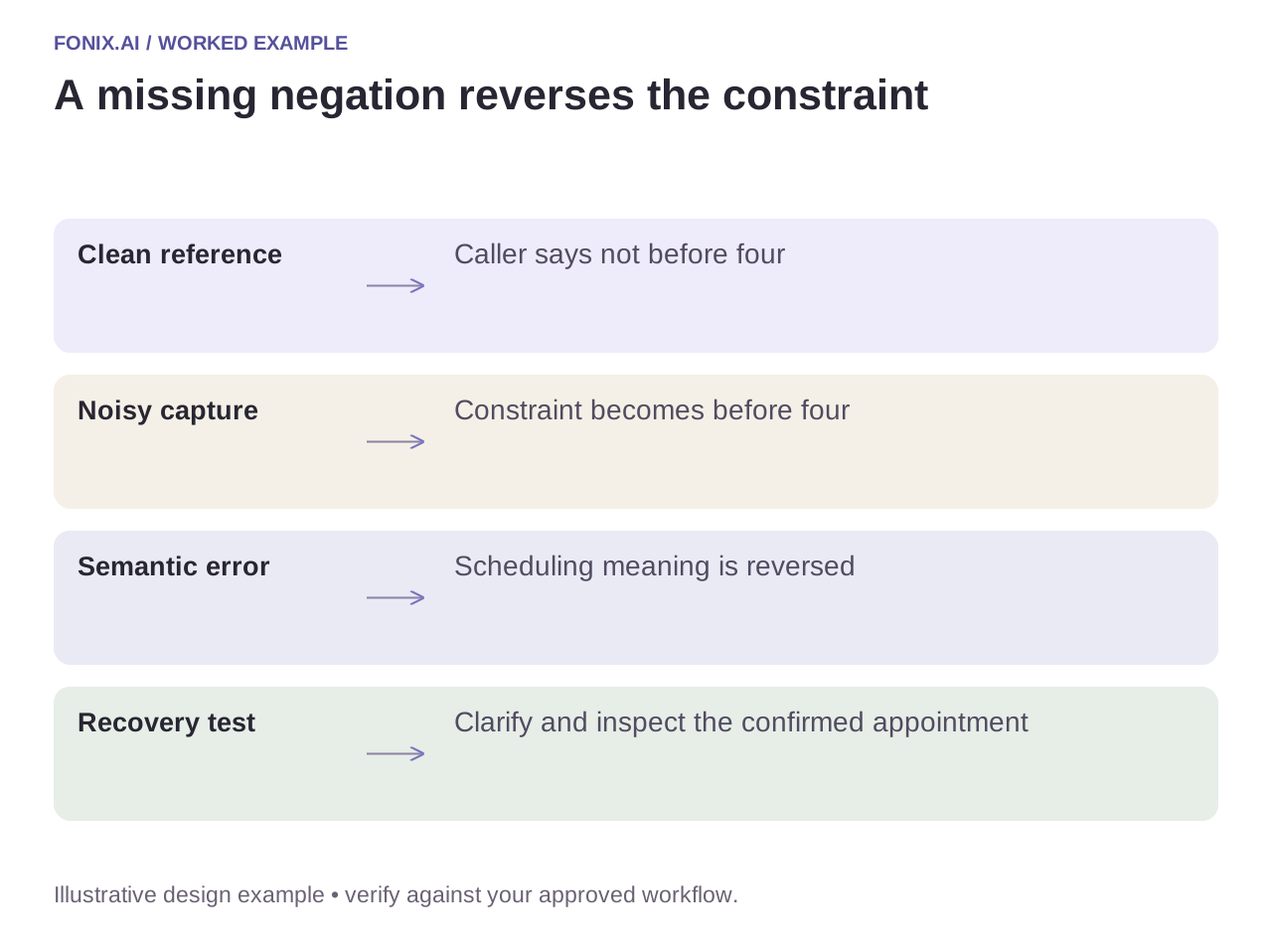
Worked example: an appointment time loses its negation
A fictional caller says “not before four”. Under office chatter, the captured field becomes “before four”. Word-level accuracy may remain high, but the scheduling constraint reverses. Score the final semantic constraint and resulting appointment choice, not merely the number of recognised words.
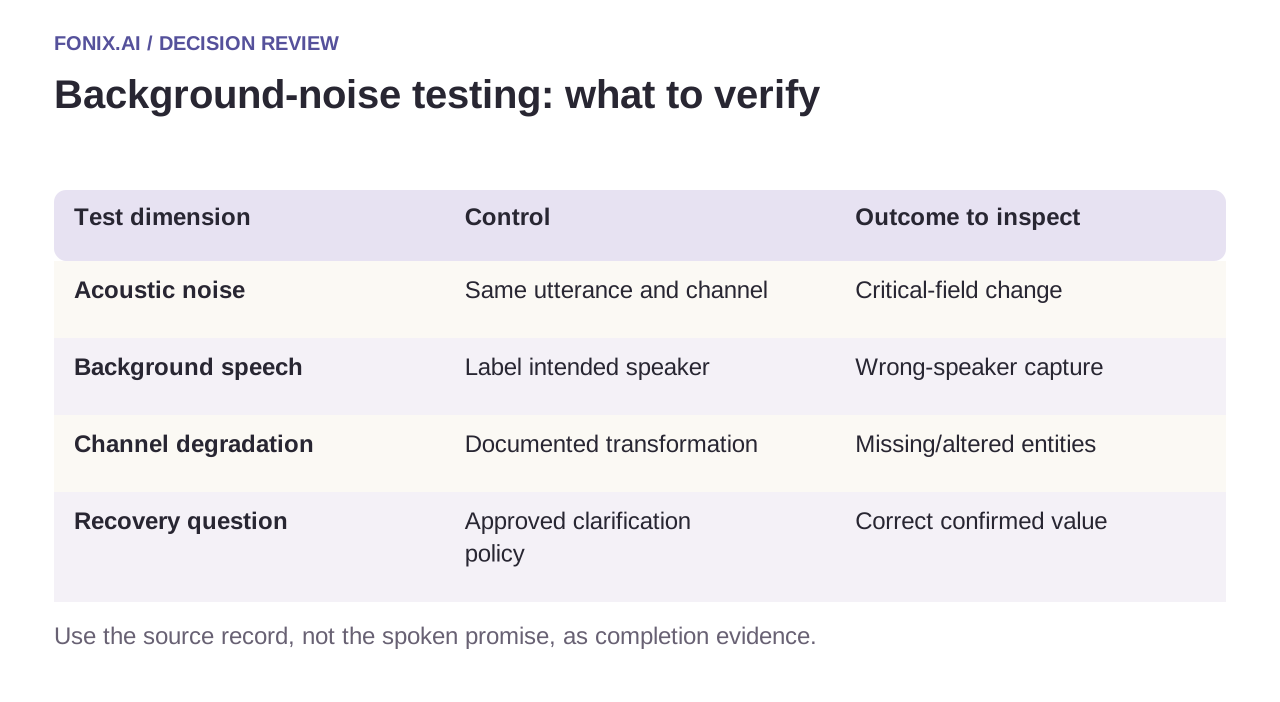
| Test dimension | Control | Outcome to inspect |
|---|---|---|
| Acoustic noise | Same utterance and channel | Critical-field change |
| Background speech | Label intended speaker | Wrong-speaker capture |
| Channel degradation | Documented transformation | Missing/altered entities |
| Recovery question | Approved clarification policy | Correct confirmed value |
Reward clarification when evidence is uncertain
An agent should ask a focused question when a critical field is unclear. Guessing the most common value can improve superficial completion while harming customers. Track unnecessary repetition too, so conservative handling does not make every ordinary call tedious.
Preserve the first capture, clarification and final confirmation as separate scoring points. Review whether the system remains safe at the task boundary: a low-confidence address should not become a confirmed dispatch merely because the conversation continued.
A paired clean-versus-noisy business-field test
Build paired clean and noisy versions of synthetic or authorised utterances. Keep language, channel and intended speaker labels explicit. Begin with one changed condition at a time before testing representative real-world combinations.
| Pilot case | Required behaviour |
|---|---|
| Noise removes the negation in a time constraint | Score the final semantic constraint and appointment choice, not only recognised words. |
| A nearby speaker says another person's number | Reject wrong-speaker capture or clarify under the approved policy. |
| The agent cannot hear a critical identifier reliably | Request a bounded clarification instead of confidently writing a guessed value. |
Report critical-field and task outcomes by language and noise condition, with clarification success and failure visible. Preserve the clean reference and transformation method. One blended accuracy figure can hide a condition that makes the intended deployment unusable.
Does a realistic noise sample automatically make a fair comparison?
No. Use the same reference material and documented channel conditions for systems being compared. Keep intended speaker and answer labels fixed, and distinguish acoustic noise from semantic background speech. Otherwise the comparison can change several factors at once.
Report results by condition and language
Keep sample counts, field types, language mix and channel path visible. Compare clean-to-noisy degradation and recovery rate rather than publishing one aggregate score. Include unresolved samples and failures in the report.
Review a noise-resilience test corpus with your workflow's critical fields. Names and numbers testing defines exact-value scoring; multilingual evaluation covers language and code-switching conditions.