

A practical guide / Fonix.AI
Response-latency measurement: a practical implementation guide
A worked scenario, illustrated decision review and a practical pilot worksheet.
Measure latency from the caller's experience
To measure voice agent response latency, define when the caller stopped speaking and when the next meaningful agent audio became audible. Model token timing and a server's first audio packet describe parts of the pipeline; neither alone describes the pause the caller hears.
This Fonix.AI guide supplies a measurement protocol, not a published performance claim. Use the actual telephony path and a documented workload before comparing systems or choosing an operating threshold.
Put timestamps on the full turn
Capture caller speech end, endpoint decision, recognition completion where relevant, model/tool milestones, audio generation and audible playback. Synchronise clocks or use a single observation point where practical. Explain the uncertainty when comparing timestamps from different machines.
Separate a short acknowledgement from the first substantive answer. “Let me check” can arrive quickly while a booking answer takes several seconds. Report both if both affect the experience, rather than using the acknowledgement to conceal a slow tool path.
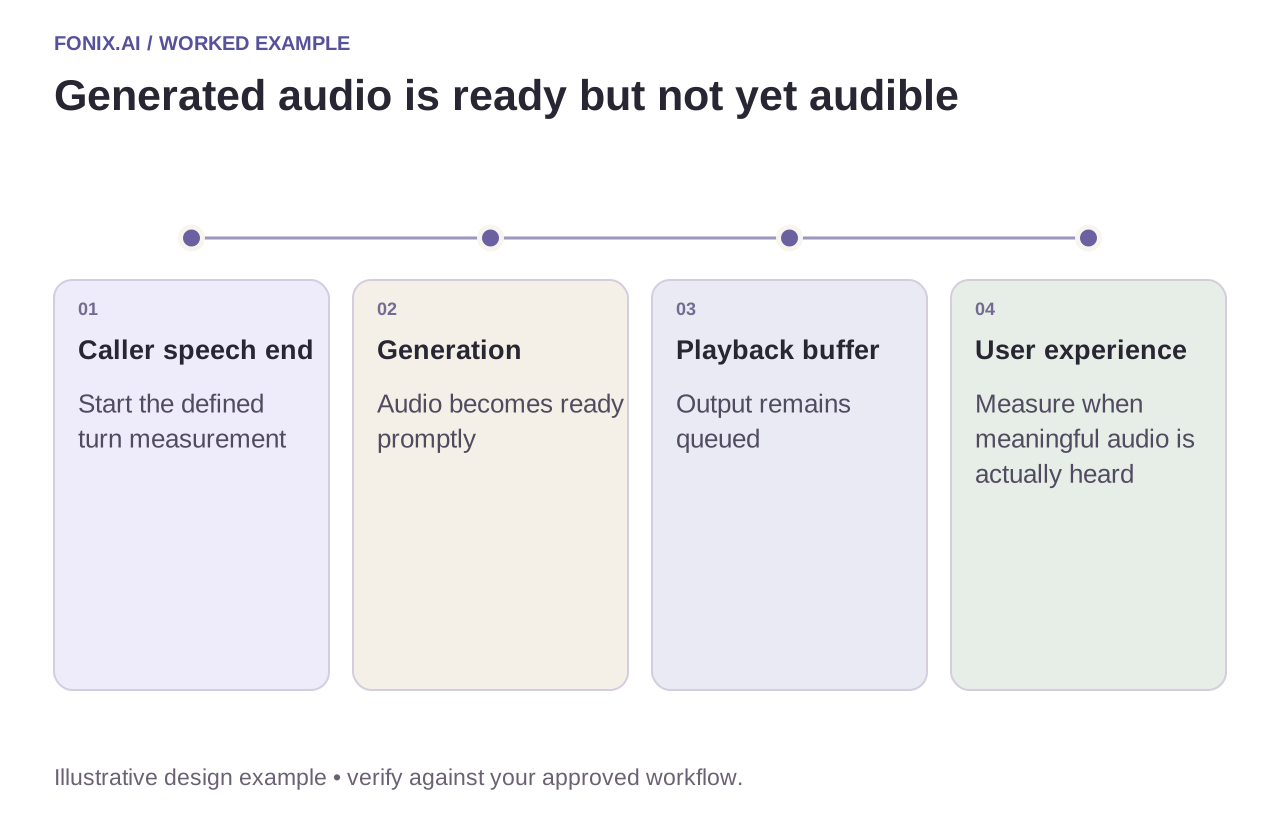
Worked example: fast generation, delayed playback
A fictional service generates audio promptly but queues it behind buffered content. Server-side generation looks fast, while the caller hears a long pause. Capture playback or an equivalent end-to-end observation to locate the delay. Optimising model response alone would miss the bottleneck.
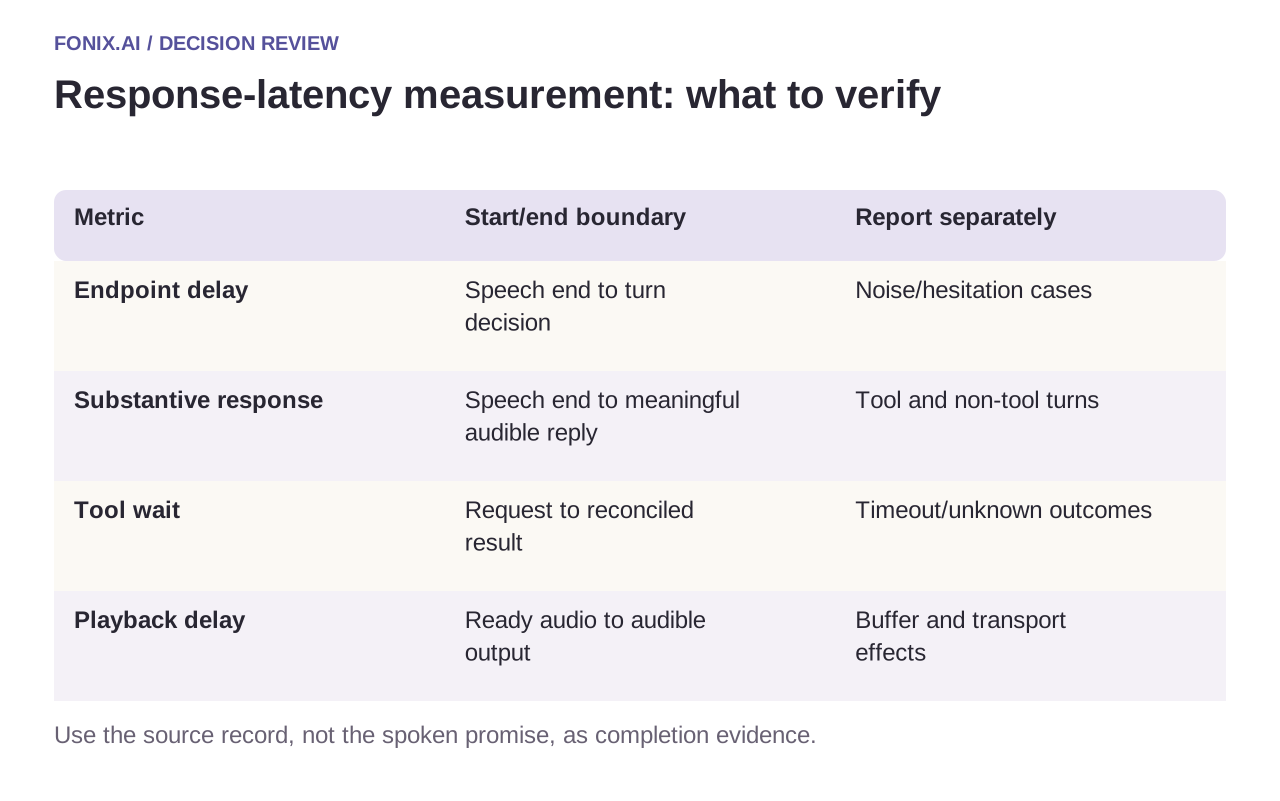
| Metric | Start/end boundary | Report separately |
|---|---|---|
| Endpoint delay | Speech end to turn decision | Noise/hesitation cases |
| Substantive response | Speech end to meaningful audible reply | Tool and non-tool turns |
| Tool wait | Request to reconciled result | Timeout/unknown outcomes |
| Playback delay | Ready audio to audible output | Buffer and transport effects |
Use a distribution and a defined workload
Report sample count, p50 and a tail percentile such as p95 with the selected definition. Separate language, network path, call load and tool use. An average across easy and hard turns hides the experience buyers need to evaluate.
Include interruptions, corrections and unanswerable questions. Do not remove slow failed turns without reporting the exclusion. Keep warm-up and steady-state results labelled, and record configuration versions so a later release can be compared meaningfully.
An audible-turn timing protocol
Choose a documented language, channel and task mix. Capture a common timeline with caller speech end and meaningful audible response. Label tool and non-tool turns separately and keep synthetic recordings for human review.
| Pilot case | Required behaviour |
|---|---|
| Audio is generated quickly but waits in a buffer | Measure audible playback as well as server readiness to locate the delay. |
| A filler phrase plays before a long tool wait | Keep first sound separate from the substantive answer or accepted result. |
| Endpointing changes under background noise | Report the condition and effect rather than averaging it into a single clean-call figure. |
Publish sample counts and latency distributions for each defined turn class, including timeouts and missing responses. Specify whether a percentile includes failed turns and how they are reported. A mean of successful model responses is not end-to-end caller latency.
Should we optimise only time to the first audio byte?
It can help diagnose generation, but the caller experiences speech detection, transport and playback too. Use meaningful audible response as an end-to-end measure and retain component timestamps to identify the part worth improving.
Turn observations into a deployment decision
Choose acceptance criteria before testing and inspect recordings alongside traces. A fast wrong answer is not a good outcome. Publish observed measurements only with their boundaries, workload and limitations; this worksheet does not imply a Fonix benchmark number.
Review a response-latency experiment with your call path and expected tool use. Concurrent-call testing adds load; barge-in testing measures interruption response rather than ordinary turn-taking.