

A practical guide / Fonix.AI
Barge-in testing: a practical implementation guide
A worked scenario, illustrated decision review and a practical pilot worksheet.
Barge-in quality includes stopping and recovering
Voice agent barge in testing should establish whether the agent notices a genuine interruption, stops audible speech promptly and uses the caller's correction correctly. Detecting sound is insufficient: background speech can trigger a false stop, and buffered audio can continue after generation has been cancelled.
Use this Fonix.AI evaluation lab to define test cases and evidence. It is distinct from a glossary explanation of interruption handling and does not claim a measured stop time for an untested configuration.
Mark the interruption in the audible timeline
Record caller interruption onset, detection, output cancellation and the last audible agent speech. Use the actual phone or media path. Retain a reviewer label indicating whether the interruption was intended, incidental background speech or an ambiguous overlap.
Test both a brief “yes” and a meaningful correction. A backchannel should not always cancel an explanation. Conversely, “No, Tuesday, not Thursday” needs to stop the obsolete answer and revise the relevant field.
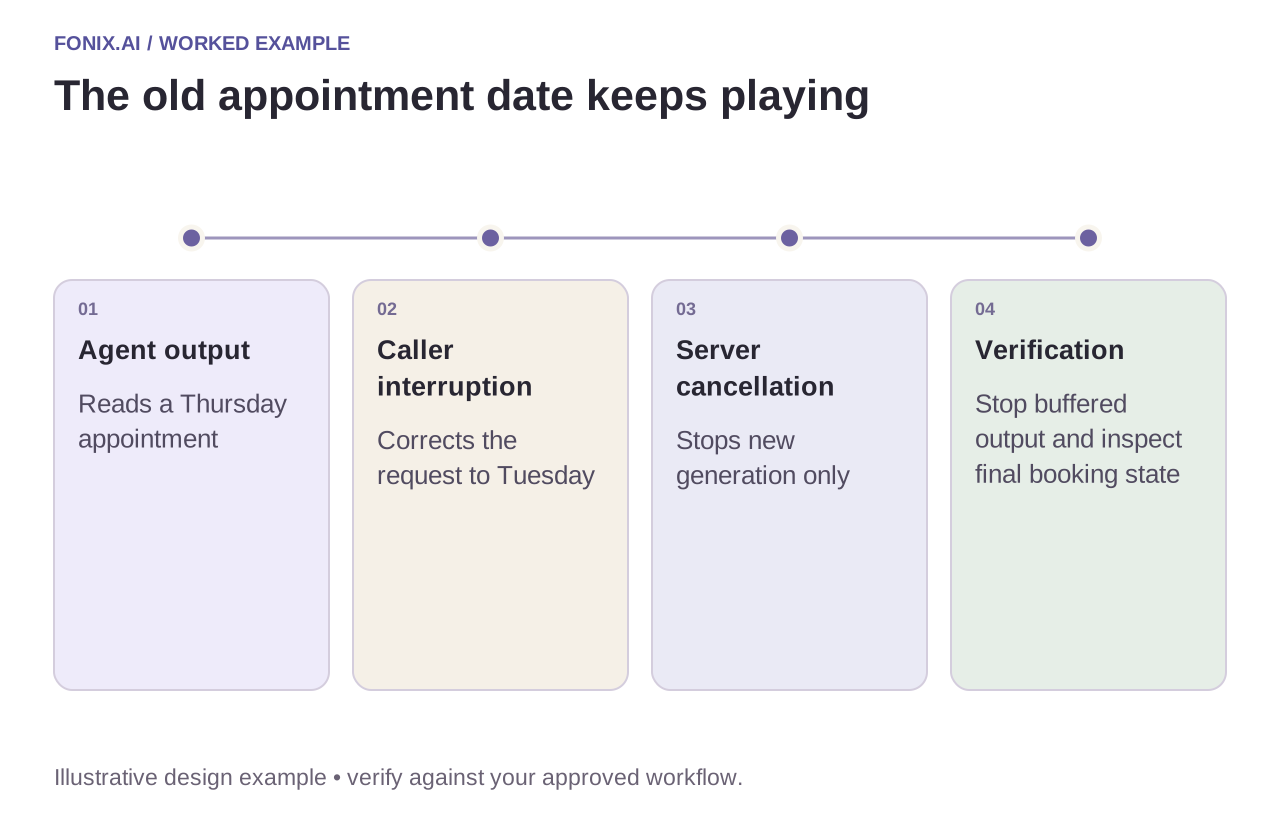
Worked example: the old date keeps playing
A fictional agent reads a Thursday appointment while the caller corrects it to Tuesday. The model stops generating, but buffered speech finishes the Thursday confirmation. The user hears conflicting information. Verify output-buffer handling and the final booking state, rather than scoring the interruption as successful from a server cancellation event alone.
| Test case | Desired behaviour | Failure to count |
|---|---|---|
| Explicit correction | Stop obsolete output; confirm revision | Old value remains committed |
| Short backchannel | Appropriate continuation | Unnecessary cancellation |
| Background speaker | Preserve intended turn policy | False interruption |
| Overlap near tool write | Reconcile committed state | Unapproved silent change |
Score false stops and missed interruptions separately
Report true interruptions detected, intended interruptions missed and non-interruptions that caused a stop. Include sample counts and conditions. A sensitive detector can improve apparent response time while making ordinary conversations unusable.
After every correction, inspect the final stated and written value. If a tool action already committed, follow its change process; do not pretend cancelling speech cancelled the booking. Preserve the caller's correction and the resulting action evidence.
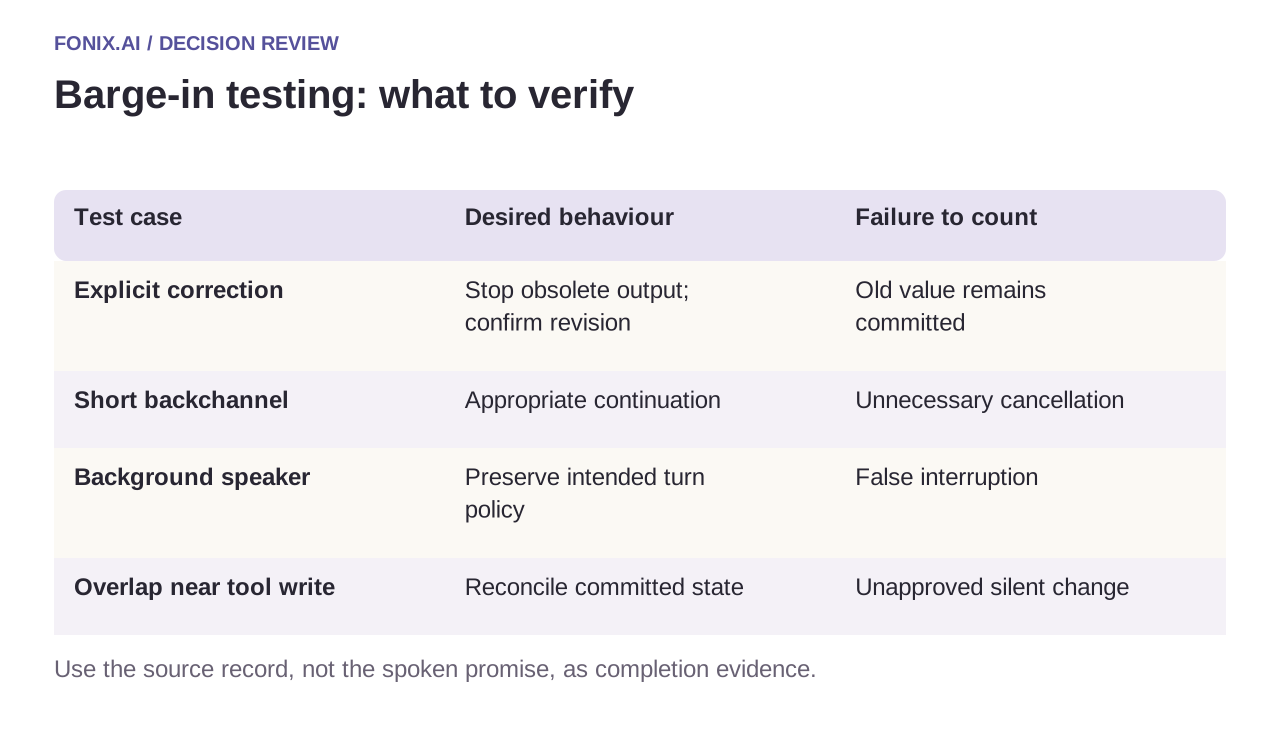
A stop-and-recover listening worksheet
Prepare synthetic corrections, brief acknowledgements and background-speaker cases. Capture both audio directions and the business write timeline. Define the expected treatment of overlap before scoring the system.
| Pilot case | Required behaviour |
|---|---|
| The caller corrects a date during confirmation | Stop obsolete audible output and reconcile the final requested and committed date. |
| The caller gives a short listening acknowledgement | Apply the intended turn policy instead of cancelling every response unnecessarily. |
| An interruption arrives after a tool commit | Explain or route the required change; do not silently pretend the original action never happened. |
Report missed interruptions, false stops, audible stop delay and correct recovery as distinct measures. Count final critical-field errors after recovery. A server cancellation timestamp alone cannot prove that queued audio stopped reaching the caller.
Is every overlapping sound a valid interruption?
No. Backchannels, background speech and explicit corrections have different meanings. Define the intended behaviour for each, then listen to both the stop and recovery. Aggressively stopping everything can make an agent as difficult to use as one that never stops.
Test natural overlap, not just scripted interruptions
Use different speaker levels, languages, hesitation and ordinary room noise with authorised material. Review audio from the caller's side. Keep stop-time percentiles separate from successful correction rates; both affect usefulness.
Review an interruption test set with your expected call conditions. Latency measurement defines ordinary turn boundaries; names and numbers covers critical-field corrections.