

A practical guide / Fonix.AI
Function-calling reliability: a practical implementation guide
A worked scenario, illustrated decision review and a practical pilot worksheet.
Function-calling reliability is a transaction problem
Voice agent function calling reliability means that a requested business action reaches a known, authorised outcome without duplication. A well-formed tool call and a confident spoken confirmation do not establish that a booking, payment request or CRM write committed.
Use this Fonix.AI lab to review the action boundary in a deployment. The state names below are a proposed design, not a public Fonix API schema. Implement them through the actual tool and business system's supported contract.
Keep requested, accepted and committed distinct
Validate arguments and authorisation before execution. Give the action a stable identity scoped to the account and task. Store its state durably so a worker restart or repeated event does not lose ownership.
An accepted request may be asynchronous. A timeout may mean the action failed, is still running or already succeeded without a response. Preserve unknown as a real state and provide a reconciliation path. Do not reduce every exception to “try again”.
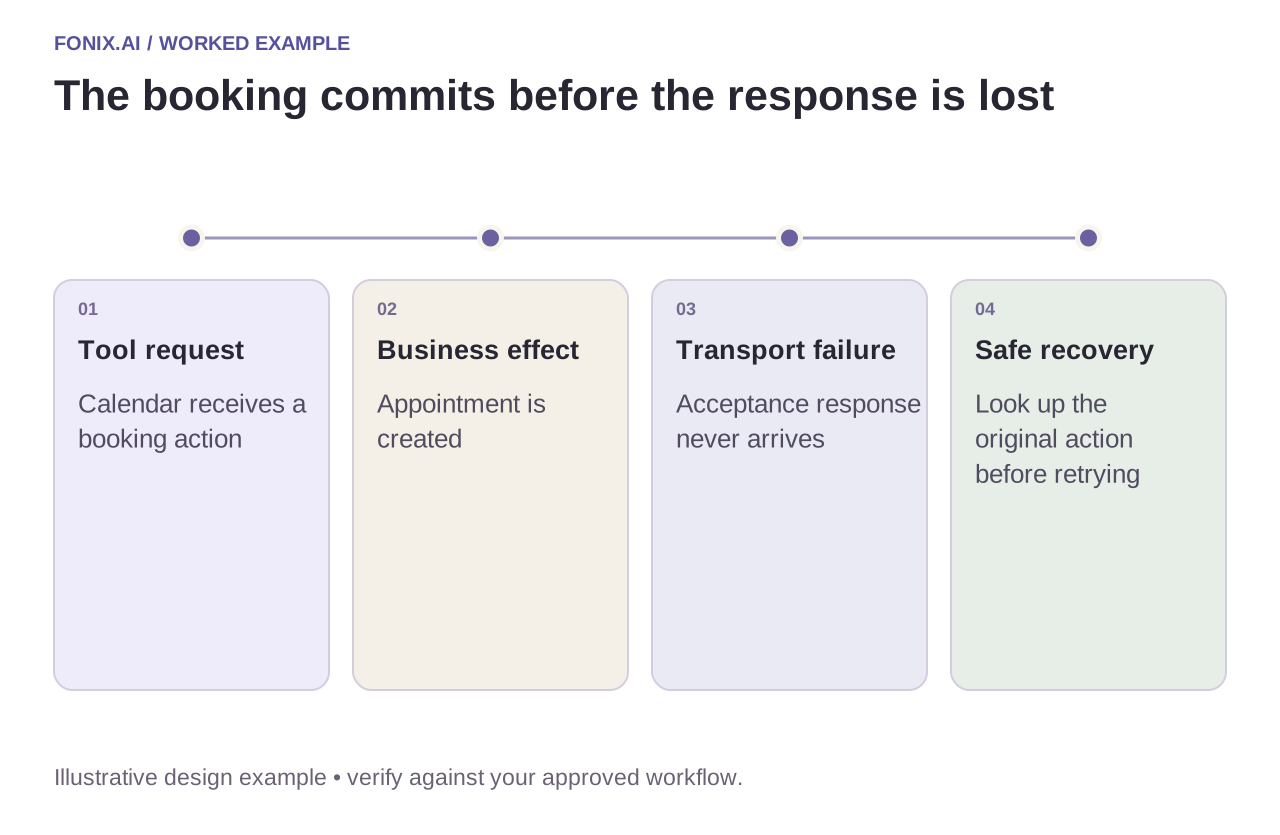
Worked example: a calendar accepts the booking before timeout
A fictional tool creates an appointment but the response is lost. Repeating the creation can reserve two slots. Query the existing action or booking through the supported reference before retrying. Until the result is known, the caller should hear that confirmation is pending, with an owned next step.
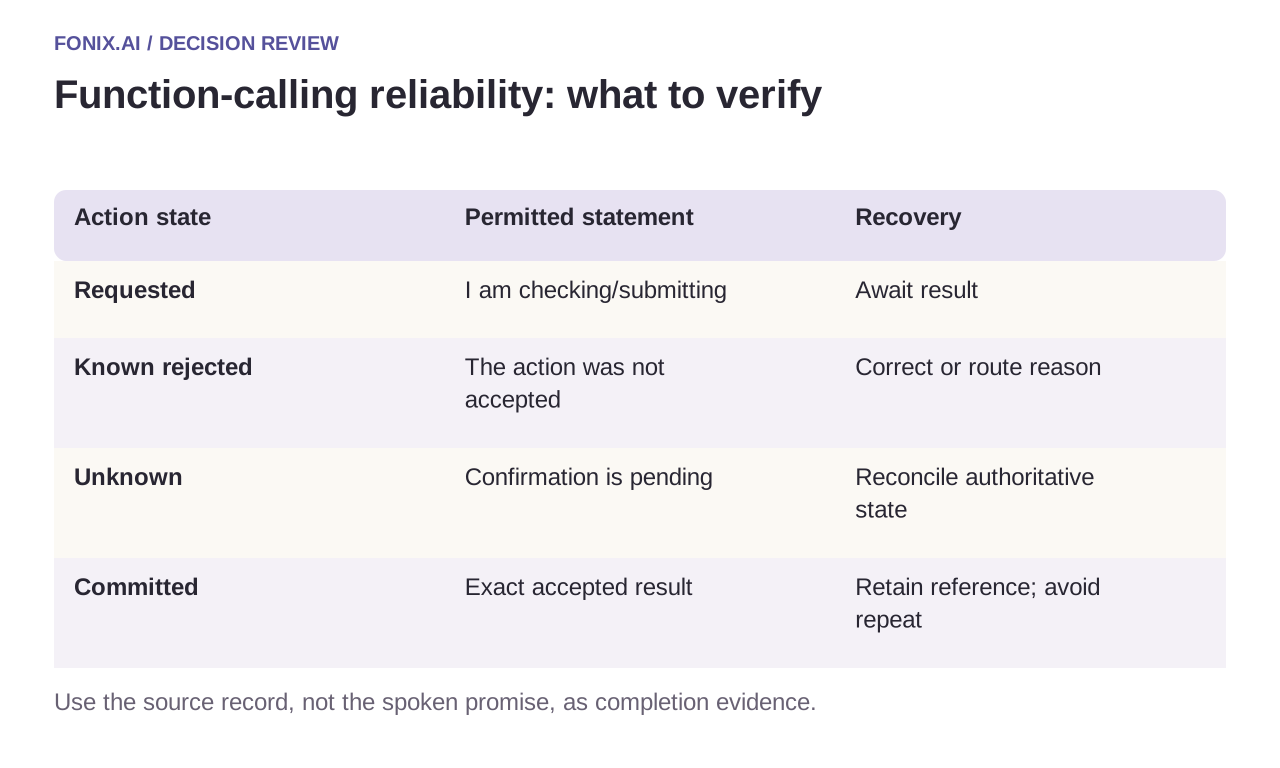
| Action state | Permitted statement | Recovery |
|---|---|---|
| Requested | I am checking/submitting | Await result |
| Known rejected | The action was not accepted | Correct or route reason |
| Unknown | Confirmation is pending | Reconcile authoritative state |
| Committed | Exact accepted result | Retain reference; avoid repeat |
Coordinate concurrency and cancellation
Two workers must not independently own the same consequential action. Use a unique key, transaction, lease or equivalent mechanism appropriate to the system. An idempotency key helps only where the receiving service actually enforces its meaning; otherwise maintain an integration ledger and supported lookup.
Cancelling speech does not cancel a committed write. If the caller changes their mind, inspect the action state and use the authorised reversal/change process. Record compensation separately; an attempted cancellation is not a completed rollback.
A lost-response and duplicate-action fault lab
Choose one consequential tool action with an inspectable authoritative result. Define stable action identity, permitted retries and a reconciliation owner. Use a test system where responses can be delayed or dropped without affecting real customers.
| Pilot case | Required behaviour |
|---|---|
| The calendar accepts a booking before the response is lost | Look up the original action/result before considering another create request. |
| Two workers process the same business action | Enforce a durable claim or the supported destination uniqueness mechanism. |
| Cancellation arrives during an unresolved create | Reconcile both intentions under the current-state rule rather than assuming execution order. |
Report requested, rejected, unknown, committed and reconciled actions with duplicates and lost work counted explicitly. Compare spoken promises with authoritative records. Tool transport success and customer-facing task correctness are related but different measures.
Does adding an idempotency key guarantee no duplicates everywhere?
Only if the receiving operation supports and enforces the intended contract. A locally generated key is still useful for correlation, but the integration needs durable ownership, supported destination semantics and a recovery path for ambiguous results.
Inject the failures that ordinary demos miss
Simulate a lost response after acceptance, a repeated completion event, two concurrent requests and caller hangup during execution. Inspect the business record and ledger. Measure duplicate effects, unresolved outcomes and false confirmations directly, with a documented test cohort.
Review a tool-action reliability test with one consequential workflow. n8n automation applies the pattern to events; high availability applies it to worker recovery; caller verification defines authority.