

A practical guide / Fonix.AI
Exotel integration: design and pilot guide
A worked scenario, illustrated decision review and a practical pilot worksheet.
Exotel voice integration needs a tested call flow
An Exotel AI voice agent integration should specify the number route, supported agent connection, transfer path and status-event mapping. An account with a working phone number does not establish that every streaming or transfer approach is available for that route.
Use this Fonix.AI guide to scope and test the actual Exotel configuration. Confirm the supported connection and commercial/account requirements with the deployment team; this page does not claim a universally available native connector.
Map the call flow before interpreting callbacks
Document where Exotel receives the call, which configured flow handles it and how the voice service joins. Record caller and destination legs separately. Define which callback identifies ringing, answer, bridge, hangup or failure for the supported path.
The official Exotel connection-mode guide provides the provider's current integration starting point. Match implementation details to the product and account in use rather than borrowing status meanings from another telephony vendor.
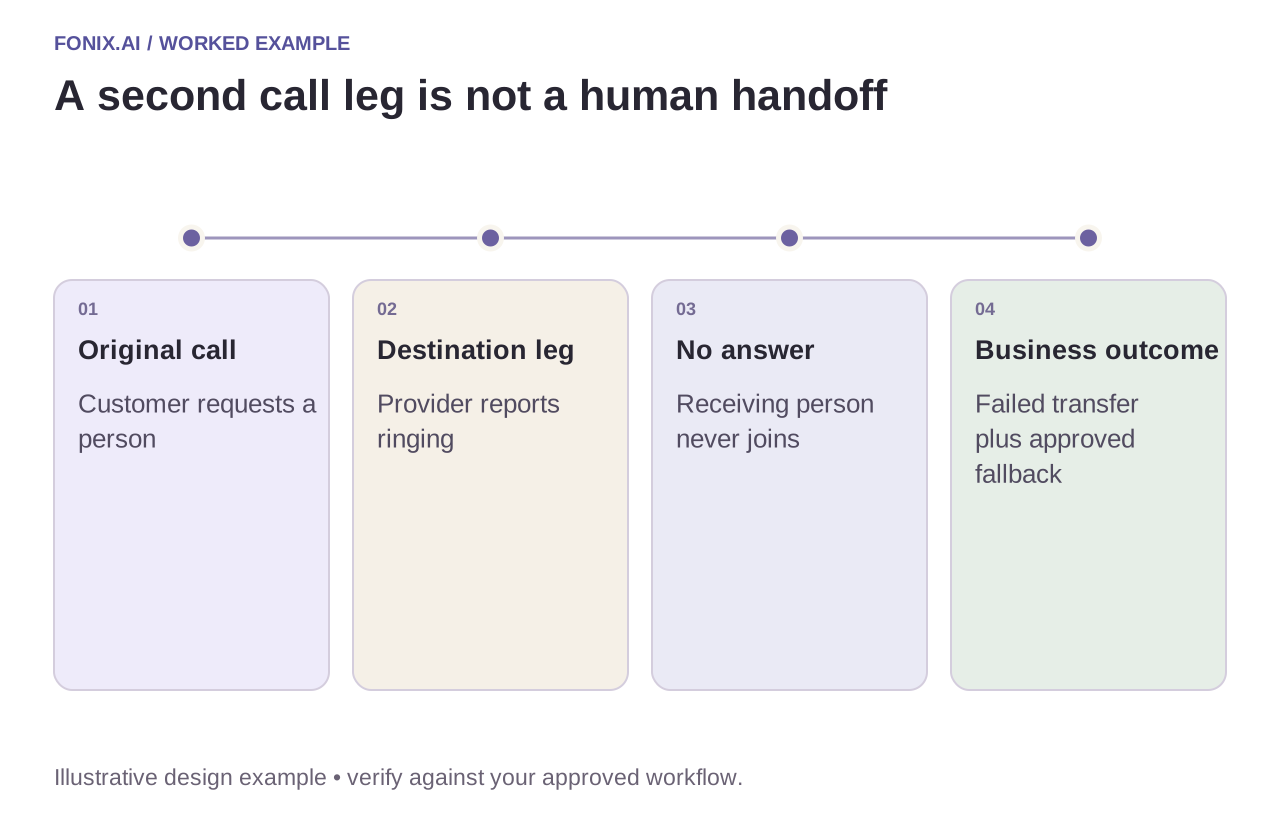
Worked example: a transfer destination rings but never joins
A fictional customer asks for a person. Exotel reports a destination attempt, but the receiving leg is not answered. The business record should show a failed or pending transfer and its approved fallback, not a successful human handoff because a second call leg exists.
| Provider evidence | Business interpretation | Additional check |
|---|---|---|
| Inbound call accepted | Call entered flow | Agent/media connection |
| Agent leg connected | Voice session possible | Two-way audio |
| Destination ringing | Transfer attempted | Human acceptance/bridge |
| Hangup/failure event | Leg ended | Which leg and final outcome |
Reconcile lifecycle events without losing context
Keep a mapping from provider references to the Fonix session and business task. Webhook retries should update one event record, not create another sales or support outcome. A late status from one leg must not overwrite the completed state of an unrelated leg.
Validate inbound provider requests using the supported security controls and keep account credentials server-side. Restrict diagnostic logs because phone numbers and routing details may be private. If a connection path fails, return the approved operational fallback and retain the reason for review.
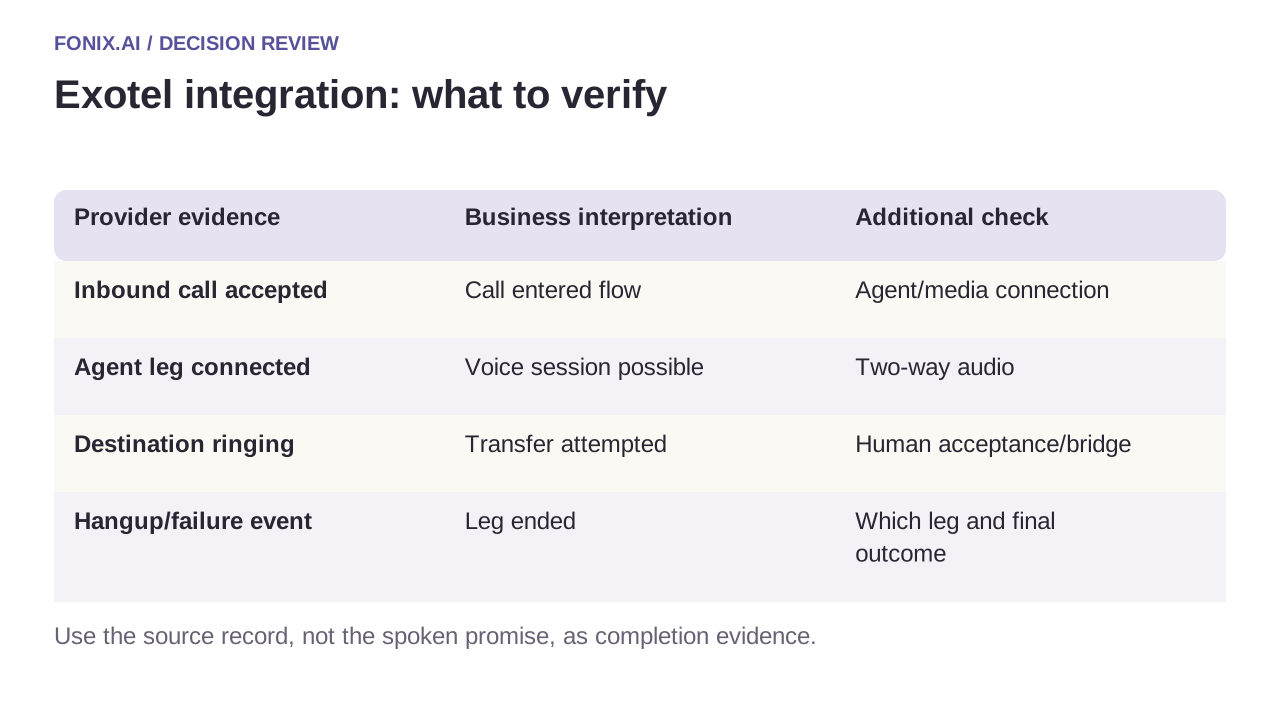
An account-specific Exotel call-path review
Document the Exotel account's selected connection mode and supported flow with the telephony owner. Use controlled numbers and sanitised callbacks. Confirm transfer behaviour on that path rather than importing assumptions from another Exotel configuration.
| Pilot case | Required behaviour |
|---|---|
| A destination leg rings but never joins | Keep the transfer incomplete and apply the agreed alternate route. |
| One leg ends while another remains active | Reconcile each leg and session independently before closing the business task. |
| A status callback is delivered twice | Update one mapped event without creating a duplicate CRM outcome. |
Count usable two-way sessions and completed requested outcomes separately from carrier-connected calls. Report unsupported path requirements and failed transfers explicitly. Provider documentation does not establish a deployed Fonix connector or every possible flow capability.
Does the guide mean Exotel is a Fonix partner or native connector?
No partnership or universal connector is claimed. It is a technical evaluation guide for teams using Exotel. Confirm the account's mode, permitted media/flow actions and tested integration before selecting it for a production workflow.
Prove both directions and teardown
Test inbound and outbound where in scope, caller hangup, destination busy and a duplicate callback. Listen from each endpoint and inspect the final provider/session mapping. Count completed business outcomes separately from carrier connections.
Review an Exotel calling path with your flow diagram and sanitised status samples. Warm-transfer design defines acceptance; SIP integration covers signalling/media troubleshooting. Official provider reference checked 15 October 2026.