

A practical guide / Fonix.AI
Knowledge retrieval: a practical implementation guide
A worked scenario, illustrated decision review and a practical pilot worksheet.
Knowledge retrieval should return an approved answer for this caller
Voice AI knowledge base retrieval should connect a spoken answer to current, permitted source material. Finding a semantically similar paragraph is insufficient when the policy changed, the document belongs to another client or the answer requires information the caller is not authorised to receive.
Use this Fonix.AI lab to evaluate document scope, freshness and answer grounding. It is a retrieval test design, not a promise that uploading documents automatically creates accurate production answers.
Give each source an owner, version and access scope
Inventory approved documents and identify who can publish changes. Preserve source identity, effective date and tenant or role restrictions. Retire superseded versions from the active answer path while retaining any separately authorised history.
Separate stable knowledge from live transactional data. A policy document may explain how refunds work; the status of a particular refund belongs to the authorised business system. Do not answer an account-specific question from a generic paragraph or an old transcript.
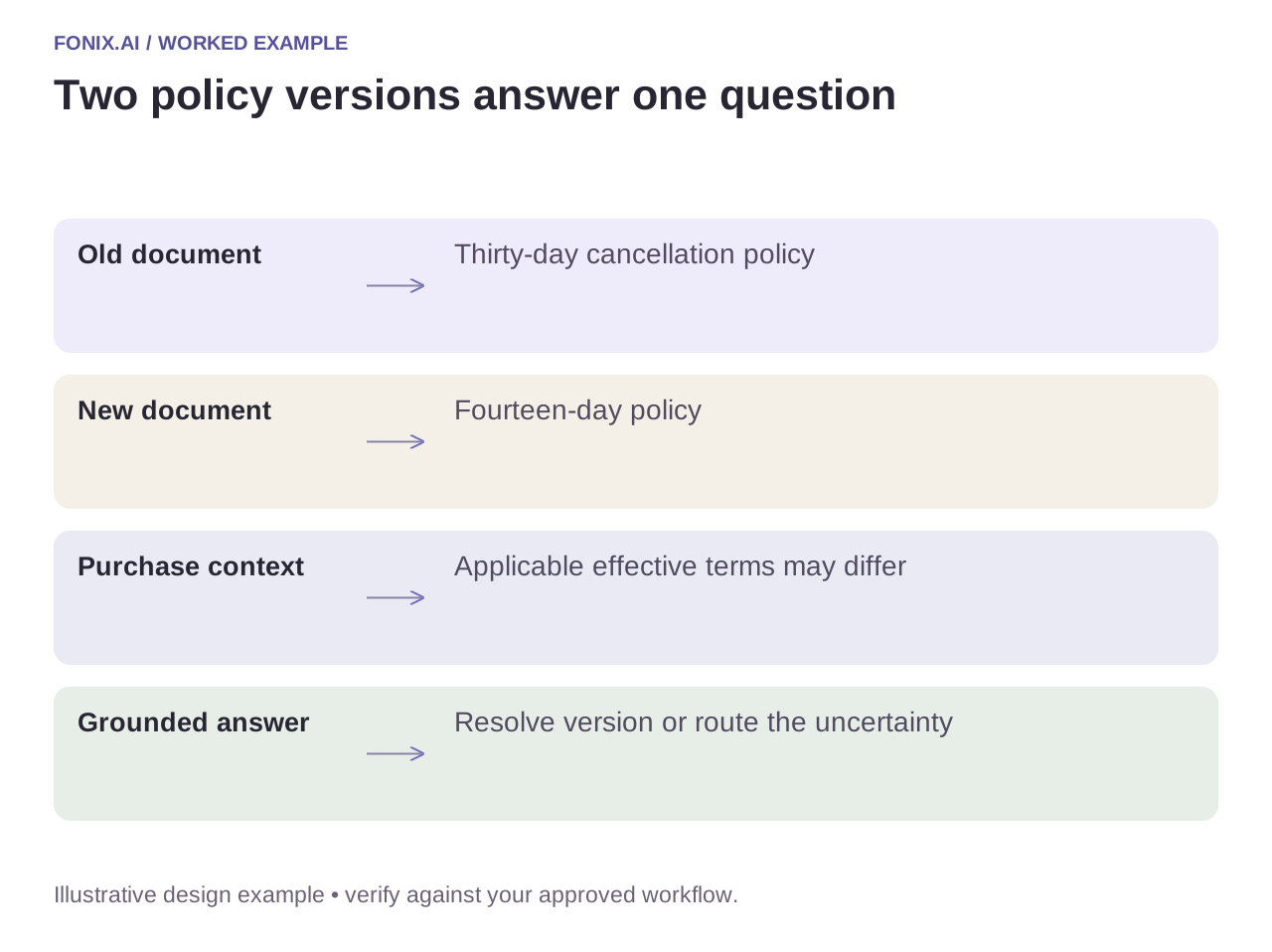
Worked example: two cancellation policies conflict
A fictional knowledge base contains an old thirty-day policy and a new fourteen-day policy. A caller's purchase may also be governed by an earlier version. Retrieval should resolve the relevant effective terms and business context, not average the documents or choose the more generous answer.
| Evaluation case | Expected behaviour | Evidence |
|---|---|---|
| Current answer exists | Use approved relevant source | Source/version mapping |
| Conflicting versions | Resolve effective policy or escalate | Version decision |
| Answer absent | State the limit and route | No invented policy |
| Restricted document | Exclude before disclosure | Access decision |
Keep document content separate from instructions
Retrieved text is evidence, not authority to change tool permissions or routing policy. A document containing an instruction to export records must not gain administrator status. Restrict tool actions independently and test indirect prompt injection with synthetic material.
For voice output, keep the answer concise enough to follow while preserving conditions that change the meaning. A short answer that omits an important exception can be misleading. Offer a supported written reference or human route when the question needs detail.
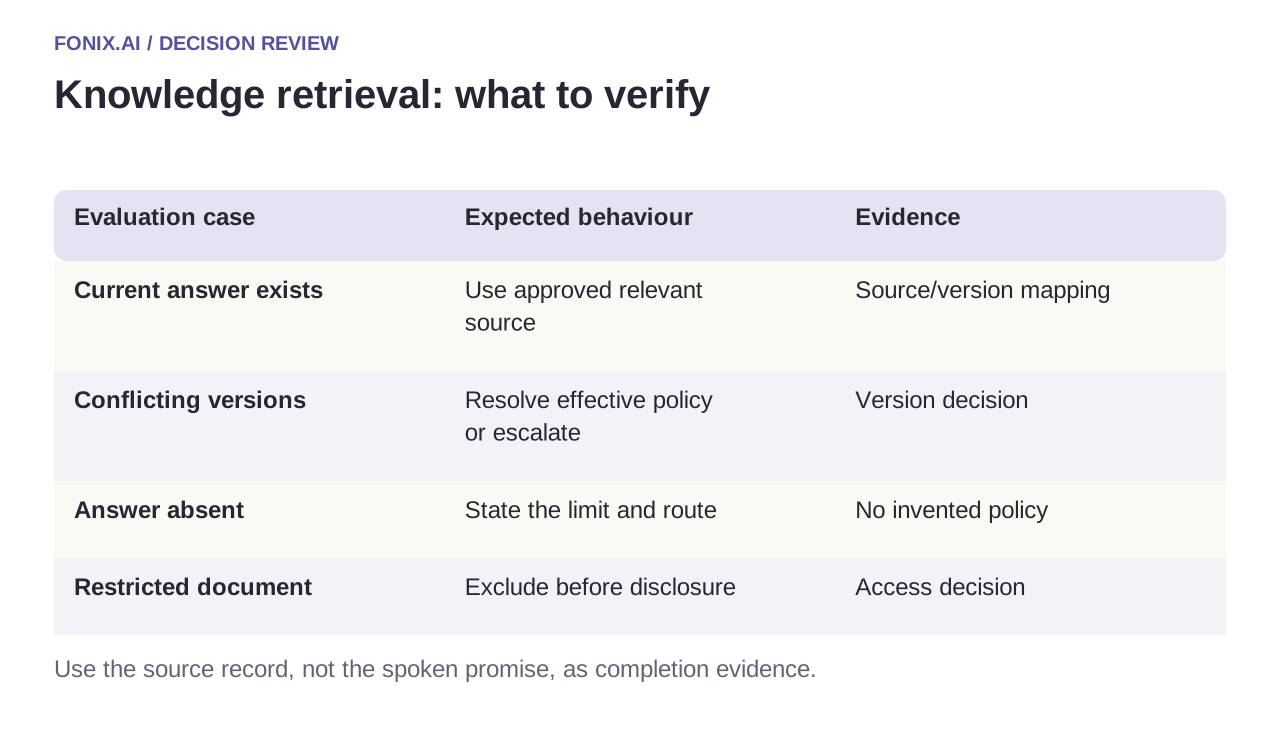
A scoped-source and conflicting-policy evaluation set
Build a test collection with superseded, current and restricted documents. Label source owner, effective context and approved audience. Create questions with known answers, missing answers and deliberate version conflicts.
| Pilot case | Required behaviour |
|---|---|
| Old and new cancellation policies both match the query | Resolve the purchase's applicable terms or request review; do not blend the two. |
| The best text match belongs to another tenant | Exclude it through trusted scope before any answer is disclosed. |
| No approved source supports the requested answer | State the limit and provide the owned escalation instead of inventing policy. |
Score answer support, applicable version, access correctness and useful abstention separately. Keep source-to-answer evidence for the reviewed test set. Fluent paraphrasing is not proof that a policy applies to the caller.
Does uploading documents make an agent production-ready?
No. Retrieval, permissions, version precedence and missing-answer handling need evaluation on the intended tasks. Document owners should approve updates and conflicting terms. Review what the agent actually says and which source supports it, not only whether search returned text.
Score grounding and usefulness together
Build questions with known answers, missing answers, conflicting versions and restricted sources. Have reviewers compare spoken claims with the approved evidence. Track unsupported claims, stale answers and successful handoffs, not only retrieval similarity scores.
Review a knowledge-grounding test set with approved documents and expected answers. Prompt-injection security covers untrusted instructions; retention covers indexed copies and lifecycle ownership.