
A practical guide / Fonix.AI
Manufacturing enquiries: a practical implementation guide
A worked scenario, illustrated decision review and a practical pilot worksheet.
A manufacturing voice bot must preserve the specification
A manufacturing voice bot can collect repeat-order enquiries and prepare quotation requests while a sales desk is occupied. Its value depends on preserving the exact item, unit, quantity, revision and requested delivery. A small transcription error can become a large procurement mistake.
Scope a Fonix.AI pilot as enquiry intake or an authorised repeat-order workflow. Agree which ERP records it can read and which commercial decisions require sales approval. Do not infer pricing authority, inventory reservation or production capacity from the ability to hold a conversation.
SKU, unit and drawing revision are separate fields
Resolve the customer's account through the approved process and ask for their item reference. Map customer part numbers to your catalogue explicitly. If a reference matches several revisions, ask which approved revision is required; a previous purchase is useful context, not permission to choose today's specification.
Read quantities with their units. Two hundred pieces, two hundred boxes and two hundred kilograms represent different orders. For made-to-order work, preserve the drawing reference and material requirement without letting the agent certify tolerances or substitute materials. Those decisions belong to authorised engineering or sales staff.
Worked example: cartons versus individual components
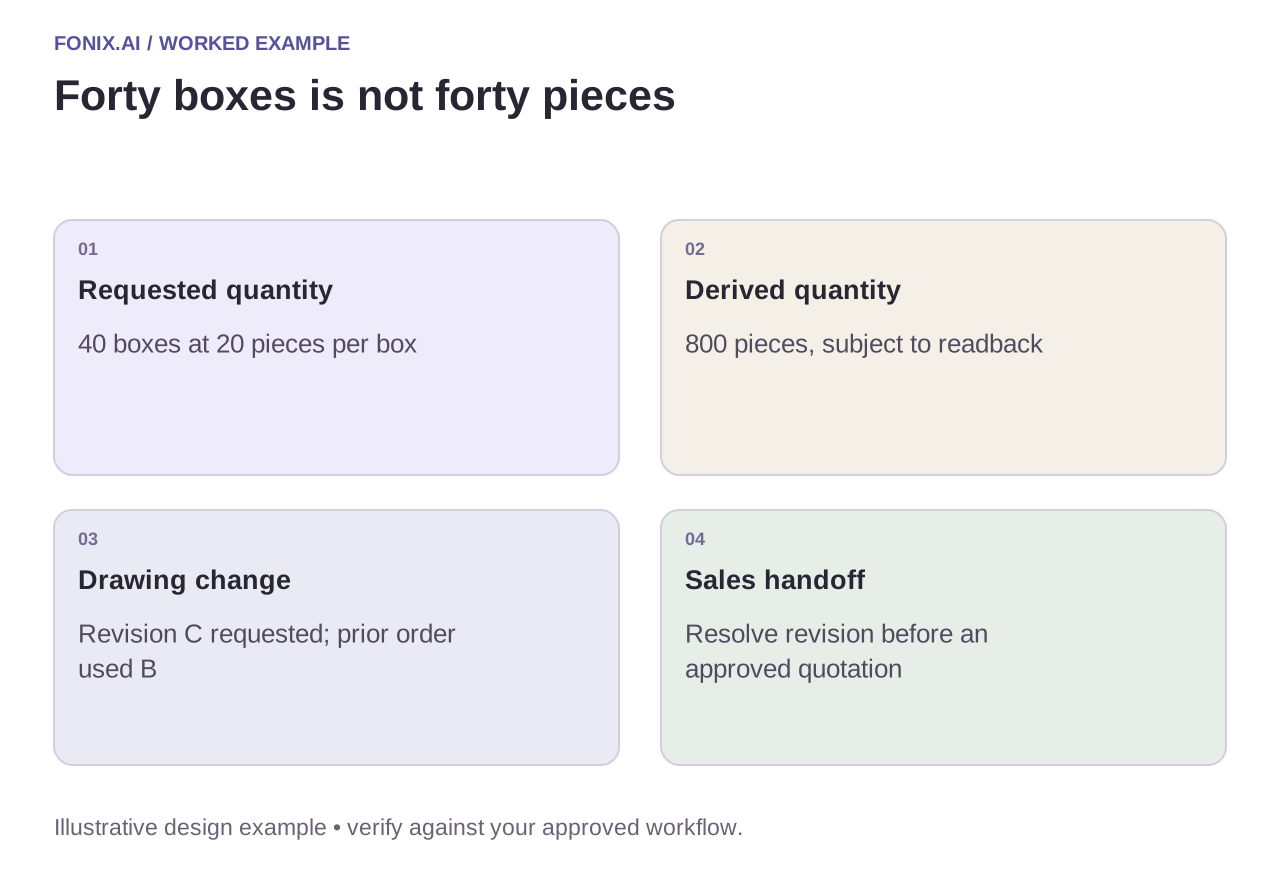
A fictional distributor asks for forty boxes of a fitting previously sold in packs of twenty. The current catalogue offers both loose pieces and packs. The intake should record forty boxes, the agreed pack size and the resulting piece quantity, then read the relationship back to the buyer.
Suppose the buyer adds that the new fitting must match drawing revision C, while the previous invoice used revision B. Retrieve the relevant catalogue or request engineering review. Reusing the old order without checking revision would preserve customer identity but lose the essential specification.
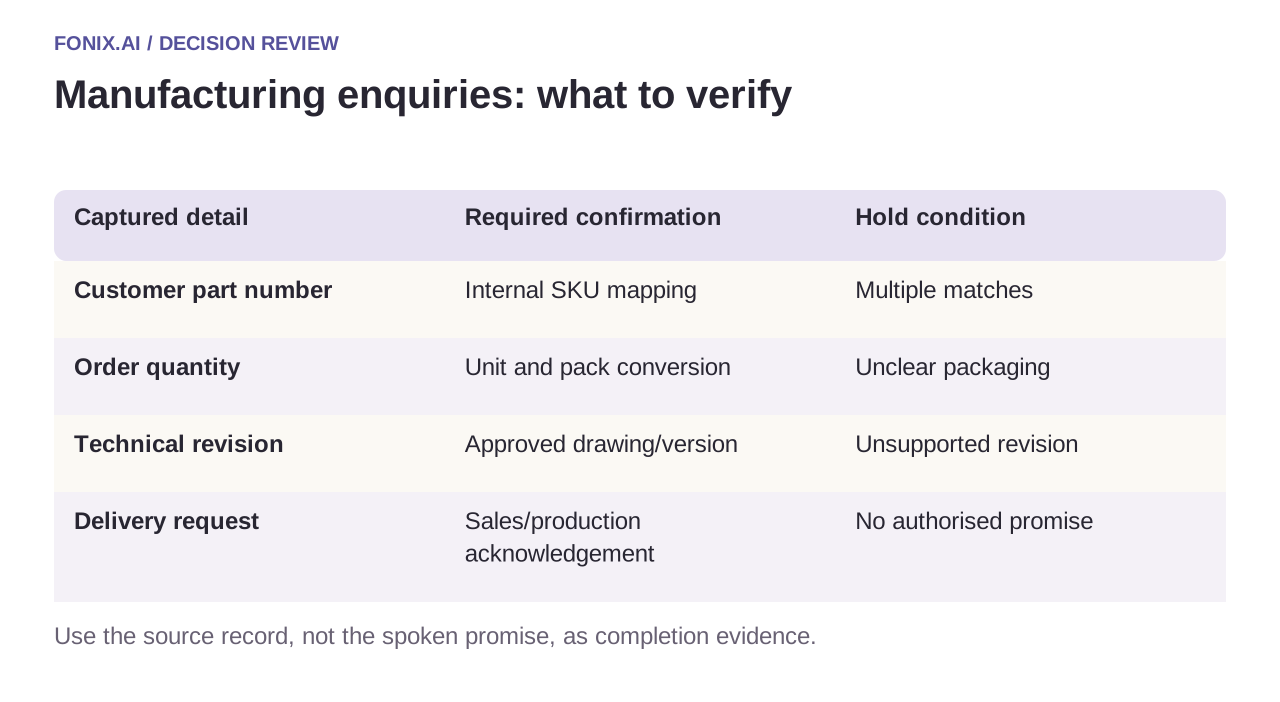
| Captured detail | Required confirmation | Hold condition |
|---|---|---|
| Customer part number | Internal SKU mapping | Multiple matches |
| Order quantity | Unit and pack conversion | Unclear packaging |
| Technical revision | Approved drawing/version | Unsupported revision |
| Delivery request | Sales/production acknowledgement | No authorised promise |
Keep quotation, sales order and production commitment distinct
An enquiry may become a quotation request, an approved quote, an accepted sales order and finally a production commitment. Each transition needs its own evidence. An available stock figure does not guarantee credit approval or transport availability; a caller accepting a price does not establish that the ERP created the order.
Attach a stable enquiry reference to every downstream action. If the sales-order write times out, look up its result before another submission. Capture any requested deviation as a review item, not as an invisible change to the catalogue. Return a concise brief to the salesperson containing exact fields, open questions and the buyer's required response date.
A specification checklist for sales and engineering
Use a sanitised part catalogue containing customer references, pack sizes and drawing revisions. Sales and engineering should agree the substitution and quotation boundaries. Start with enquiry capture if ERP order authority has not been demonstrated.
| Pilot case | Required behaviour |
|---|---|
| The customer asks for boxes but the SKU is sold as pieces | Confirm pack size and read back both quantities before submitting the enquiry. |
| The requested revision differs from the previous invoice | Resolve the approved drawing or obtain engineering review; do not copy the old specification. |
| A sales-order response is lost after acceptance | Search by the durable enquiry/action reference before considering another submission. |
Score exact item, unit, quantity and revision fields against the buyer-approved request. Report sales clarification time and unsupported commitments alongside that score. Transcript accuracy alone can miss the one digit that changes a purchase order.
Can a repeat order skip specification confirmation?
Previous orders help identify the likely item, but they do not authorise the same revision, packaging or destination today. Confirm consequential fields and use the business's approved repeat-order rules before creating an order or quoting availability.
Evaluate errors in business units
Test spoken alphanumeric part numbers, corrected quantities, obsolete revisions and an account with several delivery sites. Score exact SKU/unit/revision capture and sales rework, not just transcript word accuracy. Review every unsupported price or delivery assurance as a separate failure even when the rest of the call is correct.
Review a manufacturing enquiry workflow with a sanitised item catalogue and quote approval map. See names and numbers recognition for readback tests and Odoo integration for a version-aware ERP mapping example.
Once an order is ready to move, freight pickup coordination checks the dock, release documents and carrier acknowledgement. An accepted sales order does not establish pickup readiness.