

A practical guide / Fonix.AI
Travel booking changes: a practical implementation guide
A worked scenario, illustrated decision review and a practical pilot worksheet.
Travel changes need an approved itinerary, not a confident answer
A travel agency voice bot can identify a booking, understand the traveller's proposed change and prepare an accurate service request. Reissuing a ticket is a separate action. Fare conditions, carrier availability, traveller permissions and payment approval determine whether that action can proceed.
For a Fonix.AI pilot, choose a narrow task such as collecting change requests and returning an agent-approved quote. Confirm the booking-system access and which operations remain with the travel desk. Do not present general language understanding as authority to change any airline or rail booking.
Separate passenger identity, intent and ticket state
A booking reference may contain several passengers and multiple journey legs. Ask which passenger and which segment should change. Establish whether the traveller wants an earlier departure, a date change, a cancellation or information about a possible change. These requests should not share one generic “modify booking” action.
Read back airports or stations as well as cities. Two airports serving one city are not interchangeable. Preserve the local departure date and timezone, especially for overnight journeys. Retrieve the current ticket status before quoting; an already changed or checked-in booking may require a different process.
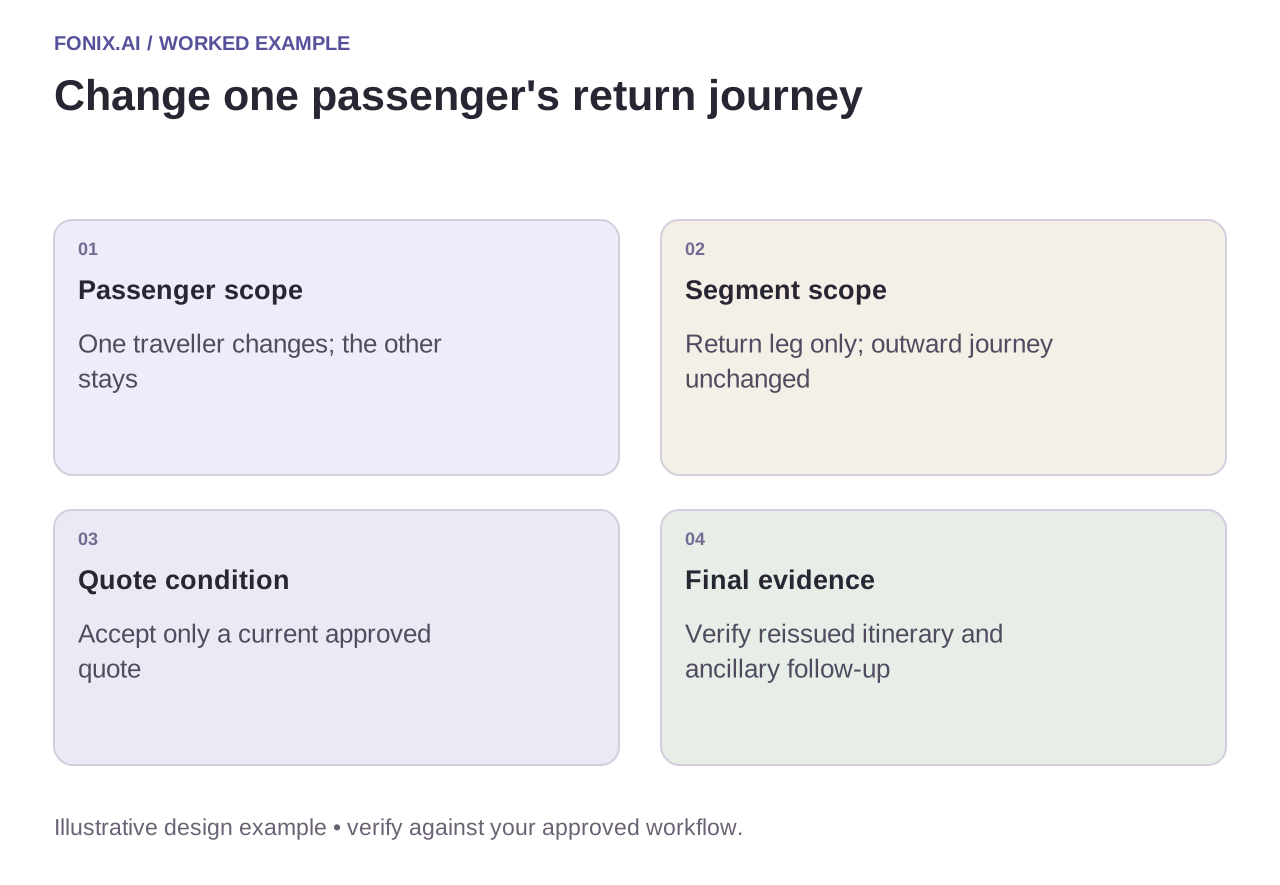
Worked example: one traveller changes the return leg
A fictional booking contains two passengers travelling out together. One person asks to return a day later; the other keeps the original itinerary. The intake should specify the changing passenger, return segment, preferred date and acceptable alternatives. It must not apply the request to every passenger or both directions.
The travel desk returns a quote with a fare difference, fees, inclusions and an expiry time. If the traveller calls after expiry, retrieve a new quote. Agreement to an expired amount does not authorise an unknown replacement price. If a payment succeeds but reissue is unresolved, the next owner needs both references and the exact outstanding step.
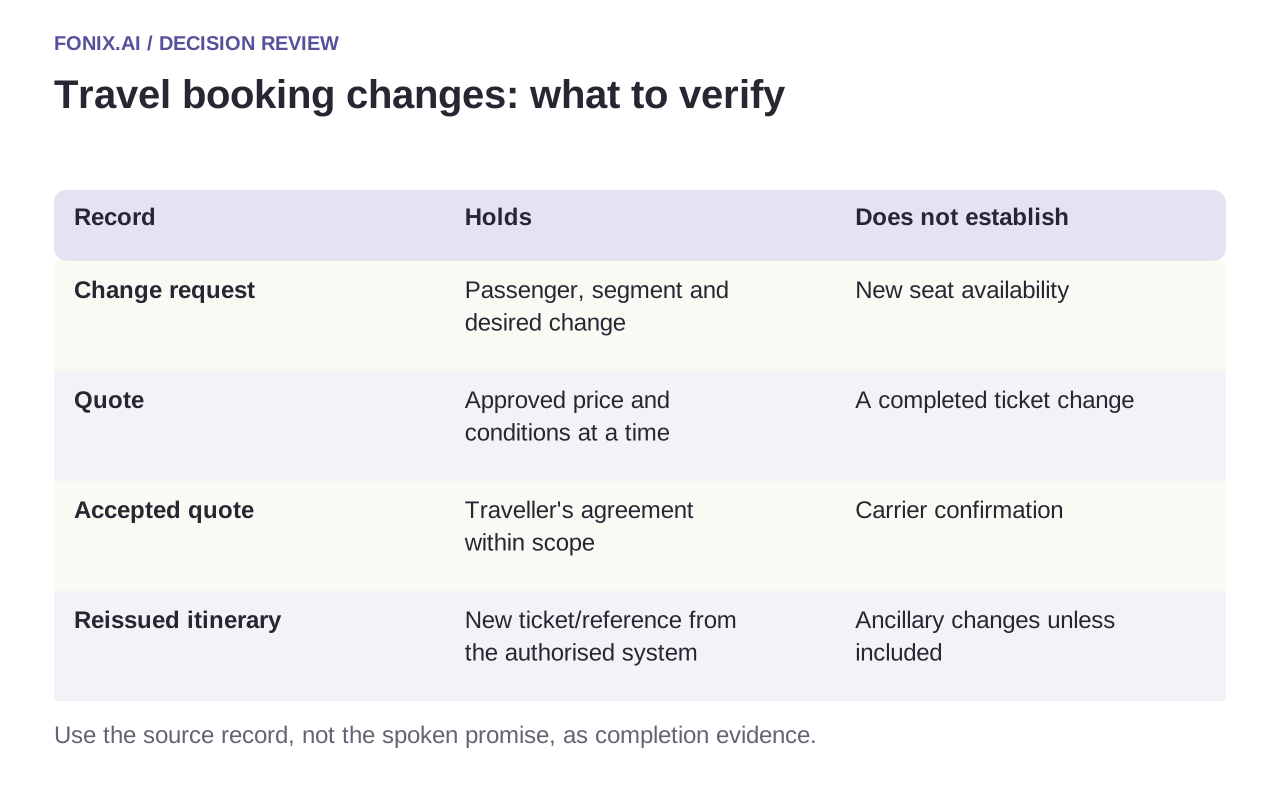
| Record | Holds | Does not establish |
|---|---|---|
| Change request | Passenger, segment and desired change | New seat availability |
| Quote | Approved price and conditions at a time | A completed ticket change |
| Accepted quote | Traveller's agreement within scope | Carrier confirmation |
| Reissued itinerary | New ticket/reference from the authorised system | Ancillary changes unless included |
Prevent a partial change from disappearing
Keep itinerary, payment and ancillary services as separate linked states. A new flight does not automatically move a hotel booking, wheelchair request or airport transfer. Create the relevant follow-up tasks only where the agency actually owns those services.
For a timeout, check the booking history before another reissue attempt. For a caller correction, preserve the final approved itinerary and invalidate the superseded request. If the agency cannot act on a carrier-controlled ticket, identify the correct service route and explain the limit without suggesting a change has been submitted.
An itinerary-change handoff the travel desk can audit
Choose one change-intake process and use fictional itineraries with several passengers and legs. Ask the travel desk to provide approved fare-condition wording, quote validity and the system states it will accept as evidence of reissue.
| Pilot case | Required behaviour |
|---|---|
| Only one passenger changes a return segment | Preserve everyone else's itinerary and list the exact affected passenger and leg. |
| The customer accepts after the quote expires | Request a current approved quote; do not substitute an unknown price. |
| Payment succeeds but reissue times out | Link both references and assign reconciliation before any second payment or reissue attempt. |
Score correctly scoped requests against the authorised final itinerary, including passenger and segment accuracy. Track rework and unresolved payment/reissue pairs. A change request captured during a call is not a ticket changed during that call.
Can the agent promise a fare before the desk approves it?
It can explain an approved, current quote within its stated conditions. General fare knowledge or an old search result is insufficient. Where authority remains with the travel desk, collect preferences and return an owned quote request instead.
Test the expensive misunderstandings
Use scenarios with two travellers, a midnight departure, a changed airport, an expired quote and an unknown reissue result. Inspect the service request and final itinerary together. Report correctly completed changes, agent rework and unauthorised-change attempts separately; call completion is not ticket completion.
Review an itinerary change workflow with a sanitised booking and approved fare-policy example. See caller verification for access boundaries and function-calling reliability for ambiguous writes.
A changed journey can leave accommodation unresolved. The hotel reservation guide explains room-night inventory and hold expiry; do not assume a ticket reissue also changes the hotel booking.