

A practical guide / Fonix.AI
Freshdesk integration: design and pilot guide
A worked scenario, illustrated decision review and a practical pilot worksheet.
Freshdesk voice integration needs a ticket owner and the right status
A Freshdesk AI voice agent should leave support with a correctly associated ticket, a clear customer request and an accountable next action. Creating a fresh ticket for every call can inflate workload, fragment the history and interfere with the team's response process.
Use this Fonix.AI design to scope one Freshdesk workflow. Connector support, custom fields, automation effects and account access need to be demonstrated for the deployment rather than inferred from a generic helpdesk integration claim.
Define requester, ticket and follow-up rules
Resolve the caller through the approved identity flow and locate a matching open issue. Separate the requester from the agent or group responsible for the ticket. Specify which custom fields are required and which status transitions the integration may make.
The Freshdesk API reference documents contacts, tickets and ticket updates. Use the account's actual status values and automation configuration. API transport success alone does not establish that a receiving team has accepted the work.
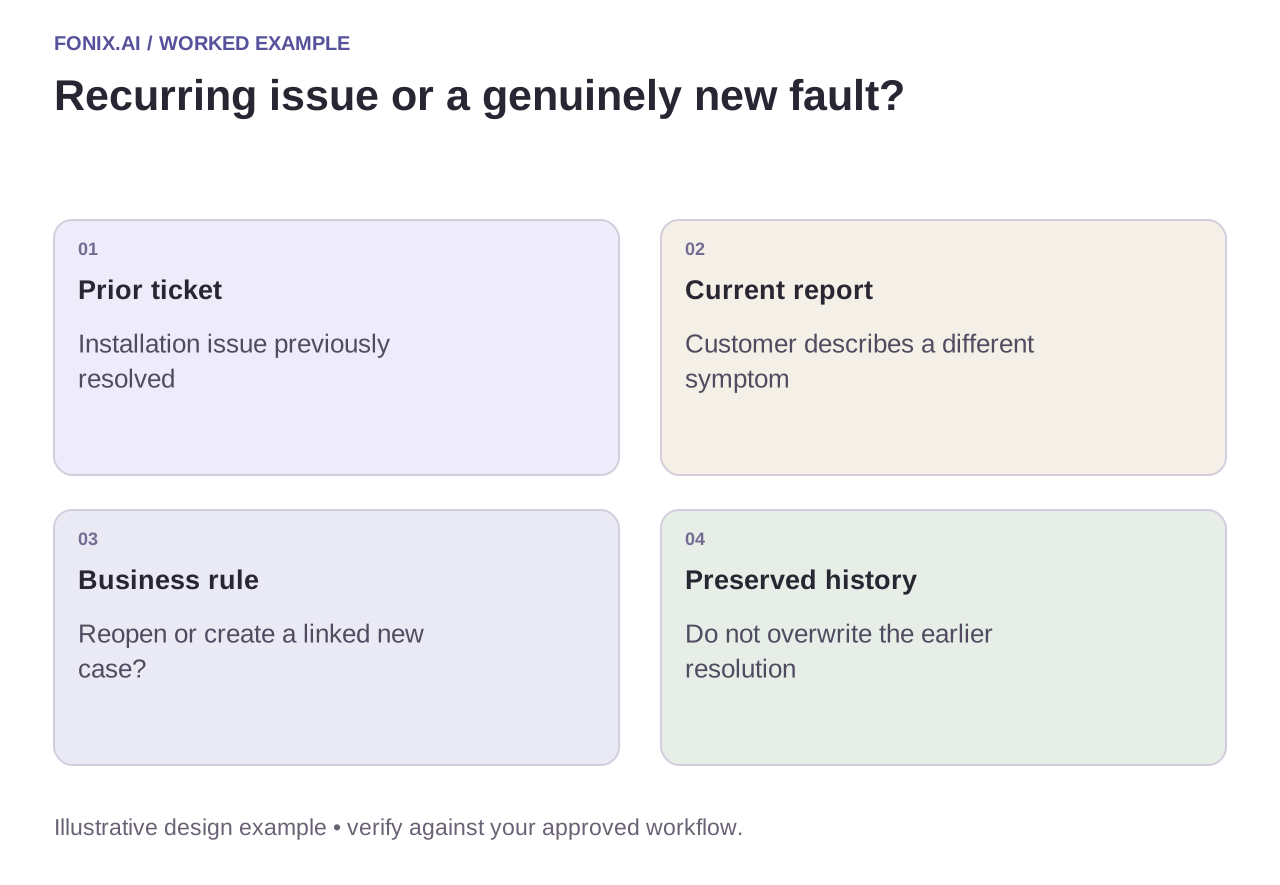
Worked example: a resolved issue returns with a new symptom
A fictional customer calls about a previously resolved installation issue but now describes a different fault. The business rule should determine whether to reopen the old ticket or create a linked new case. The model should not choose solely because the last ticket was easy to find.
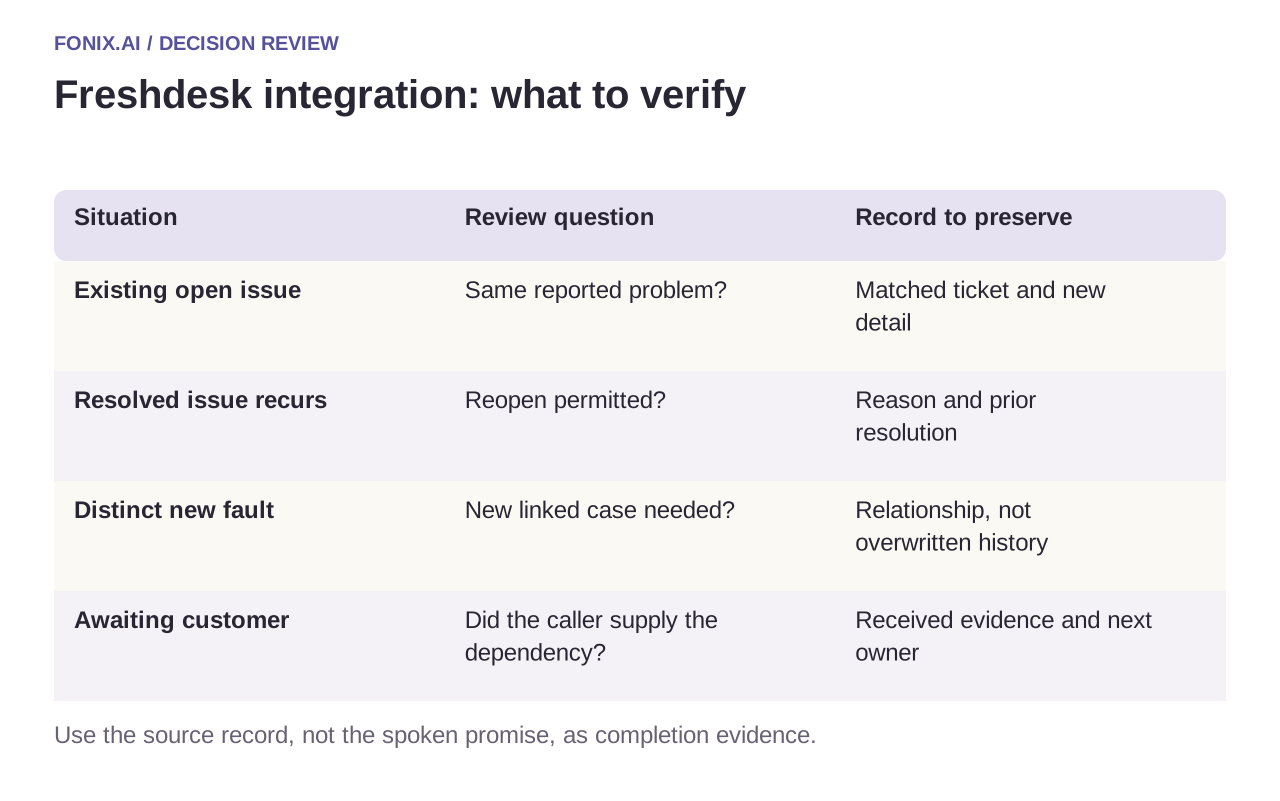
| Situation | Review question | Record to preserve |
|---|---|---|
| Existing open issue | Same reported problem? | Matched ticket and new detail |
| Resolved issue recurs | Reopen permitted? | Reason and prior resolution |
| Distinct new fault | New linked case needed? | Relationship, not overwritten history |
| Awaiting customer | Did the caller supply the dependency? | Received evidence and next owner |
Keep SLA-relevant actions intentional
Status changes and assignments may affect downstream timers or automations. Test those effects with the support administrator. Do not use “resolved” as a convenient way to end an automated call when the underlying issue still awaits a person or part.
Maintain one durable action reference per call outcome. If adding a note succeeds and assignment fails, preserve the partial result and retry only the missing action after checking its state. Give the caller the actual next step and keep unsupported appointment promises out of the summary.
A Freshdesk case-state and ownership rehearsal
Use a Freshdesk test account with required custom fields, group assignments and representative status rules. Ask the support administrator to document automation and timer effects for the permitted updates.
| Pilot case | Required behaviour |
|---|---|
| A resolved issue returns with a different symptom | Apply the reopen-versus-linked-new-case rule while preserving the previous history. |
| A mandatory custom field is missing | Keep the action blocked and visible rather than inventing a value. |
| A note succeeds but group assignment fails | Retain the note and recover the missing assignment after checking current state. |
Measure correctly associated, actionable cases with an accountable next owner. Include false resolutions, duplicate tickets and manual clarification. Ticket creation rate alone can rise while customer service becomes harder.
Can we mark a case resolved when the caller is satisfied with intake?
Use the support team's actual resolution policy. A customer may appreciate the conversation while an engineer, part or approval is still pending. Preserve the unresolved dependency and status instead of using resolution as a convenient closing label.
Verify the support team's ability to act
Test a repeated call, a closed issue, a required custom field and an unavailable receiving group. Inspect the final ticket, visibility and automation effects. Measure accurate ownership and avoidable rework, not just created-ticket counts.
Bring your ticket states and routing rules to review Freshdesk voice integration. Warm transfers cover live acceptance; function reliability covers partial and unknown writes. Official API reference checked 15 October 2026; validate fields and permissions in your account.