

A practical guide / Fonix.AI
Indian-language TTS: a practical implementation guide
A worked scenario, illustrated decision review and a practical pilot worksheet.
Indian-language TTS should be evaluated on business text
Indian language TTS evaluation for voice agents should measure whether listeners understand the names, numbers, dates and conditions the business needs to convey. A pleasant isolated sentence can hide pronunciation errors or streaming behaviour that makes a real phone conversation difficult.
This Fonix.AI lab defines a corpus and review rubric. It does not claim one voice performs equally in every language or publish an unmeasured naturalness score. Choose languages and channel conditions that reflect the intended audience.
Build the corpus around consequential words
Include local names, branch locations, product identifiers, amounts, dates and mixed-language phrases from sanitised or synthetic examples. Add abbreviations and punctuation that affect spoken meaning. Keep the approved intended reading with each item.
Separate text normalisation from synthesis. An amount expanded incorrectly before synthesis can sound natural while conveying the wrong value. Test the full text-to-audible pipeline, including phone encoding, streaming and playback, rather than judging a studio-quality file alone.
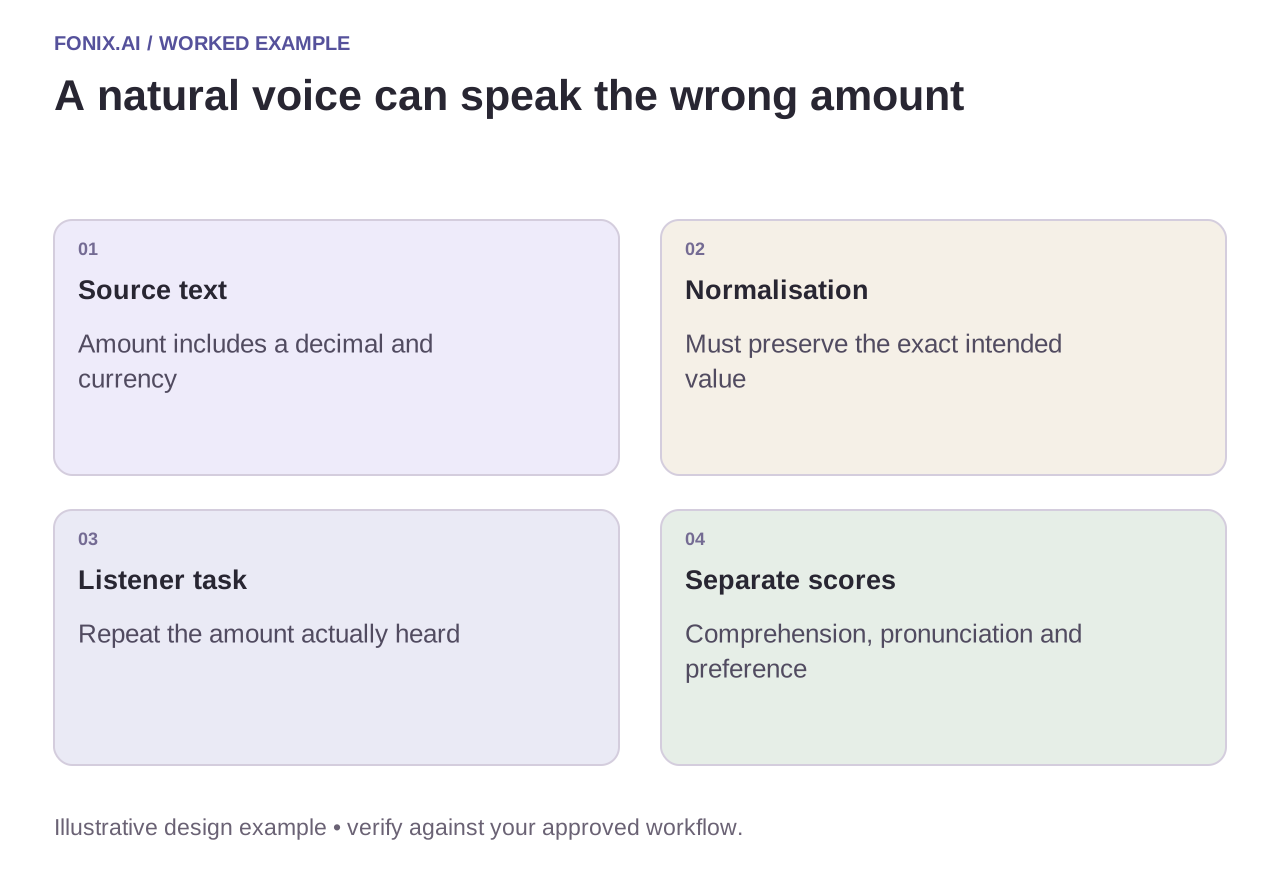
Worked example: a decimal amount sounds like separate digits
A fictional payment message contains an amount with a decimal and currency. Review whether listeners hear the intended amount, not merely whether the voice sounds smooth. Test local numbering conventions deliberately, and preserve the exact business value through any text expansion.
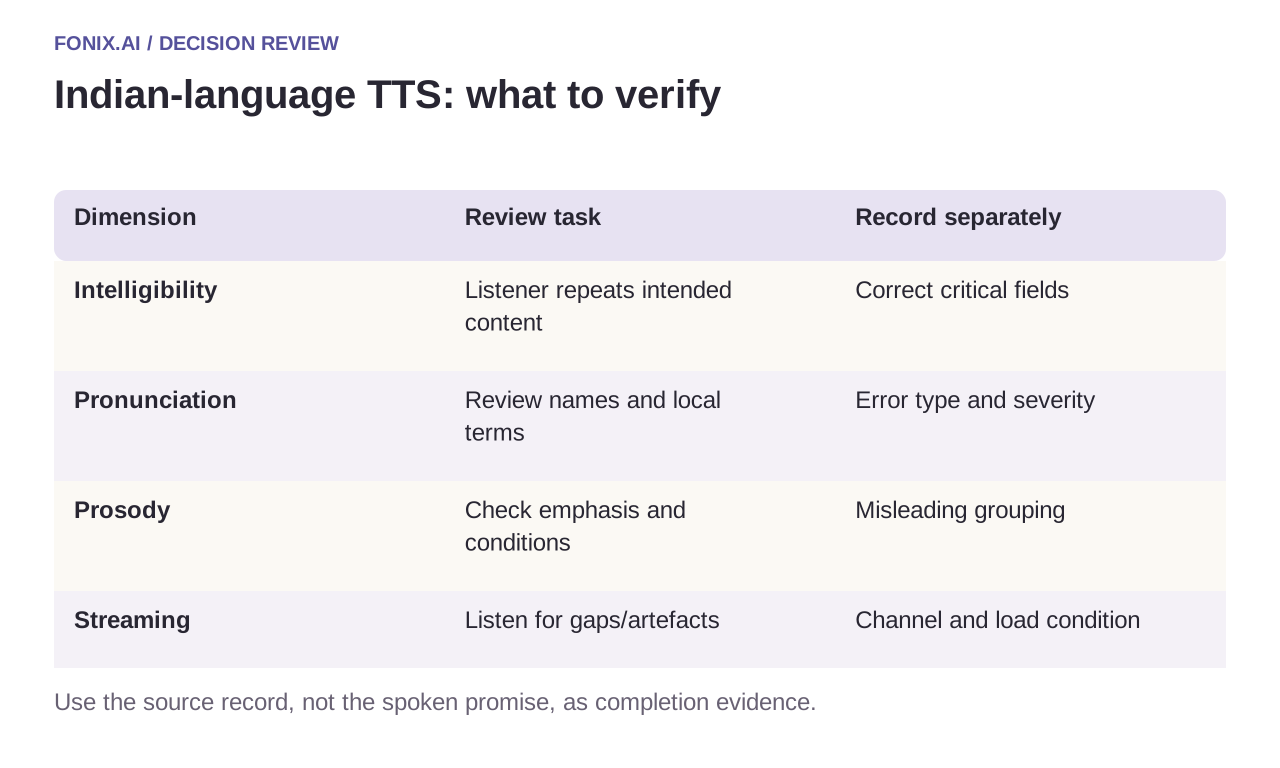
| Dimension | Review task | Record separately |
|---|---|---|
| Intelligibility | Listener repeats intended content | Correct critical fields |
| Pronunciation | Review names and local terms | Error type and severity |
| Prosody | Check emphasis and conditions | Misleading grouping |
| Streaming | Listen for gaps/artefacts | Channel and load condition |
Use independent listeners and clear questions
Recruit reviewers with the relevant language competence and define the rubric before listening. Keep comprehension tasks distinct from preference ratings. A listener may prefer a voice that is less accurate on a particular name.
Randomise samples where practical and record reviewer count, corpus scope and any excluded items. Avoid comparing systems using different source text or audio channels. Keep accessibility and comfortable speaking pace in the review alongside business precision.
A business-text listening panel protocol
Choose the intended languages and telephone channel. Build a synthetic corpus of local names, addresses, dates, decimal amounts and mixed-language product terms. Keep exact business values and approved spoken forms alongside the source text.
| Pilot case | Required behaviour |
|---|---|
| A decimal amount sounds like separate unrelated digits | Have listeners repeat the intended value, currency and unit before scoring intelligibility. |
| A product name crosses languages within a sentence | Review pronunciation and meaning with listeners familiar with that usage. |
| Text expansion changes a number's value | Reject the transformation even if the generated speech sounds natural. |
Report listener agreement and correct critical fields by language and channel, alongside pronunciation severity and streaming artefacts. Record sample counts and review procedure. Do not turn a small set of favourable demos into a universal naturalness score.
Is one native speaker's preference enough to choose a voice?
It is useful feedback, but not a complete evaluation. Use independent listeners, clear questions and representative business text. Separate intelligibility, pronunciation and style preference so the most pleasant sample does not hide a consequential amount or name error.
Report scoped results and unresolved terms
Publish observations by language, field type and channel with sample counts. Maintain an error list and approved correction process for recurring terms. Do not turn a small pilot into a blanket “human-like in every language” claim.
Review an Indian-language TTS corpus with your essential names and spoken values. Multilingual evaluation covers conversation understanding; latency measurement covers audible turn timing; critical-field recognition covers the input side.