

A practical guide / Fonix.AI
Salon reception: a practical implementation guide
A worked scenario, illustrated decision review and a practical pilot worksheet.
A salon AI receptionist needs service, stylist and resource capacity
A salon AI receptionist should book a service interval that the branch can deliver with the right stylist, chair and equipment. A free calendar slot is insufficient when colour processing, wash stations or overlapping staff responsibilities affect capacity.
Evaluate Fonix.AI with one branch, a current service menu and an approved booking-system connection. Confirm whether the outcome is a committed appointment or a request for staff review. Medical consultation scheduling belongs in the clinic guide.
Translate the request into a bookable service
Ask for the service and any stylist preference using the branch's approved menu. Clarify ambiguous names without recommending a treatment the business has not approved. Record quoted prices and duration from the current catalogue; a starting price should not become a final charge for an unassessed service.
Check the full resource interval, including preparation and cleanup where required. Multi-stage services may release a stylist during processing but still occupy a chair. Use the booking system's actual capacity model rather than assuming all time is interchangeable.
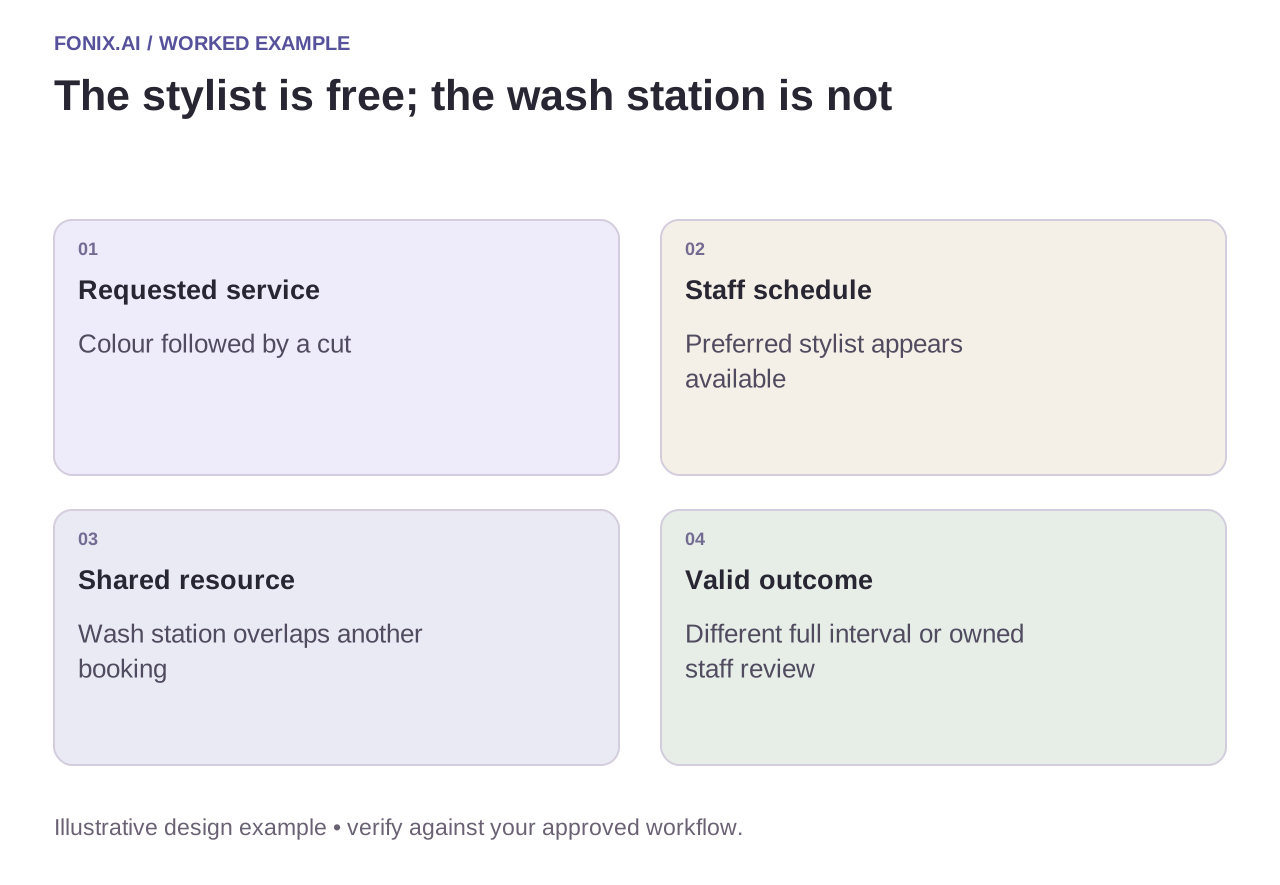
Worked example: the stylist is free but the wash station is not
A fictional caller requests a colour service followed by a cut. The preferred stylist is available, but the required wash station overlaps another appointment. Offer a valid alternative interval or staff review; do not confirm a slot based only on the stylist's calendar.
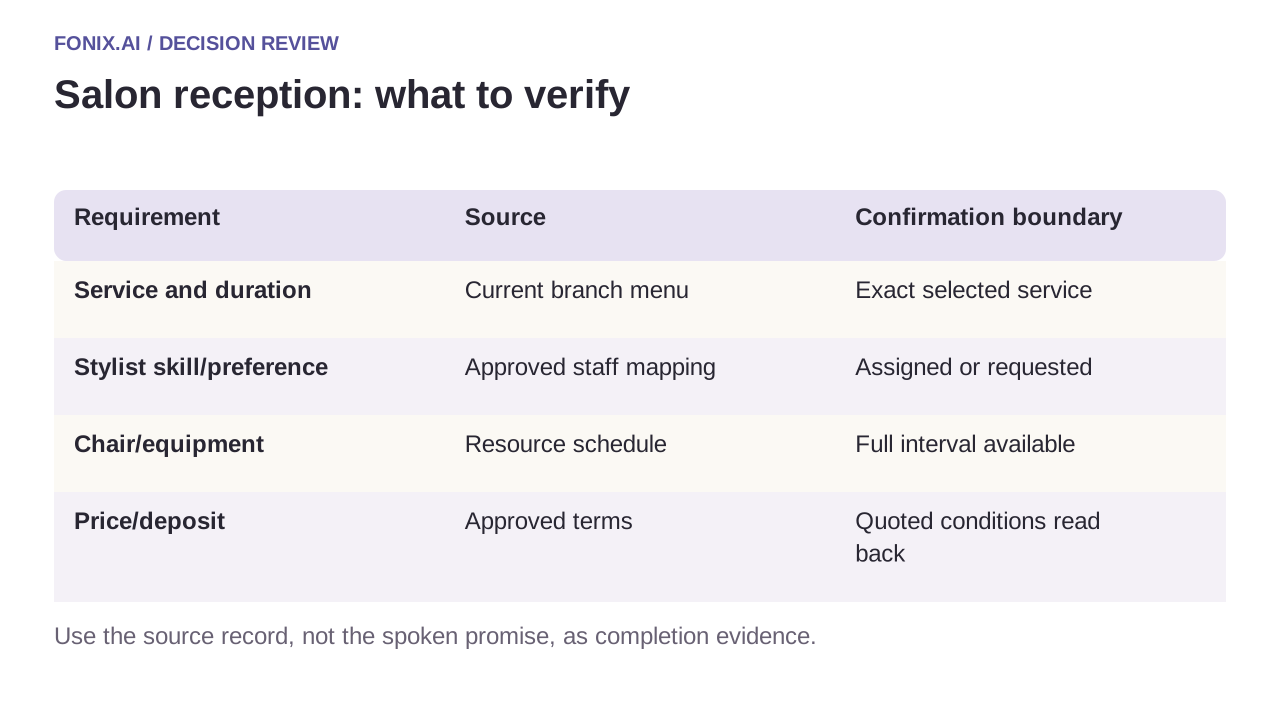
| Requirement | Source | Confirmation boundary |
|---|---|---|
| Service and duration | Current branch menu | Exact selected service |
| Stylist skill/preference | Approved staff mapping | Assigned or requested |
| Chair/equipment | Resource schedule | Full interval available |
| Price/deposit | Approved terms | Quoted conditions read back |
Handle changes without double booking
Retrieve the original booking before rescheduling. Release the old interval only through the booking system's supported change process, and preserve the reference. If the new write times out, reconcile it before creating another appointment.
Keep allergies, suitability questions and requests outside the approved intake scope with trained staff. The agent should not interpret a customer's description as professional clearance. Record the question and receiving owner without exposing unnecessary personal details in a general salon note.
A busy-Saturday salon resource rehearsal
Use one branch's current service menu, durations, stylist capabilities and chair/equipment schedules. Include approved deposit wording and the staff owner for uncertain service combinations. Start with synthetic appointments around busy intervals.
| Pilot case | Required behaviour |
|---|---|
| The stylist is free but the wash station overlaps | Offer a valid full-resource interval or staff review instead of confirming the stylist calendar alone. |
| A caller changes a cut into a longer colour service | Recalculate duration, skill and equipment needs before keeping the time. |
| A reschedule fails after a new slot is requested | Preserve the accepted original until the supported change process establishes the replacement. |
Count appointments that staff and resources can honour divided by all spoken confirmations. Include duplicate reservations, avoidable desk clarification and misquoted service terms. Booking volume alone can rise while the salon floor becomes harder to run.
Can the agent choose a technical treatment for the caller?
Keep service selection within the salon's approved intake and booking rules. Where consultation is needed, book or request that consultation rather than inventing a technical recommendation. Stylist preferences should remain requests unless the resource is actually assigned.
Test the busy-Saturday combination
Include a combined service, a preferred stylist, an unavailable resource and a late cancellation. Compare spoken confirmations with the actual branch schedule. Measure appointments staff can honour, duplicate bookings and rework caused by missing details.
Review a salon booking flow with your menu and resource rules. Appointment reminders cover attendance follow-up, while restaurant reservations illustrate another shared-capacity scheduling problem.