
A practical guide / Fonix.AI
Twilio integration: design and pilot guide
A worked scenario, illustrated decision review and a practical pilot worksheet.
Twilio voice integration must choose the supported media path
A Twilio AI voice agent integration needs more than call creation. It must connect audio in the required directions, map lifecycle events and close every resource when the caller or agent ends the session. A working Twilio account is a prerequisite, not proof of a complete voice-agent workflow.
Fonix.AI evaluation should confirm the actual Twilio path used by the deployment. The architecture below describes review requirements and does not replace the configuration or credentials of an existing integration.
Distinguish the call from its stream
Twilio's Media Streams documentation distinguishes unidirectional and bidirectional streaming. Select the mode that fits the supported voice service and inspect its documented constraints. A stream receiving caller audio does not automatically provide the return-audio path the agent needs.
Correlate CallSid, StreamSid where applicable, the agent session and the business task. Keep those identifiers distinct. Validate Twilio requests through the documented mechanism and keep credentials out of browser code, prompts and logs.
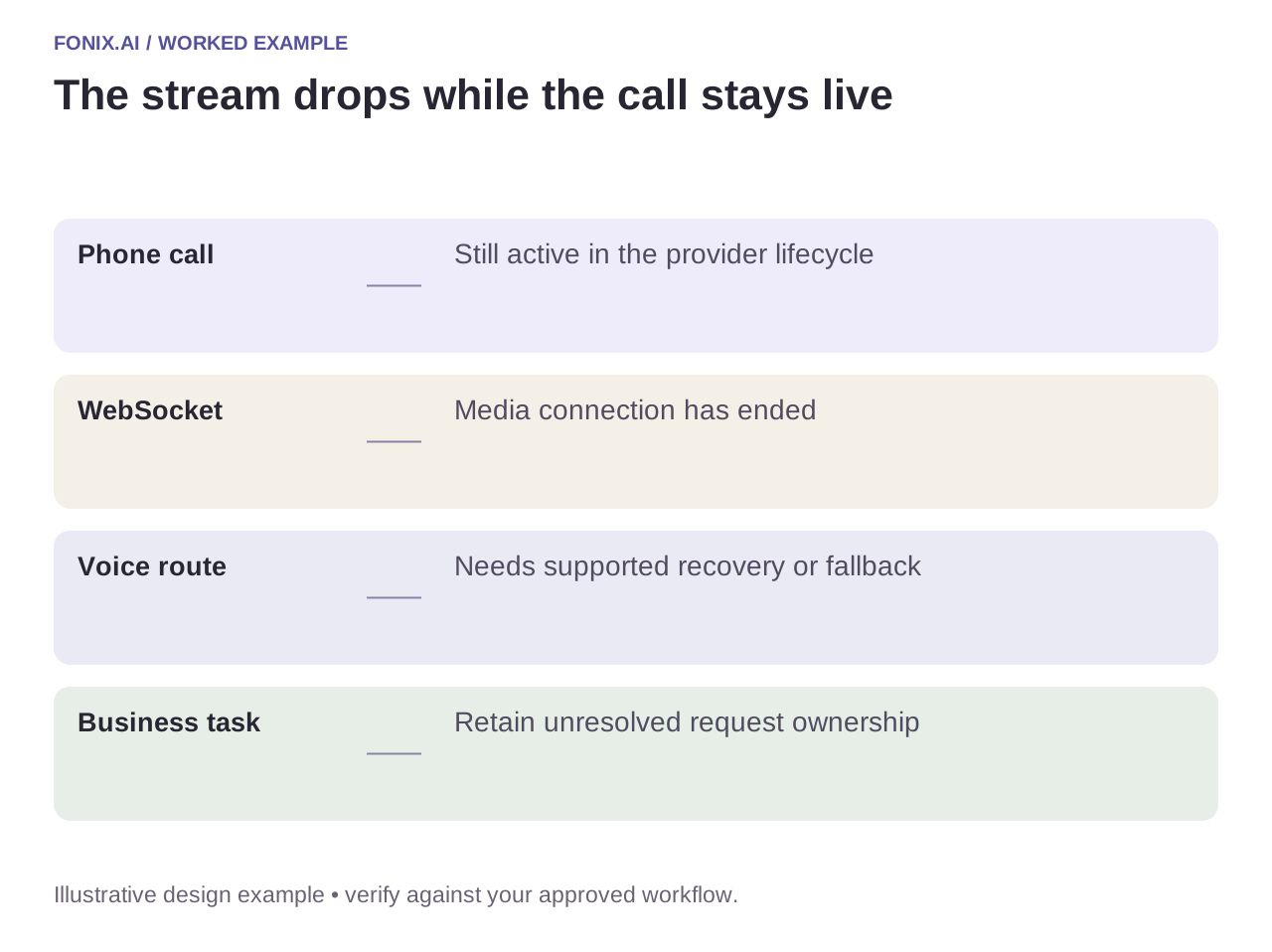
Worked example: the stream drops while the call remains active
A fictional conversation loses its WebSocket connection. The phone call has not yet ended. The route needs an explicit approved response: reconnect if supported, transfer, play a controlled message or end cleanly. Treating stream closure as proof of completed customer service leaves the caller waiting in silence.
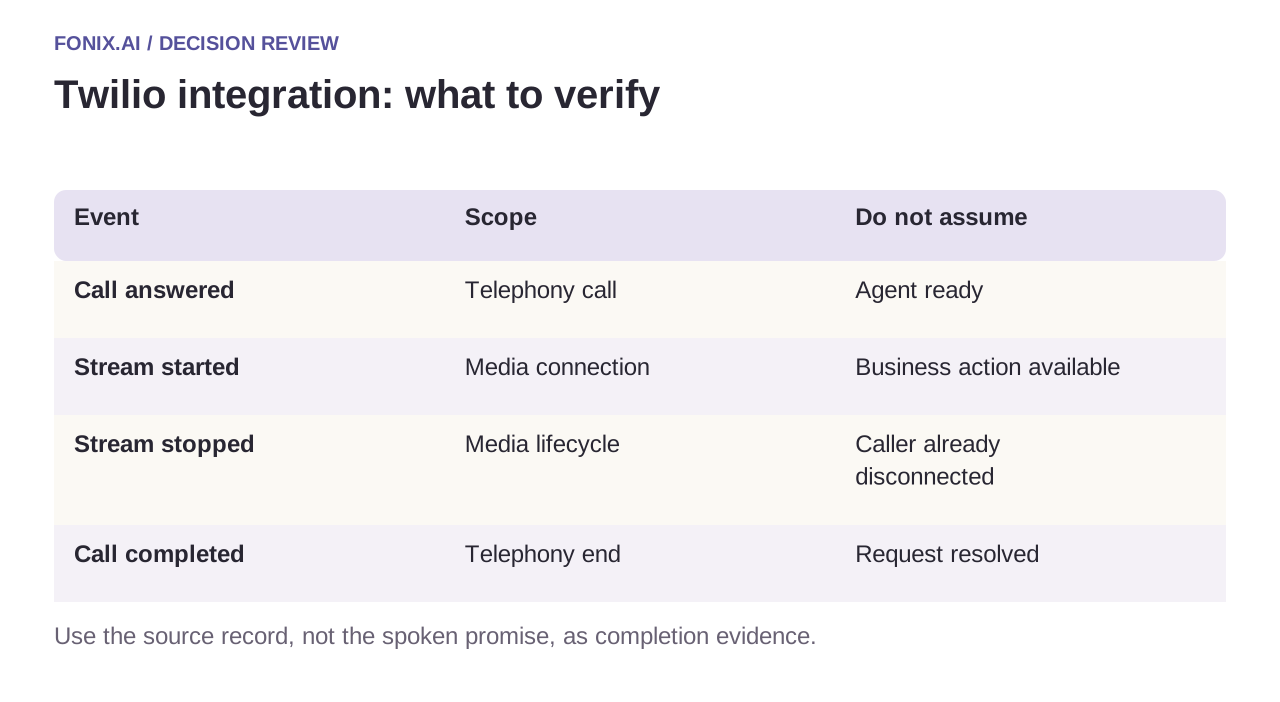
| Event | Scope | Do not assume |
|---|---|---|
| Call answered | Telephony call | Agent ready |
| Stream started | Media connection | Business action available |
| Stream stopped | Media lifecycle | Caller already disconnected |
| Call completed | Telephony end | Request resolved |
Handle interruption and late events deliberately
When a caller interrupts, verify how queued outgoing audio is stopped on the chosen path. Stopping model generation is insufficient if previously buffered speech still plays. Test the listener experience as well as server timestamps.
A completion callback may arrive after your application has already closed the session. Reconcile it idempotently and preserve the actual business outcome. Do not create another follow-up task merely because both the stream and call lifecycle report termination.
A Twilio call-versus-stream failure drill
Use a controlled Twilio number, the intended region and the selected media-stream mode. Agree webhook validation, stream security and the fallback when audio is unavailable. Test the deployed route without changing existing production integration settings.
| Pilot case | Required behaviour |
|---|---|
| The WebSocket drops while the phone call remains active | Apply the supported recovery or controlled fallback and inspect the caller experience. |
| The customer interrupts buffered speech | Verify audible playback stops on the selected path, not merely model generation. |
| Both stream and call completion events arrive | Reconcile one business outcome without creating two follow-up tasks. |
Track complete two-way test sessions, audible interruption behaviour and orphaned session resources. Keep tool transaction success separate from call completion. A provider's completed-call label does not establish that the request was resolved.
Can a receive-only stream play the agent's answer back?
A unidirectional Media Stream receives call audio but does not send playback into the call through that stream. Select the documented supported media path for the required interaction and validate its limitations. Stream modes are not interchangeable.
Test the real number route
Use a controlled Twilio number and the deployed media endpoint. Test two-way speech, caller interruption, stream failure, transfer and caller hangup during a tool action. Check orphaned sessions and unresolved actions, not just the call log's final label.
Review a Twilio voice-agent path with a sanitised topology and supported-mode details. Barge-in testing covers interruption measurement; function reliability covers actions still pending after hangup. Official Media Streams reference checked 15 October 2026.