

A practical guide / Fonix.AI
Ecommerce returns: a practical implementation guide
A worked scenario, illustrated decision review and a practical pilot worksheet.
Returns conversations need item-level policy and state
An ecommerce returns voice bot can capture a return request, explain the applicable approved policy and arrange the next operational step. It must distinguish a requested return, authorised pickup, warehouse receipt and completed refund. These are different records, often owned by different systems.
Evaluate Fonix.AI against a bounded post-purchase workflow with your order and returns tools. COD confirmation happens before delivery; this guide starts with delivered items and their return eligibility.
Retrieve the delivered item and applicable policy
Resolve order identity through the approved process, then ask which item and quantity the caller wants to return. Check delivery date, item restrictions, seller rules and the policy version attached to the purchase. Do not apply today's generic homepage policy to an older order without checking its terms.
Record the customer's reason without converting it into a warehouse verdict. “Arrived damaged” is a reported condition, not a completed inspection. If photographs or documents are required, use the approved submission channel rather than suggesting that a voice description satisfies the requirement.
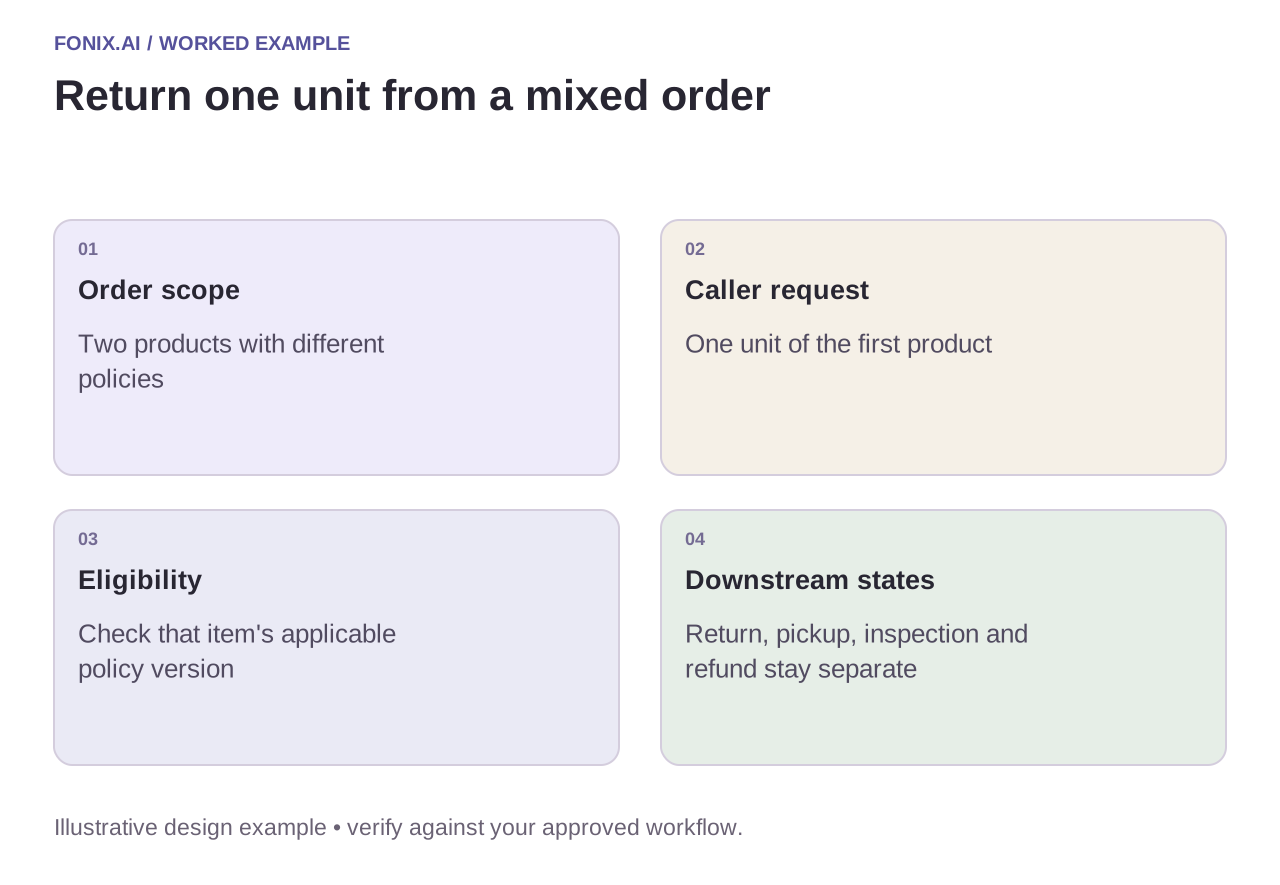
Worked example: one item in a mixed order
A fictional order contains two products with different return rules. The customer wants to return only one unit of the first product. The request must retain line-item identity and quantity; cancelling or refunding the complete order would be an expensive mistake.
| Stage | Source of truth | Caller-facing statement |
|---|---|---|
| Request captured | Intake record | We recorded your request |
| Return authorised | Returns policy/system | Your return is approved under these terms |
| Pickup accepted | Carrier booking | Pickup is scheduled for this interval |
| Refund completed | Payment/finance result | Refund issued with its reference |
Handle the races between pickup and refund
Before rebooking a missed pickup, check the existing carrier job. A delayed status callback can make a completed pickup appear pending. Preserve the return reference through retries and reconcile unknown results before creating replacements.
Do not promise an immediate refund unless that action is actually authorised and its result established. A return may require inspection, a replacement choice or a finance review. Keep the outstanding dependency and receiving owner visible so the customer does not need to explain the item again on every call.
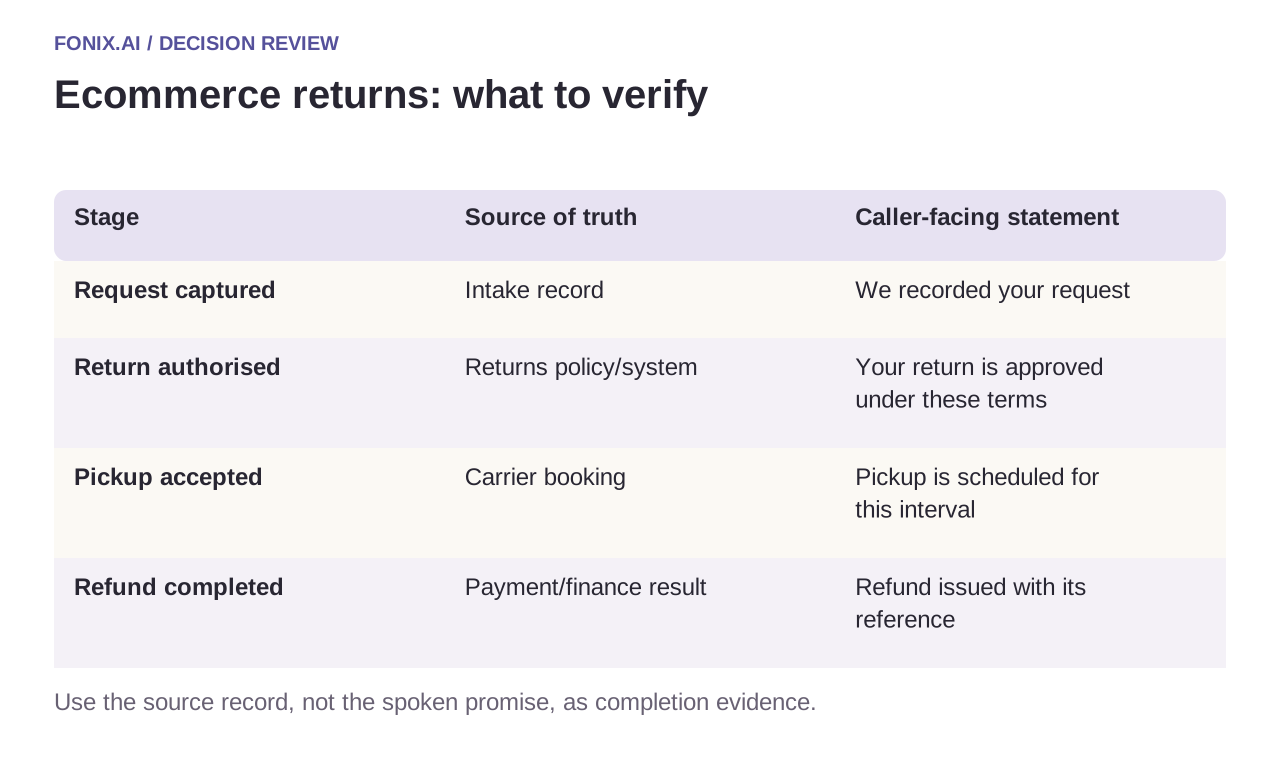
A returns-manager review from item to refund
Use test orders containing several items, quantities and policy versions. Define the merchant's return-authorisation and payment boundaries. Include a carrier sandbox or simulated pickup acknowledgements with clearly labelled synthetic results.
| Pilot case | Required behaviour |
|---|---|
| Only one unit of a mixed order is returned | Preserve its line-item ID and quantity; leave unrelated items unchanged. |
| A pickup event arrives twice | Reconcile the existing carrier job instead of creating another collection. |
| A refund depends on warehouse inspection | Explain the outstanding dependency and owner without describing the refund as issued. |
Track correctly scoped authorised returns, duplicate pickups and unsupported refund statements. Follow a defined cohort through pickup and refund states rather than treating ticket creation as completed service. Include requests that remain pending or fail.
Can a voice description alone authorise every return?
No. The merchant's applicable policy may require evidence or inspection. Capture what the customer reports, provide the approved submission route and keep review pending where necessary. Do not replace a required warehouse decision with model-generated certainty.
Evaluate the full return record
Test an expired window, mixed-policy items, a partial quantity and a carrier event arriving twice. Compare spoken promises with the returns and payment records. Measure correctly scoped requests, duplicate pickups and avoidable status calls; a created ticket is not a refunded order.
Review a returns-by-voice workflow with sanitised orders and return rules. Shopify order changes and WooCommerce integration cover platform-specific order states.