

A practical guide / Fonix.AI
Home-service answering: a practical implementation guide
A worked scenario, illustrated decision review and a practical pilot worksheet.
An AI answering service for home services must dispatch the right job
An AI answering service for home services can answer enquiries while technicians are on the road. Its useful output is a service request that matches the trade, coverage area, resource requirements and a real appointment window. Booking an electrician for a plumbing fault creates an expensive failure even if the caller liked the conversation.
Start a Fonix.AI evaluation with one service category and one dispatch region. Confirm calendar or field-service access and which requests require an operator. Installation prerequisites for a delivered appliance are covered separately in the installation guide.
Establish the location and the work before offering a time
Ask for the service location, not just the caller's current location. Resolve postcode, locality and branch coverage against your operating map. Then classify the reported problem using approved intake questions. Capture the customer's observations without turning them into an unverified technical diagnosis.
The dispatch rule needs skill, expected duration, travel allowance and any equipment requirement. Price language also needs boundaries: a visit fee, inspection estimate and final repair quotation are different commitments. Read out only the charge the business has approved for the specific stage.
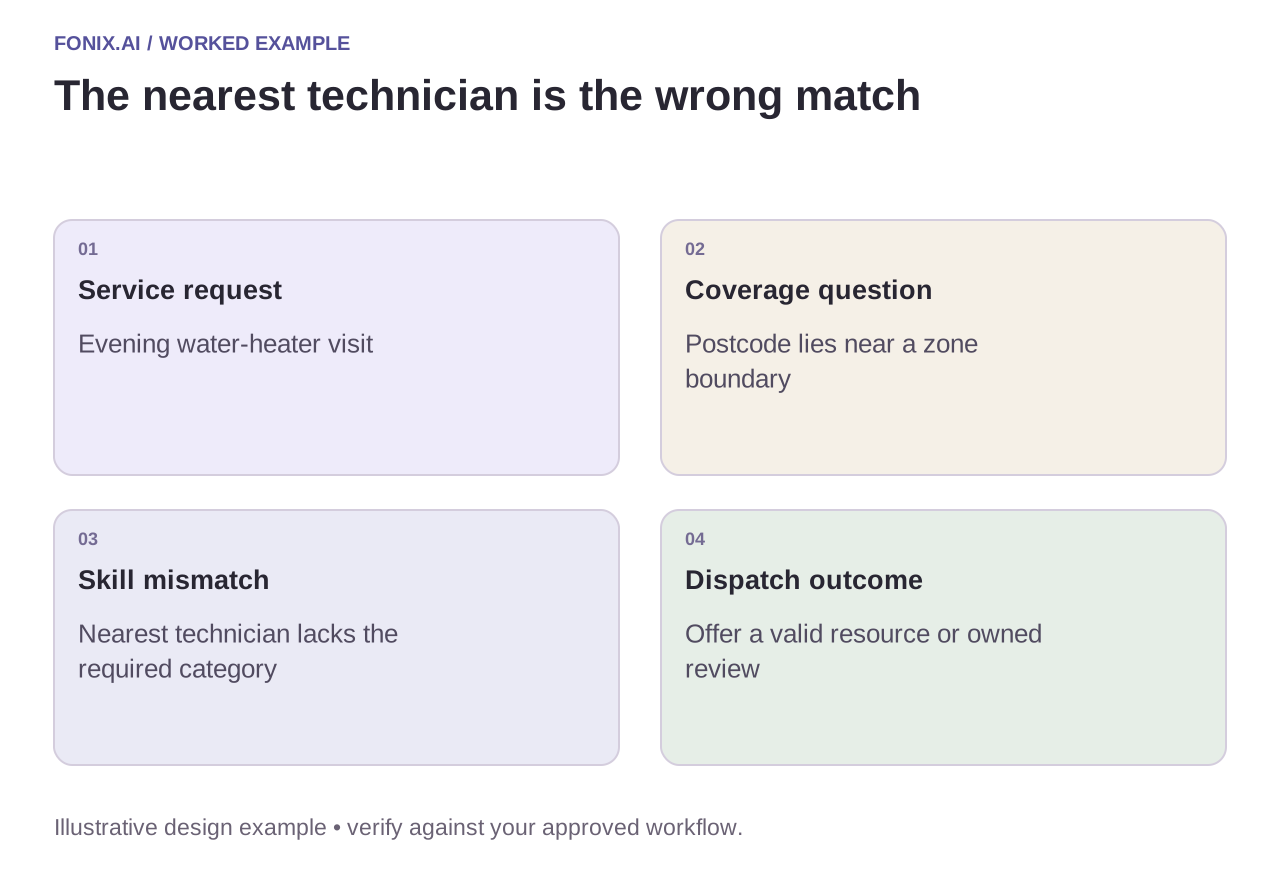
Worked example: a same-day request outside the normal zone
A fictional homeowner requests an evening water-heater visit. Their postcode borders two service zones, and the nearest available technician handles electrical work but not the requested appliance category. Distance alone must not determine assignment.
The correct path is to resolve the address, check the approved skill matrix and offer the next valid window. If an operator can approve an exceptional dispatch, record that request with its expected response time. Until approval arrives, tell the caller that a visit has been requested, rather than promising the technician is on the way.
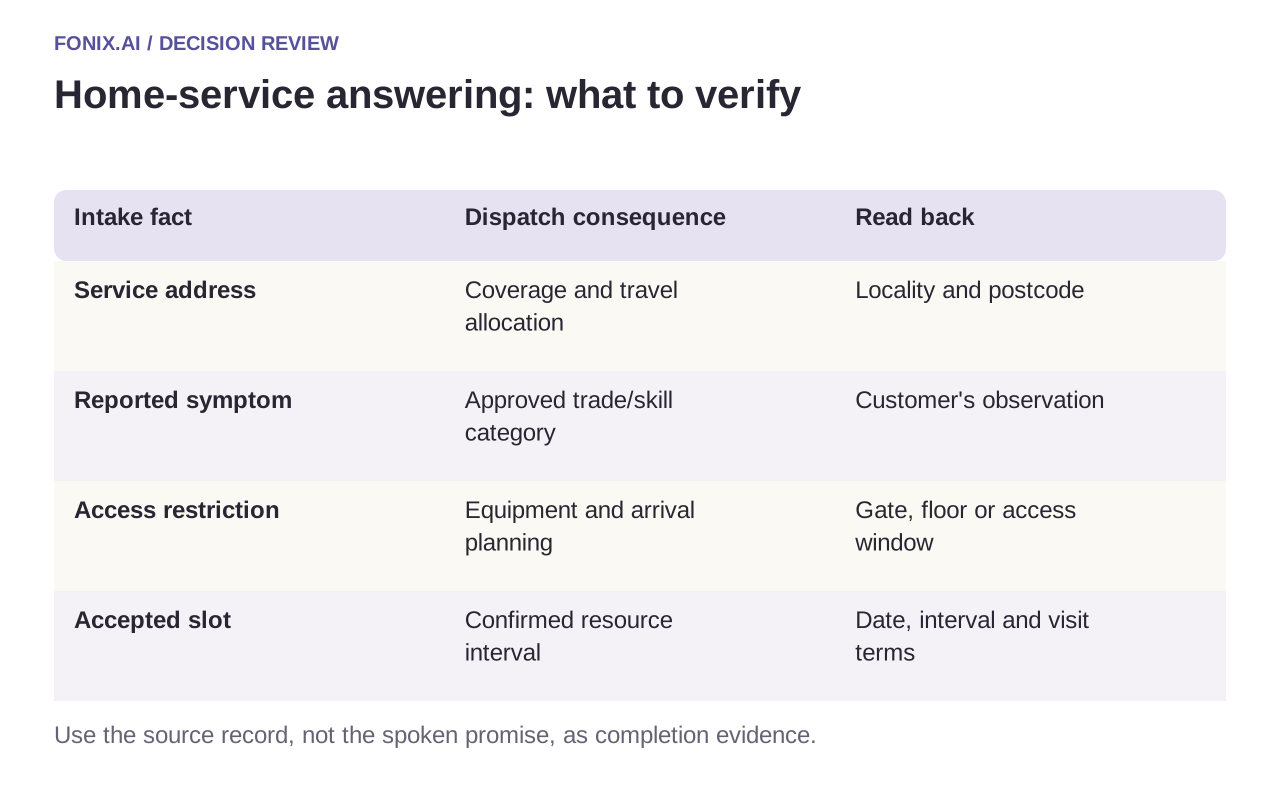
| Intake fact | Dispatch consequence | Read back |
|---|---|---|
| Service address | Coverage and travel allocation | Locality and postcode |
| Reported symptom | Approved trade/skill category | Customer's observation |
| Access restriction | Equipment and arrival planning | Gate, floor or access window |
| Accepted slot | Confirmed resource interval | Date, interval and visit terms |
Handle urgency without inventing safety advice
Use an operator-approved urgent route for reported hazards. The agent should not diagnose a gas leak, exposed electrical fault or structural danger from a conversation. Approved emergency wording and escalation destinations must be configured by the service business before testing.
Keep the booking reference through callbacks. When a technician cancels, do not retain a “confirmed” status simply because the original calendar write succeeded. Release or reassign the resource, notify the responsible dispatcher and explain the revised position to the customer through the approved process.
A dispatcher-led acceptance rehearsal
Begin with a single trade and service region. Supply the approved skill matrix, appointment durations, visit-fee wording and urgent-report route. Dispatchers should define which exceptions can be requested and which can actually be confirmed.
| Pilot case | Required behaviour |
|---|---|
| The nearest technician lacks the required skill | Offer an eligible resource or request dispatcher review instead of booking by distance alone. |
| The caller changes the service address | Recheck coverage, travel allowance and the slot before preserving confirmation. |
| A hazard is reported during routine intake | Use the approved urgent route promptly; do not delay it to finish optional questions. |
Track appointments accepted by a correctly skilled resource divided by calls claiming a visit is booked. Separately count access-related repeat visits, unsupported price promises and urgent reports routed incorrectly. Completed intake is not completed repair.
Can a basic answering pilot work before dispatch is connected?
Yes, if it captures a structured request and assigns a human dispatcher. Tell the customer that the visit is pending confirmation. Automatic appointment promises need a tested resource schedule, coverage rules and an accepted dispatch result.
Test dispatch quality alongside answer rate
Include a boundary postcode, a skill mismatch, an unavailable part, an urgent report and a customer changing the address after booking. Measure correct trade assignment and appointments that technicians can honour. Track repeat calls caused by missing access details and avoid treating a created job as a completed repair.
Review a home-service answering workflow with your service map, job categories and scheduling rules. Warm transfer helps define live operator escalation; after-hours routing handles branch closures and callback ownership.
When the request comes through a managed building, property-management intake adds the unit, repair-responsibility and resident-access checks that ordinary home-service dispatch may not cover.