

A practical guide / Fonix.AI
After-hours answering: a practical implementation guide
A worked scenario, illustrated decision review and a practical pilot worksheet.
After-hours answering starts with the right calendar
An AI after-hours answering service should distinguish a closed department, an open duty team and a request that can wait. Answering every call with the same callback promise hides the decision that matters: who can act now, and who owns the next working-day response?
Scope Fonix.AI around your actual branches, departments and duty roster. This guide covers schedule-aware routing across a business. The missed-call guide covers recovering an unanswered enquiry after the call has ended.
Resolve branch, timezone and holiday before routing
Store normal opening intervals, local timezone, holiday overrides and exceptional closures. Apply the most specific approved override first. A national holiday list alone does not describe a branch that operates a special clinic, emergency desk or maintenance rota.
Ask which branch or service the caller needs. A central number can serve teams with different hours. Keep the schedule lookup separate from the urgency decision; a closed sales desk does not imply that a technical duty team is unavailable.
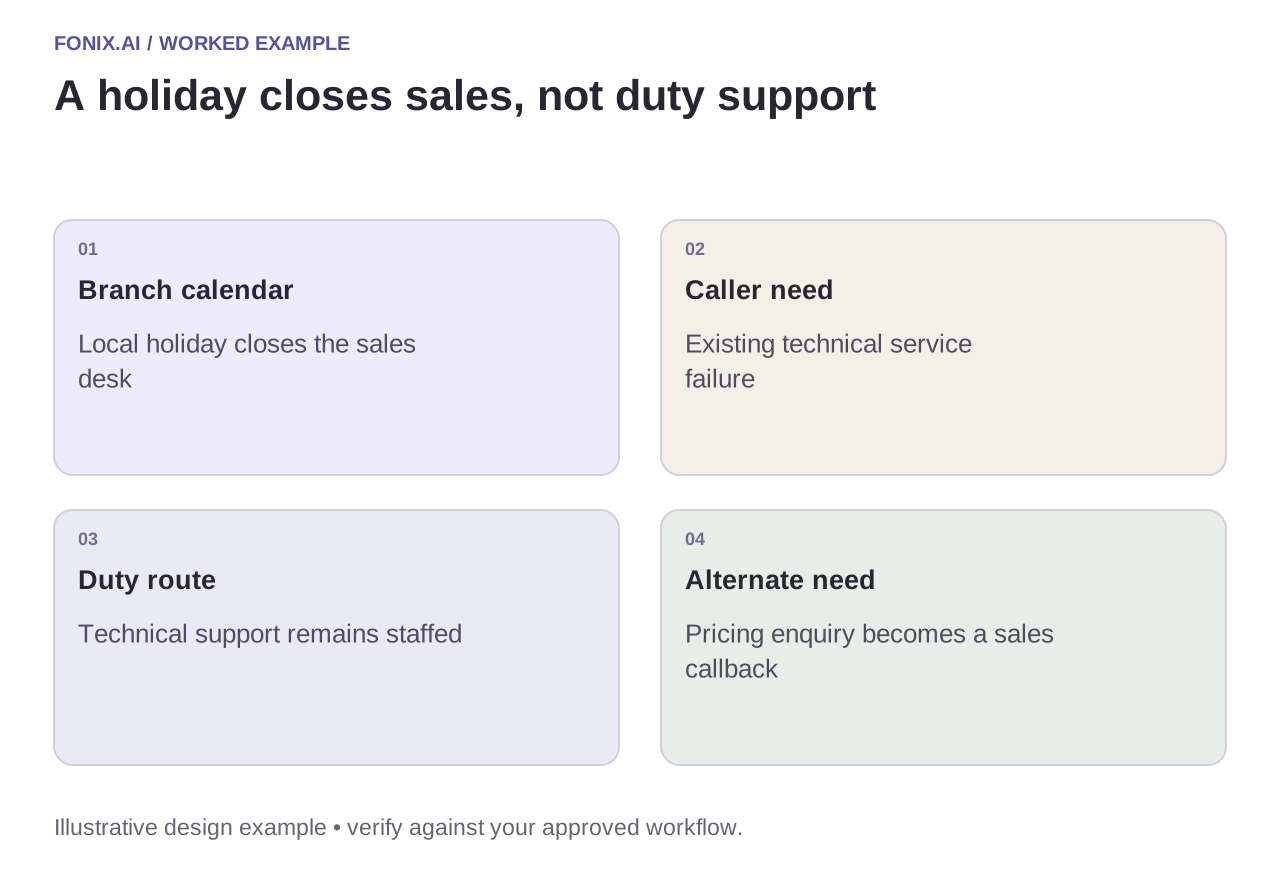
Worked example: the branch is closed but support is staffed
A fictional business closes sales on a local holiday while technical support remains on duty. A caller asks about an existing service failure. Route through the approved support path, rather than promise a sales callback tomorrow. A new pricing enquiry can instead become a callback for the next sales opening.
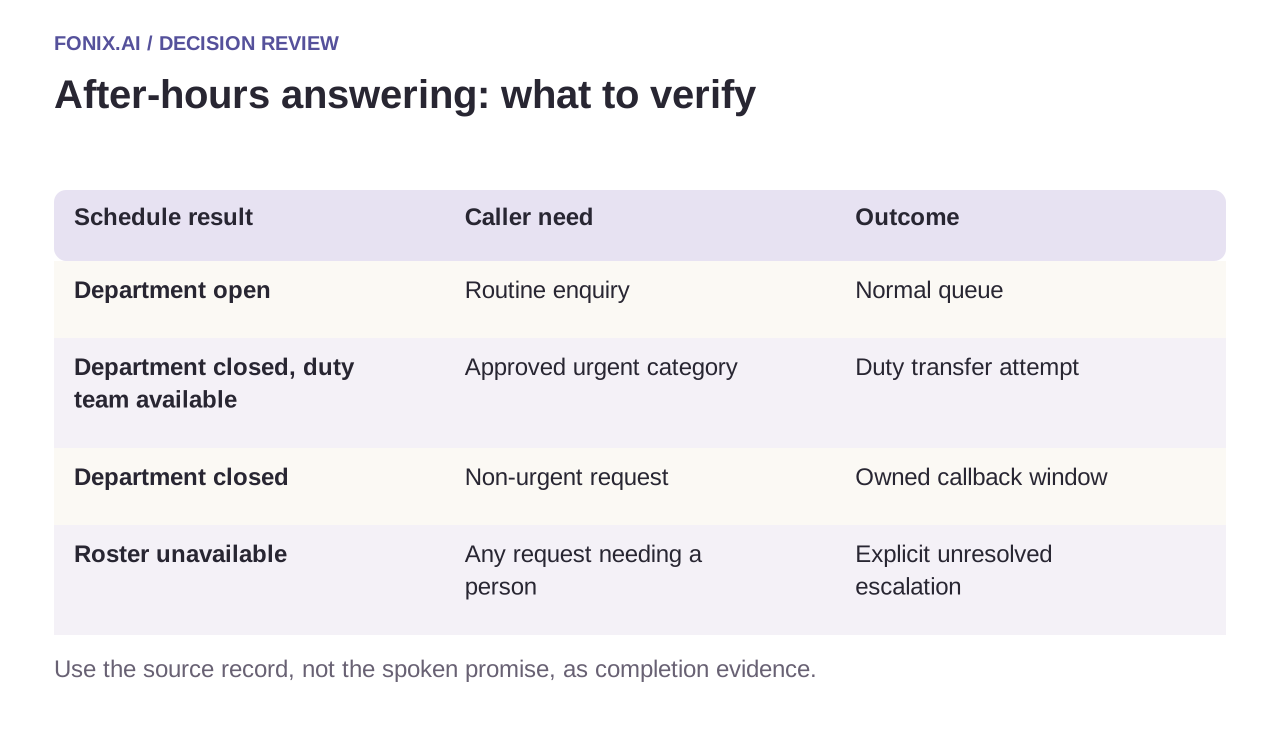
| Schedule result | Caller need | Outcome |
|---|---|---|
| Department open | Routine enquiry | Normal queue |
| Department closed, duty team available | Approved urgent category | Duty transfer attempt |
| Department closed | Non-urgent request | Owned callback window |
| Roster unavailable | Any request needing a person | Explicit unresolved escalation |
A callback time needs a receiving owner
Calculate the next working interval from the receiving team's calendar. Record the requested time, timezone, destination and acceptance state. “Tomorrow morning” becomes misleading when the team has a second holiday or the caller is abroad.
If the duty transfer fails, retain the attempt result and apply the approved backup. Do not loop indefinitely between closed extensions. An unrecognised urgency description should reach a human triage route where available, without the model inventing a safety policy.
A calendar-boundary test for the duty manager
Provide branch timezones, normal intervals, holiday overrides and a duty rota. Name the owner of a missing or contradictory schedule. Begin with controlled calls around opening and closing boundaries before forwarding a production number.
| Pilot case | Required behaviour |
|---|---|
| A local holiday closes sales but not support | Use the requested department and approved urgency route rather than a site-wide closed message. |
| The next day is another non-working day | Offer the next actual receiving-team interval with its timezone. |
| The duty transfer rings without answer | Record the attempt and execute the bounded backup or owned callback path. |
Count correctly routed eligible calls and callbacks accepted by a receiving team. Track urgent transfers separately from routine intake, including no-answer failures. Answer rate alone cannot reveal a callback queue that no one owns.
Can customers keep their existing business number?
A forwarding-based pilot may be possible if the current provider supports the required route. Verify forwarding behaviour, caller identity, charges and the fallback on that actual number. Do not promise universal carrier support or assume every transfer preserves the same information.
Test midnight and holiday boundaries
Use calls just before closure, after midnight, during an override and when the duty roster is missing. Compare the chosen route with the schedule version used at that instant. Track correctly owned callbacks and unanswered urgent transfers separately from answer rate.
Bring your branch calendars and duty escalation map to review after-hours routing. See warm transfers for connection evidence and overflow handling for busy periods during opening hours.
Reservations teams can adapt the schedule rehearsal to hotel room nights or salon service resources. In either case, after-hours intake should preserve a request until the booking system or receiving team accepts it.