

A practical guide / Fonix.AI
Voice AI for BPO: a practical implementation guide
A worked scenario, illustrated decision review and a practical pilot worksheet.
Voice AI for a BPO must preserve client boundaries
Voice AI for BPO operations should keep each client's knowledge, call routes, permissions and outcomes separate. A shared operating team does not justify a shared answer source or unrestricted access across client accounts.
Evaluate Fonix.AI with one clearly bounded client workflow first. Define which work is automated, which remains with operators and who owns changes to scripts, business tools and escalation rules. This is an operating design; actual tenant isolation and access controls require deployment evidence.
Build a client-by-action ownership matrix
For each client, identify approved knowledge sources, languages, calling numbers, receiving queues and permitted tool actions. Assign a client owner for content and a BPO owner for daily operations. Keep production configuration changes reviewable rather than allowing an operator to modify every client's policy from one unrestricted screen.
Separate service outcomes from staff productivity measures. A completed call may still require verification, a specialist or a client-side system update. Define how that pending work reaches the right queue and how the receiving organisation acknowledges it.
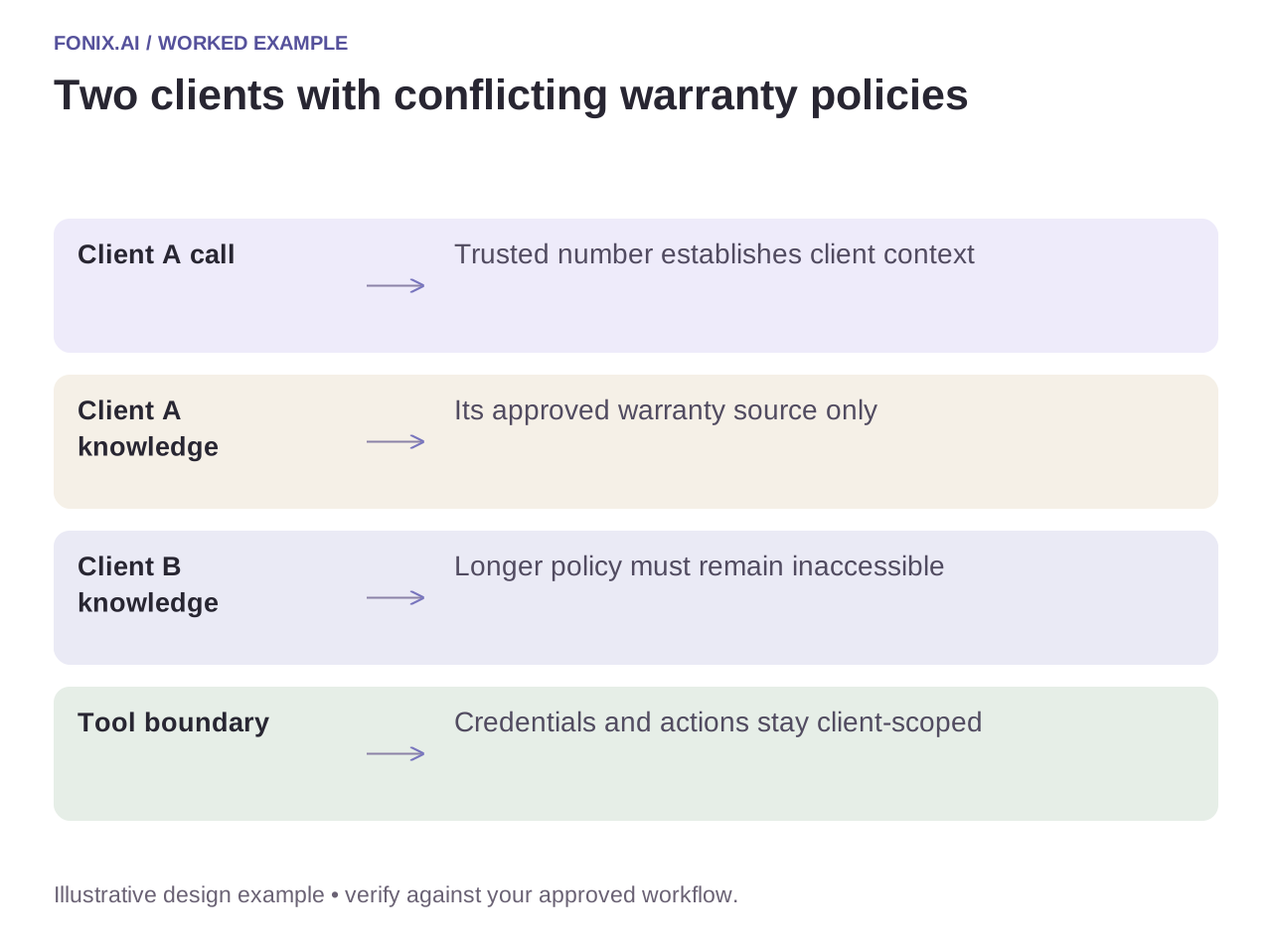
Worked example: two clients sell similar products
A fictional BPO serves two appliance brands. A caller reaches brand A's number and asks about a warranty. Brand B's longer warranty must never appear merely because both documents are in the same operator workspace. Retrieval and tool access should be scoped by trusted routing context before the model generates an answer.
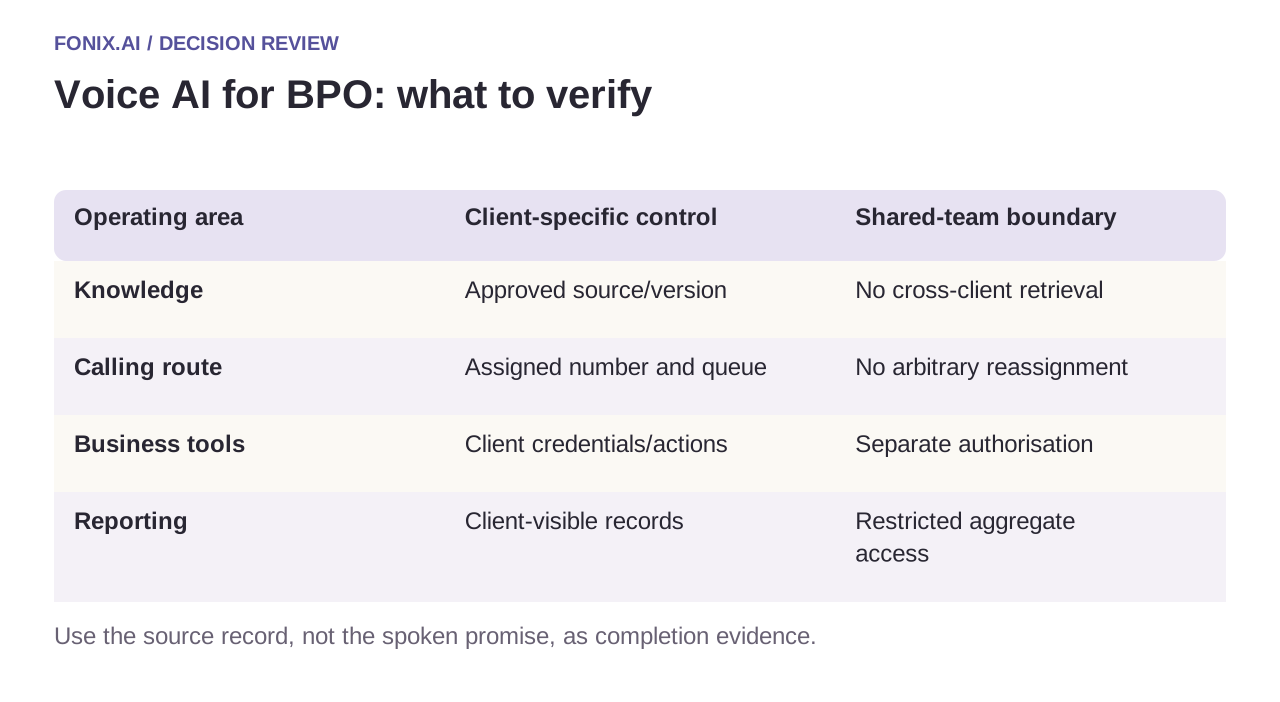
| Operating area | Client-specific control | Shared-team boundary |
|---|---|---|
| Knowledge | Approved source/version | No cross-client retrieval |
| Calling route | Assigned number and queue | No arbitrary reassignment |
| Business tools | Client credentials/actions | Separate authorisation |
| Reporting | Client-visible records | Restricted aggregate access |
Plan human capacity for exceptions
Estimate exception workload from a tested cohort, including peak arrivals and specialist availability. Do not assume every automated call removes an equal amount of human work. Some failures create more effort because the operator must reconcile conflicting records.
Give operators a concise handoff with the original request, verified facts, attempted actions and unresolved dependency. Record configuration changes and make rollback ownership explicit. Offboarding one client should revoke its access and routes without disrupting others.
A client-isolation and exception-workload pilot
Begin with one client workflow and an explicit action-responsibility matrix. For isolation testing, add a second fictional tenant with a similar product name and contradictory policy. Assign exception queues and rollback ownership before scale testing.
| Pilot case | Required behaviour |
|---|---|
| The same product name appears under two clients | Retrieve only the trusted route's approved client knowledge. |
| A restricted operator requests another client's records | Reject access in the tool/reporting layer and retain the decision evidence. |
| Human exceptions exceed the staffed queue | Apply the approved capacity policy rather than issuing unowned callback promises. |
Measure correctly scoped answers, denied cross-client actions and accepted human handoffs. Calculate staffing impact from observed exception and reconciliation workload, not from an assumption that every automated minute removes a human minute.
Can one shared dashboard imply shared access to everything?
No. Shared operations should still enforce client-specific roles, routes and data access. Reporting aggregation, support access and offboarding need deliberate boundaries. Demonstrate them under restricted identities, not only through an administrator account.
Test isolation alongside service quality
Use deliberately similar product names and conflicting policies across two fictional tenants. Attempt cross-client reads and writes under restricted operator roles. Measure correct client answers, denied cross-client actions and accepted human handoffs. Report staffing effects only after observing actual workload.
Review a BPO voice pilot with one client workflow and an operating-responsibility map. Access-control audit logs cover evidence, while overflow handling covers peak traffic and callback capacity.
Before choosing a voice for a multilingual client queue, use the Indian-language TTS listening protocol. Correct amounts, names and mixed-language terms matter independently of how natural a demo sounds.