

A practical guide / Fonix.AI
Invoice reminders: a practical implementation guide
A worked scenario, illustrated decision review and a practical pilot worksheet.
Invoice reminder calls should begin with the reconciled balance
Automated invoice reminder calls can help accounts-receivable teams find the right accounts-payable contact, clarify a dispute and record an agreed follow-up. They should start from the current ledger, including credit notes and recorded payments, rather than a stale exported amount.
This Fonix.AI guide covers B2B invoice follow-up. Loan instalments belong in the EMI reminder guide. Your finance team defines permitted wording, contact eligibility and escalation; the agent does not negotiate unapproved settlements.
Match invoice, purchase order and AP responsibility
An account may have several invoices, partial payments and different AP owners. Resolve the invoice reference and currency, then check the latest open amount. Preserve disputed, promised, paid and unreconciled as separate states. A caller saying that payment was sent is evidence to investigate, not a ledger posting.
Ask whether the receiving person handles the invoice. If not, collect an approved routing update instead of reading sensitive account details to an unrelated employee. Where a purchase-order mismatch blocks payment, capture the specific mismatch for the account owner.
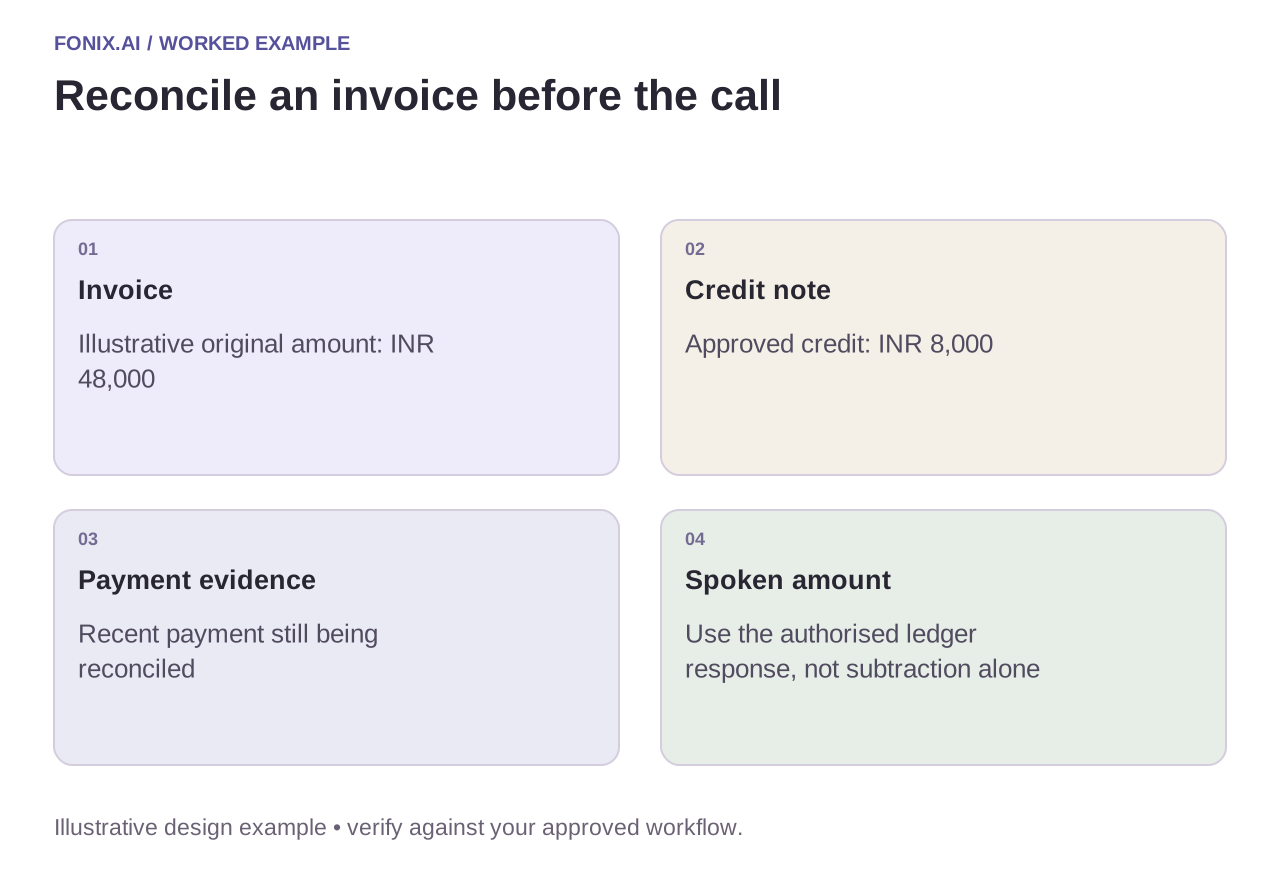
Worked example: a credit note changes the amount due
A fictional invoice is for ₹48,000. An approved ₹8,000 credit note exists, while a recent payment is still being reconciled. The agent should use the authorised open-balance response and disclose its unresolved state accurately. It must not demand the original amount or promise that a payment is already reflected.
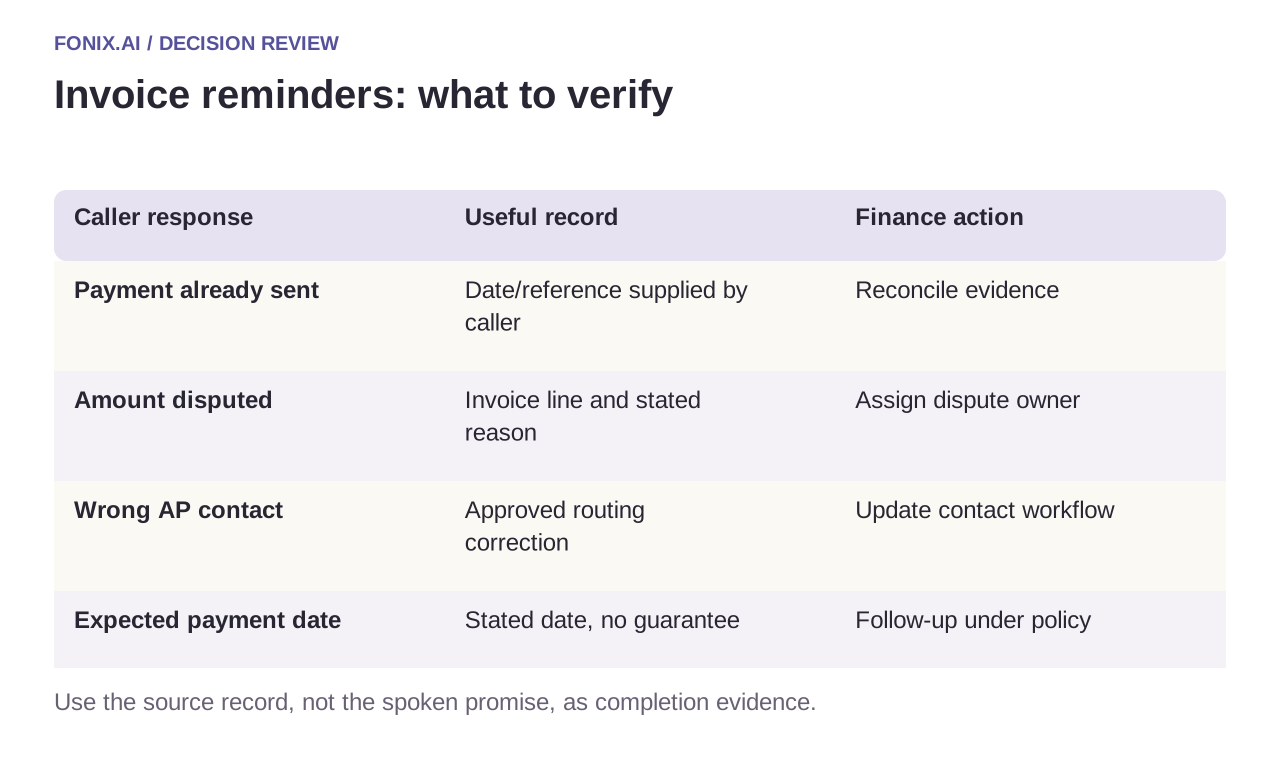
| Caller response | Useful record | Finance action |
|---|---|---|
| Payment already sent | Date/reference supplied by caller | Reconcile evidence |
| Amount disputed | Invoice line and stated reason | Assign dispute owner |
| Wrong AP contact | Approved routing correction | Update contact workflow |
| Expected payment date | Stated date, no guarantee | Follow-up under policy |
Suppress obsolete reminders before every attempt
Recheck ledger and contact state when the call begins, not just when the campaign was created. A payment, dispute or preference change can make the queued reminder inappropriate. Keep one active task per invoice/workflow rather than launching a new call for every duplicated event.
Record commitments as caller statements with their timestamp. Do not label an invoice paid because someone promised a date. If the balance API is unavailable, use an approved limited message or route to finance; guessing a balance undermines the entire workflow.
A finance-approved receivables test set
Use a synthetic ledger containing partial payments, credit notes and disputes. Finance should approve contact eligibility, amount wording and escalation. Re-read the ledger when a queued task starts, not only when the list is exported.
| Pilot case | Required behaviour |
|---|---|
| A credit note reduces the original invoice | Read the authorised open balance and preserve the credit reference. |
| The recipient says a payment was sent | Record the supplied evidence for reconciliation; do not mark the ledger paid. |
| The invoice becomes settled before dialling | Suppress the obsolete task and retain the execution-time decision. |
Measure settled-account suppression, correctly routed disputes and reconciled follow-up outcomes. Compare equivalent invoice cohorts and include manual finance effort. A payment occurring after a reminder does not by itself establish incremental collection caused by that call.
Should the agent negotiate a discount or settlement?
Only if finance has explicitly authorised a bounded offer and acceptance process. Otherwise capture the request and route it to the accountable person. A caller's expected payment date remains a statement, not a guaranteed payment or a posted transaction.
Judge the workflow on reconciliation and resolved disputes
Test partial payment, credit note, wrong contact, disputed line and a payment arriving after queue creation. Measure correctly reconciled outcomes, accepted dispute handoffs and avoidable reminders to settled accounts. Compare equivalent invoice cohorts instead of crediting every later payment to the call.
Review an invoice follow-up workflow with a sanitised ledger sample and AP ownership rules. Use function-calling reliability for payment-state reads and caller verification for account-information access.
For the commercial decision before an invoice is due, subscription renewal intake tracks authorised acceptance, effective dates and entitlements separately. An open receivable does not explain the whole renewal state.