

A practical guide / Fonix.AI
Diagnostic lab booking: a practical implementation guide
A worked scenario, illustrated decision review and a practical pilot worksheet.
A diagnostic lab voice bot should book the requested service accurately
A diagnostic lab voice bot can help callers find an approved test listing, choose a centre or collection window and receive the lab's current preparation instructions. It should not recommend a test, interpret symptoms or decide whether a requested investigation is medically appropriate.
Evaluate Fonix.AI with your lab catalogue, collection schedules and approved patient-facing wording. Doctor consultations belong in the clinic receptionist guide. This workflow concerns a test or package, sample collection and the operational record needed by the lab.
Resolve the catalogue item before offering collection
Tests can have similar spoken names, different sample requirements and branch-specific availability. Match the caller's request to a catalogue identifier, then confirm the displayed test name. If the caller has a prescription that cannot be interpreted reliably, route it through the lab's approved staff process rather than guessing from a partial name.
For home collection, check service area, eligible sample type, collector capacity and the full visit window. A centre appointment and a home visit should have different resource rules. Use preparation text supplied by the lab for that exact test/version; do not generate fasting or medication instructions from general model knowledge.
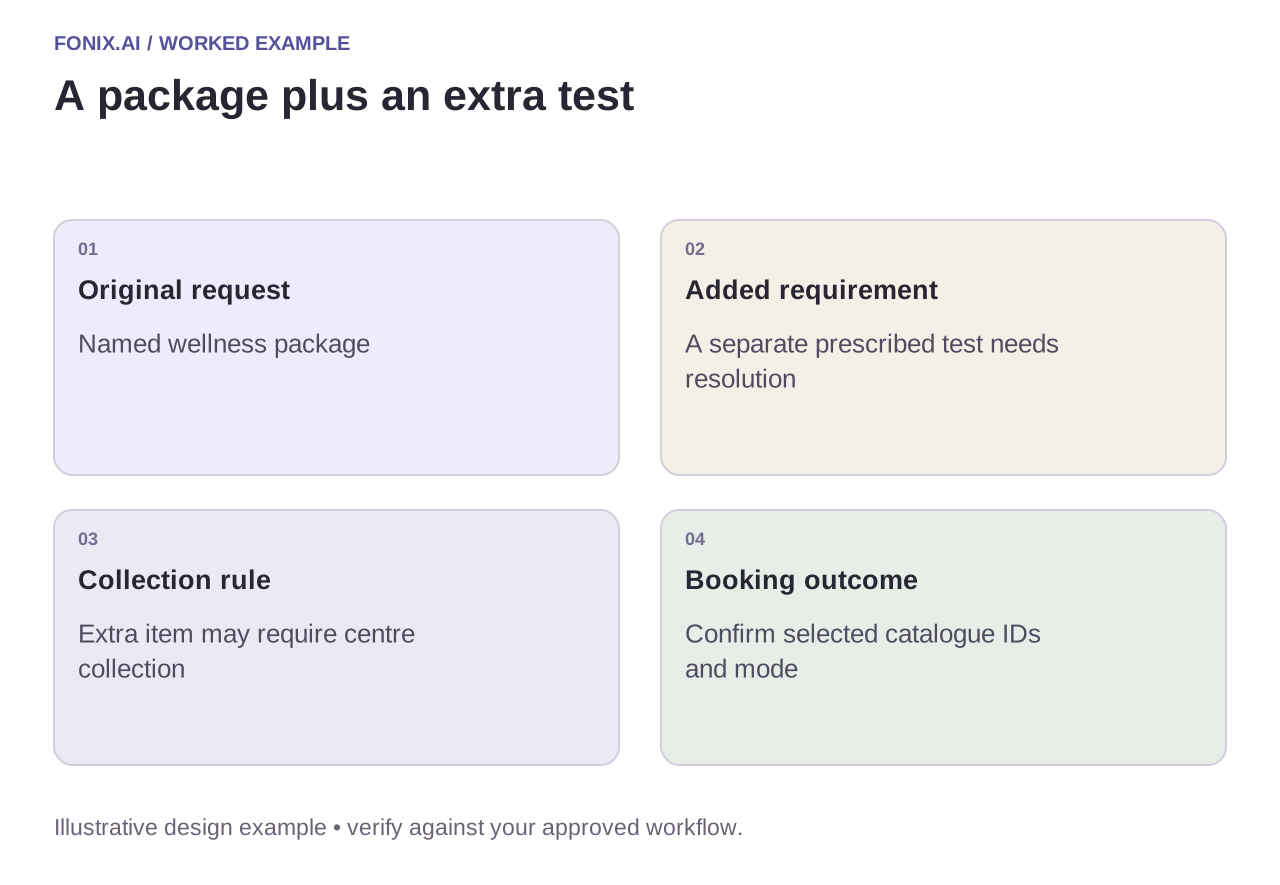
Worked example: a package changes during the call
A fictional caller asks for a named wellness package and then mentions an additional prescribed test. The lab catalogue shows that the package already includes one similarly named investigation, but not the additional test as requested. Keep the package and extra item separate until staff or the catalogue resolves the difference.
If the extra item cannot be collected at home, explain the approved centre option. Do not book all items into the home-collection route simply because the original package qualified. Read back the selected items, location, visit interval, current quoted price and any lab-approved next step.
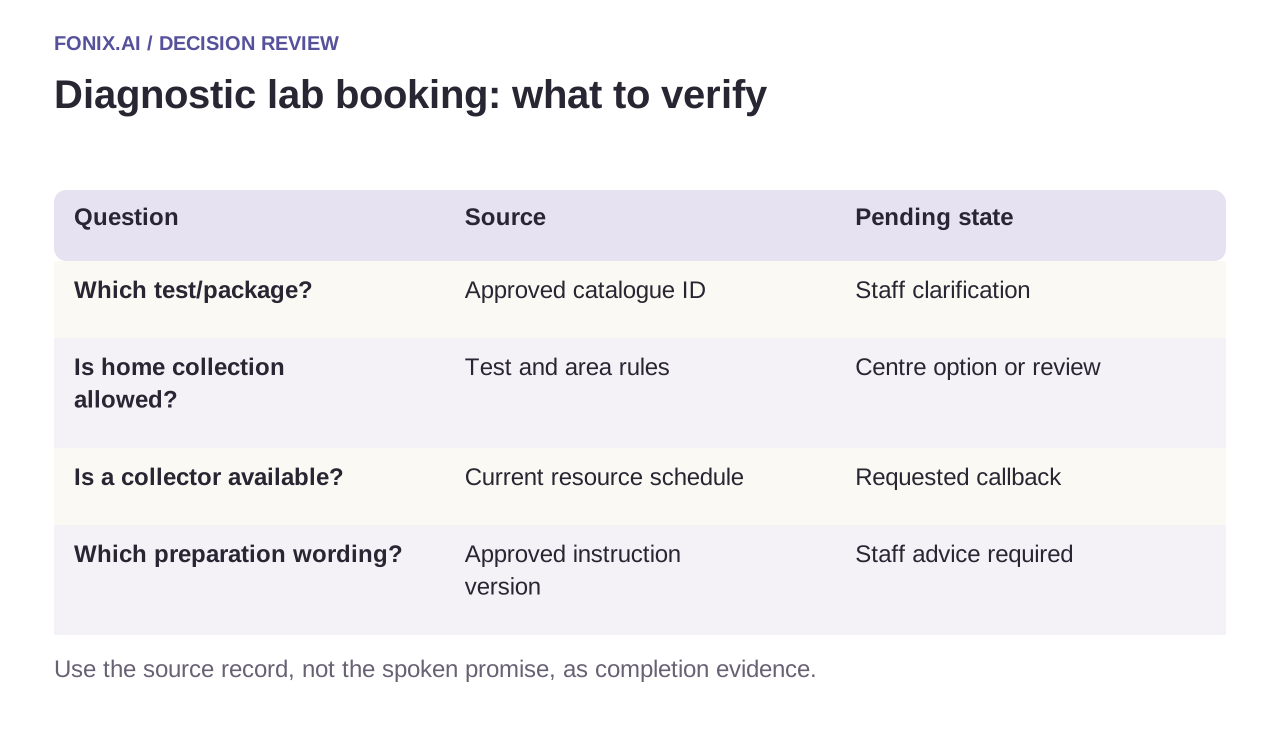
| Question | Source | Pending state |
|---|---|---|
| Which test/package? | Approved catalogue ID | Staff clarification |
| Is home collection allowed? | Test and area rules | Centre option or review |
| Is a collector available? | Current resource schedule | Requested callback |
| Which preparation wording? | Approved instruction version | Staff advice required |
Separate booking, collection and result access
A successful appointment write confirms an appointment, not sample collection or test completion. Record the booking reference and collection mode. If a collector changes availability, the revised appointment needs its own confirmation and customer communication.
Keep result delivery outside a general booking conversation unless the deployment has an approved identity and access process. Family members may share a phone number. The agent must not read out private test information merely because the caller knows the booking time. Clinical questions should reach authorised lab staff with enough context to avoid repeating the whole intake.
Catalogue and collection checks owned by the lab
Start with one centre's approved test catalogue and synthetic patient bookings. Include home-collection restrictions, collector capacity and preparation-text versions. Lab staff should own unclear prescriptions and clinical questions.
| Pilot case | Required behaviour |
|---|---|
| Two tests sound similar over the telephone | Resolve the catalogue identifier with clarification; do not book the more familiar name by default. |
| An extra test is ineligible for home collection | Split or reroute the request using the lab's approved process before confirming the visit. |
| A relative asks for results during booking | Apply the separate identity/access route rather than using booking knowledge as authority. |
Compare spoken test names, catalogue IDs and collection mode with accepted booking records. Track staff clarification and missed collections caused by missing operational details. Keep enquiry, appointment, sample collected and test completed as separate outcomes.
Should the agent create preparation instructions itself?
Use the lab's current approved wording for the exact catalogue item. If that source is unavailable or ambiguous, request staff assistance. A scheduling assistant should not infer fasting, medication or diagnostic advice from general language-model knowledge.
Run a catalogue-and-capacity acceptance test
Include two confusing test names, an unavailable centre, a home-collection restriction and a caller correcting the patient name. Compare catalogue IDs and booking records against the spoken confirmation. Track accurate bookings, avoidable staff clarification and collection failures caused by missing instructions. Do not count a captured enquiry as a collected sample.
Bring a sanitised catalogue and approved instruction examples to review a lab booking workflow. Use appointment reminders for the later attendance step and caller verification for protected information.
For an approved written booking follow-up, the voice-to-WhatsApp handoff guide separates destination verification, accepted appointments and message delivery. Private results need their own access process.